
Stand on the footbridge over the Passaic River in Paterson, New Jersey, and you can feel the ground hum before you even look down. Right in the middle of a dense, brick-and-concrete city, the river suddenly drops 77 feet through a jagged gorge of dark basalt rock. Spray rises in a fine mist, catching the afternoon light, while thousands of gallons of water thunder into the chasm below every second. Most people who visit today come to take in the view or snap a photo of one of the largest waterfalls in the eastern United States. As someone who has spent a career working with water systems, I always look at that drop and ask a different question: what can falling water actually do?
The short answer is that it can run a city, launch an industrial revolution, and keep the lights on centuries later—all without burning a single lump of coal or a drop of oil. To understand how that works, it helps to trace the water’s path through a modern hydroelectric power plant like the one nestled right into the rock beside the Great Falls.
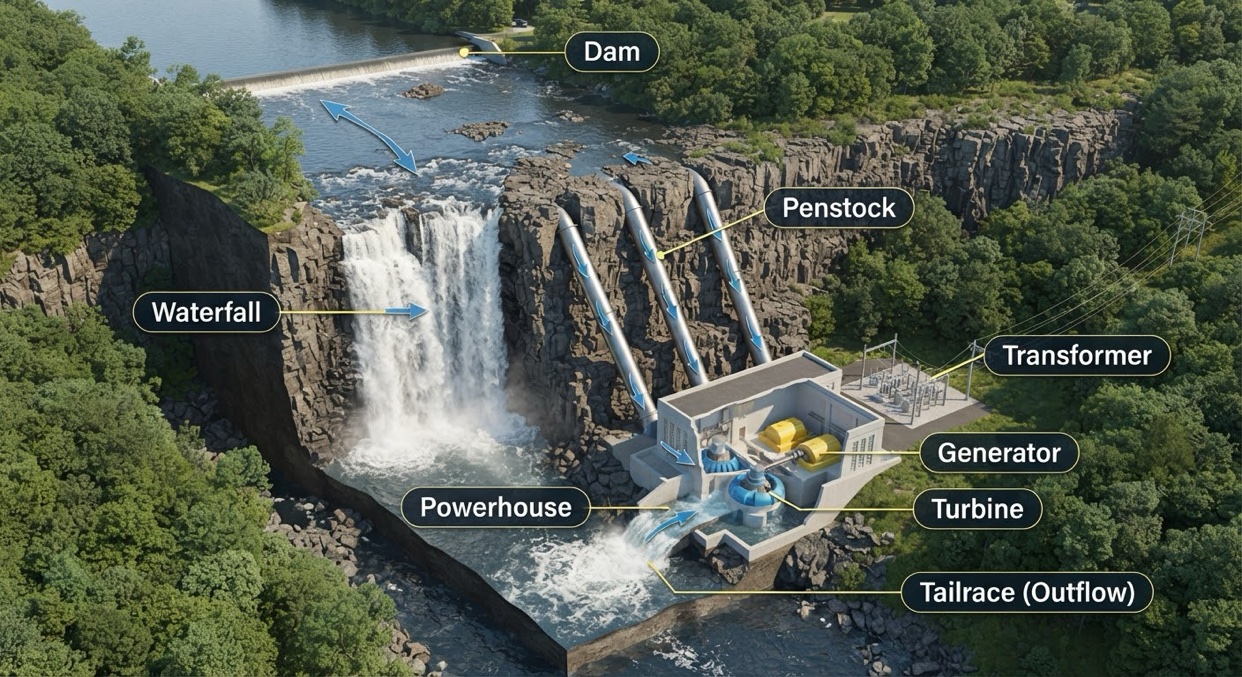
It starts at the top of the ridge with a dam. A dam doesn’t stop a river permanently; rather, it acts like a thumb over the end of a garden hose, holding the water back just enough to control its flow and build up steady, reliable pressure behind the wall. From that reservoir behind the dam, water is directed into a penstock—a massive, heavy-duty steel pipe angled steeply down the cliff face. As gravity pulls the water downward through the enclosed penstock, all that stored potential energy converts into pure kinetic force, rushing toward the bottom of the gorge at high speed.
At the base of the cliff sits the powerhouse, where the real mechanical magic happens. Inside, the pressurized water from the penstock slams into the curved blades of a turbine, a heavy metal wheel designed much like a boat propeller in reverse. The force of the water pushes those blades around, spinning the turbine rapidly. Connected directly to the turbine by a solid steel shaft is a generator. As the turbine spins, it rotates giant magnets inside coils of copper wire within the generator, inducing an electrical current. That spinning motion—water pushing metal, metal turning magnets—is what creates electricity.
Before that electricity can travel across New Jersey, it passes into a transformer yard right outside the powerhouse. Electricity leaving a generator doesn’t have enough voltage to travel long distances efficiently without losing energy along the way, so the transformer steps the voltage up, sending power out onto the regional grid and into homes and businesses. Meanwhile, what happens to the water that did all the heavy lifting? After passing through the turbine blades, it exits through a channel called the tailrace, flowing smoothly back into the Passaic River gorge below. Not a drop is consumed, boiled away, or polluted. It leaves the plant completely unharmed, ready to flow downstream and be used again. No fuel is burned, no smoke rises into the sky—gravity does all the work.
Long before anyone knew how to spin copper coils to make electricity, one of America’s founders looked at those exact 77 feet of falling water and saw the future of the United States. In July 1778, during the Revolutionary War, General George Washington, the Marquis de Lafayette, and a young aide-de-camp named Alexander Hamilton stopped to picnic beside the Great Falls. While the others admired the wild scenery, Hamilton’s mind went straight to economics. At the time, the young nation had plenty of raw materials—cotton, iron, wool—but almost no factories, forcing Americans to buy expensive finished goods from Britain. Hamilton never forgot the sheer mechanical power roaring through that basalt gorge.
Thirteen years later, in 1791, as the nation’s first Secretary of the Treasury, Hamilton put that memory into action. Along with a group of investors, he chartered the Society for Establishing Useful Manufactures—known locally as the S.U.M.—and chose the Great Falls as the site for America’s first planned industrial city. They named it Paterson, after New Jersey Governor William Paterson. The city wasn’t built around a harbor or a crossroads; it was built for one reason alone: the power of that falling water.
To harness the river, Hamilton’s Society hired Pierre Charles L’Enfant—the French engineer famous for laying out Washington, D.C.—to design Paterson’s raceway system. L’Enfant envisioned a grand, sweeping network of stone canals, but his ambitious plan proved far more expensive than the Society could afford, so he was let go and the system was finished to a simpler three-level design under superintendent Peter Colt. Engineers built an ingenious network of stone-lined channels called raceways to put the river to work. Instead of letting all the water crash straight over the cliff at once, a dam above the falls diverted part of the river into an upper raceway. That channel carried water along the hillside to turn massive wooden waterwheels at a first tier of mills. Instead of dumping that water straight back into the river, the system caught the outflow in a middle raceway, routing the exact same water to a second tier of factories farther down the slope, and then a third. By stepping the water down the hillside in levels, Paterson squeezed every ounce of gravitational energy out of the Passaic before returning it to the riverbed.
Once those raceways opened, businesses flocked to Paterson, and they didn’t come for the scenery. They came because falling water was the cheapest, most dependable engine in America.
In 1836, a young inventor named Samuel Colt set up the Patent Arms Manufacturing Company in a four-story stone mill powered by Paterson’s raceways. Using water-driven lathes and milling machines, Colt’s workers manufactured the Colt Paterson revolver—the first commercially successful repeating firearm with a revolving cylinder. Though Colt’s first venture struggled financially and eventually closed in Paterson, the precision machine tools driven by the Passaic River laid the groundwork for modern American manufacturing.
Soon, heavy ironworks moved in alongside precision toolmakers. The Rogers Locomotive and Machine Works, founded in the 1830s, tapped into the city’s water power to forge, machine, and assemble thousands of steam locomotives. During the nineteenth century, Rogers engines pulled trains across the expanding American West, including locomotives that helped build the Transcontinental Railroad—iron horses born from New Jersey water power.
Then came the industry that gave Paterson its enduring nickname: “Silk City.” Drawn by the steady power of the raceways, clean water for dyeing, and proximity to New York markets, silk manufacturers began opening mills in the 1840s. By the late nineteenth century, hundreds of textile mills lined the raceways, their looms clattering day and night to produce roughly half of all the silk manufactured in the United States. Every thread spun, every locomotive wheel turned, and every rifle barrel bored owed its motion to the drop of the Passaic River.
Today, the booming silk looms and locomotive foundries are gone, replaced by quiet brick mill buildings, museums, and tree-lined walking paths. In 2009, Congress designated the area the Paterson Great Falls National Historical Park, preserving both the dramatic basalt gorge and the surviving raceway walls as a monument to American innovation. Yet the river itself hasn’t retired. Tucked neatly into the rock wall beside the waterfall sits the Great Falls Hydroelectric Generating Station, a modern facility that captures water from the historic dam, sends it down penstocks to spin modern turbines, and feeds clean, renewable electricity directly into the local grid. Nearly 250 years after Alexander Hamilton stood on the bank and did the math in his head, the exact same river is still working.
For anyone living in New Jersey—and especially for those of us who spend our days managing water—Paterson is more than a history lesson. It is a reminder that water isn’t just something we drink; it is a physical force we rely on every single minute. The very same gravity that spun Paterson’s waterwheels and turns its turbines today is what moves water through modern treatment plants, fills elevated water towers, and pushes clean drinking water out of the tap when you turn the handle in your kitchen. Falling water built a city, powered a nation, and still lights the streets around it.
Facts first, then filter. — Steve