
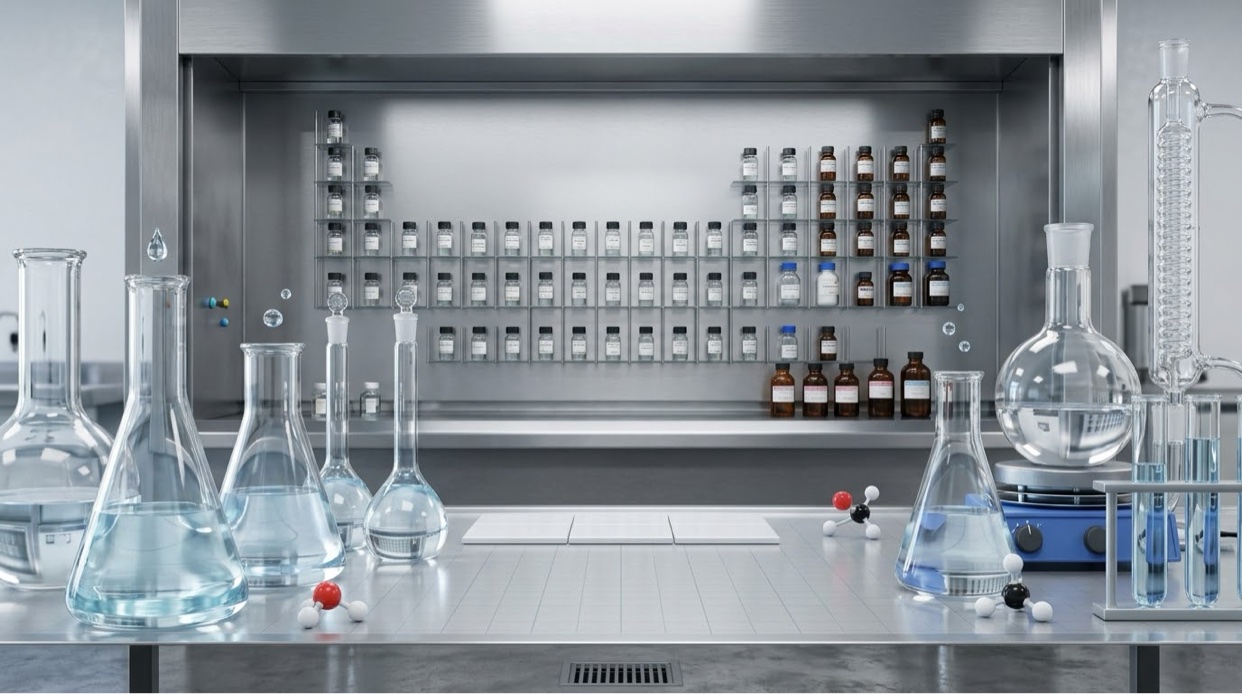
Every element below has been found in somebody’s drinking water. This is the working lab bench of iPhilter: each specimen tag tells you what the element does in your water and what actually removes it. Tags with a solid border link straight to the full article — the rest join them as their articles publish.
This page is the free companion to my book, Elements in Your Glass — get the book here.
Lab Notes — Every Specimen, Explained
82 · Pb — Lead
Gets in from lead service lines, old solder, and brass fixtures — not from the water source. There is no safe level; EPA’s health goal is zero.
Removed by: filters certified for lead (quality carbon), reverse osmosis, distillation.
80 · Hg — Mercury
Settles into water from air pollution and industrial waste. Damages kidneys and the nervous system; EPA limit is 2 ppb.
Removed by: reverse osmosis, activated carbon, distillation.
24 · Cr — Chromium-6
The Hinkley chemical. An industrial contaminant and carcinogen found in tap water serving more than 200 million Americans.
Removed by: reverse osmosis, strong-base anion exchange, filters specifically certified for chromium-6.
33 · As — Arsenic
Natural in bedrock and the #2 contaminant failing NJ private wells. Colorless, odorless, tasteless — testing is the only way to know.
Removed by: reverse osmosis, adsorptive media, distillation.
9 · F — Fluoride
Added by many cities for dental health and natural in some groundwater. Too much mottles teeth and, over years, affects bones. Ordinary carbon pitchers barely touch it.
Removed by: reverse osmosis, activated alumina, distillation.
88 · Ra — Radium
A radioactive element that forms as uranium decays in aquifers. Odorless, tasteless, and regulated because it collects in bone.
Removed by: ion exchange (a standard softener), reverse osmosis.
86 · Rn — Radon
A radioactive gas that seeps from bedrock into well water. The real danger is breathing it after it escapes into indoor air — not drinking it.
Removed by: whole-house aeration (best), granular activated carbon.
92 · U — Uranium
Natural in bedrock, so it shows up in private wells near granite. Both radioactive and a kidney toxin as a heavy metal.
Removed by: reverse osmosis, ion exchange, distillation.
48 · Cd — Cadmium
Leaches from galvanized pipes and industrial waste. Accumulates in kidneys over a lifetime of small doses.
Removed by: reverse osmosis, ion exchange, distillation.
56 · Ba — Barium
Natural in mineral deposits and released by drilling and industry. Linked to blood-pressure and heart effects at high levels.
Removed by: reverse osmosis, ion exchange, water softening.
34 · Se — Selenium
Essential in trace amounts, toxic in excess. Enters water from natural deposits, mining, and refinery waste.
Removed by: reverse osmosis, distillation.
51 · Sb — Antimony
Used in flame retardants and PET plastics; reaches water from industry and waste. A quiet contaminant with a strict EPA limit.
Removed by: reverse osmosis.
4 · Be — Beryllium
Rare in drinking water; comes from metal manufacturing and coal burning. Regulated because of lung and intestinal effects.
Removed by: reverse osmosis, ion exchange, coagulation/filtration at the plant.
81 · Tl — Thallium
One of the most toxic elements on this table. Reaches water from mining, smelting, and electronics waste; rare but taken seriously.
Removed by: reverse osmosis, ion exchange.
29 · Cu — Copper
Almost always from your own plumbing corroding — look for blue-green stains and a metallic taste. Worst in water that sits in pipes overnight.
Removed by: reverse osmosis, ion exchange; running the tap after stagnation cuts it too.
28 · Ni — Nickel
From plumbing alloys and industrial sources. Most exposure is harmless, but it is regulated in drinking water in many countries.
Removed by: reverse osmosis, ion exchange.
23 · V — Vanadium
The earth-bound trace: Vanadium reaches groundwater naturally from rock and soil and from industry. It has no federal drinking-water limit in the US, but it is on the EPA’s list of contaminants being studied for possible regulation.
Removed by: reverse osmosis, ion exchange.
27 · Co — Cobalt
The vitamin component: Cobalt comes from natural deposits, mining, and the metal industry, while also serving as an essential nutrient in trace amounts as part of vitamin B12. It has no federal drinking-water limit.
Removed by: reverse osmosis, ion exchange.
42 · Mo — Molybdenum
The essential trace: Molybdenum is a metal and an essential nutrient in trace amounts that reaches water from natural deposits and mining. It has no federal drinking-water limit.
Removed by: reverse osmosis, ion exchange.
13 · Al — Aluminum
Left over from alum, the chemical plants use to clear cloudy water, plus natural geology. Causes post-treatment cloudiness complaints.
Removed by: reverse osmosis, distillation.
30 · Zn — Zinc
Leaches from galvanized pipes as they age. Mostly a taste problem (metallic, chalky) at water levels — and a sign your pipes are corroding.
Removed by: reverse osmosis, ion exchange.
47 · Ag — Silver
Rare in tap water; sometimes used to disinfect. Chronic excess can gray the skin (argyria) — cosmetic, but permanent.
Removed by: reverse osmosis, distillation.
38 · Sr — Strontium
A natural mineral that behaves like calcium in the body. Its radioactive cousin, strontium-90, is the one with the hard reputation.
Removed by: reverse osmosis, ion exchange, water softening.
26 · Fe — Iron
The rust in well water: orange stains on fixtures and laundry, bitter taste, slimy iron bacteria. A nuisance long before it’s a health issue.
Removed by: oxidation + filtration; a softener handles low clear-water iron.
25 · Mn — Manganese
Iron’s darker partner — black-brown stains and specks, metallic taste. Now watched for infant health at higher levels, not just stains.
Removed by: oxidation + filtration, water softening.
16 · S — Sulfur
As hydrogen sulfide gas it’s the rotten-egg smell in well water; as sulfate it adds a bitter taste. Two different problems, two different fixes.
Removed by: oxidation + filtration or aeration for the gas; reverse osmosis for sulfate.
20 · Ca — Calcium
Half of hard water. Builds scale in heaters, pipes, and kettles, and eats soap. Harmless to drink — hard on everything it touches.
Removed by: ion-exchange softening, reverse osmosis.
12 · Mg — Magnesium
The other half of hard water — and a mineral your body actually uses. Softening removes it along with calcium.
Removed by: ion-exchange softening, reverse osmosis.
11 · Na — Sodium
Gets in from road salt, seawater intrusion — and ironically from water softeners, which trade calcium for sodium. Matters if you’re on a sodium-restricted diet.
Removed by: reverse osmosis at the drinking tap.
19 · K — Potassium
Natural in groundwater, and added deliberately when a softener runs on potassium chloride instead of salt. Rarely a problem.
Removed by: reverse osmosis.
17 · Cl — Chlorine
The disinfectant that makes city water safe — and makes it taste like a pool. Also the parent of byproducts like chloroform and TTHMs.
Removed by: activated carbon — this is carbon’s home turf.
6 · C — Carbon
The treatment hero of this whole table. As dissolved organic carbon it feeds taste, odor, and chlorine byproducts — and as activated carbon, it is the #1 tool that removes them.
Removed by: coagulation and granular activated carbon for organics; carbon itself is the remover for chlorine and hundreds of chemicals.
1 · H — Hydrogen
pH is hydrogen: the scale literally measures hydrogen-ion concentration. Too much of it (low pH) makes water corrosive, and corrosive water leaches lead and copper out of your plumbing.
Managed by: calcite neutralizers or soda-ash feed for low pH — always test first, never guess.
8 · O — Oxygen
Half of every water molecule, and as dissolved oxygen it quietly drives corrosion in pipes and fixtures and feeds iron bacteria. Treatment plants also weaponize it as ozone.
Managed by: corrosion control and balanced aeration; in boilers it is removed by deaeration.
5 · B — Boron
From mineral deposits and seawater. Famous among filter people for one reason: reverse osmosis rejects it poorly at normal pH, so it slips through systems that stop almost everything else.
Removed by: boron-selective ion-exchange resin, or a high-pH second RO pass.
3 · Li — Lithium
The emerging guest: USGS surveys keep finding natural lithium in wells and tap water, especially in arid regions. Unregulated, and still being studied at drinking-water levels.
Removed by: reverse osmosis, ion exchange.
14 · Si — Silicon
In water it travels as silica, straight out of sand and rock. A minor player in drinking water but a scale-forming villain in boilers, heaters, and high-purity systems — and its colloidal form is stubborn.
Removed by: reverse osmosis, strong-base anion exchange, lime softening for reactive silica.
15 · P — Phosphorus
As phosphate, it is the double agent: cities deliberately add orthophosphate to coat pipes and lock lead inside them — while excess phosphorus in source water feeds algae blooms.
Removed by: coagulation at the treatment plant; reverse osmosis at the tap.
35 · Br — Bromine
It rides in as bromide, common in coastal and groundwater. Harmless enough until ozone or chlorine treatment converts it toward bromate and brominated byproducts — bromate is regulated at 10 ppb.
Removed by: granular activated carbon, reverse osmosis; mostly controlled at the plant.
Not Elements — But Still in Your Water
Readers go looking for these on the table, so they get a bench of their own. They’re compounds and chemical families, not elements.
PFAS — “Forever Chemicals”
A family of thousands of man-made chemicals (PFOA, PFOS and kin) that barely break down. EPA limits PFOA and PFOS at 4 parts per trillion.
Removed by: granular activated carbon, reverse osmosis, ion exchange.
Nitrate
The most common chemical problem in well water near farms and septic systems. The risk that matters most is to infants (“blue baby” syndrome).
Removed by: reverse osmosis, ion exchange, distillation.
Chloramine
Chlorine bonded to ammonia — many cities use it because it lasts longer in pipes. Harder to remove than chlorine and rough on fish and dialysis patients.
Removed by: catalytic carbon with real contact time — not a quick pass through a pitcher.
Sulfate
Sulfur’s other form in water (see the S tile). Bitter taste, and at high levels a laxative effect — often paired with the rotten-egg problem in wells.
Removed by: reverse osmosis, distillation.
Covered in the sulfur notes above.
This bench grows: as each element’s full article publishes, its tag gets a solid border and a live link. Start with a water test, match your results to the table, then check the full article library for the fix that fits your home.