
Every way water gets cleaned, explained honestly — in one place. Each method below links to its full plain-English article: what it does, what it removes, what it doesn’t, and what it takes to keep it running.
The thirteen methods at a glance — tap any method to read its article.
- Reverse Osmosis, Explained Honestly: How It Works and What It Actually Removes — Pressure pushes water through a membrane with pores so fine that dissolved solids, lead, fluoride and PFAS stay behind.
- Nanofiltration, Explained Honestly — The membrane between ultrafiltration and reverse osmosis — softens water and catches most organics while letting some minerals pass.
- Ultrafiltration, Explained Honestly — A membrane sieve that stops bacteria, cysts and sediment cold, while dissolved minerals pass right through.
- Microfiltration, Explained Honestly — The coarsest membrane of the family — screens out sediment, rust, cysts and most bacteria.
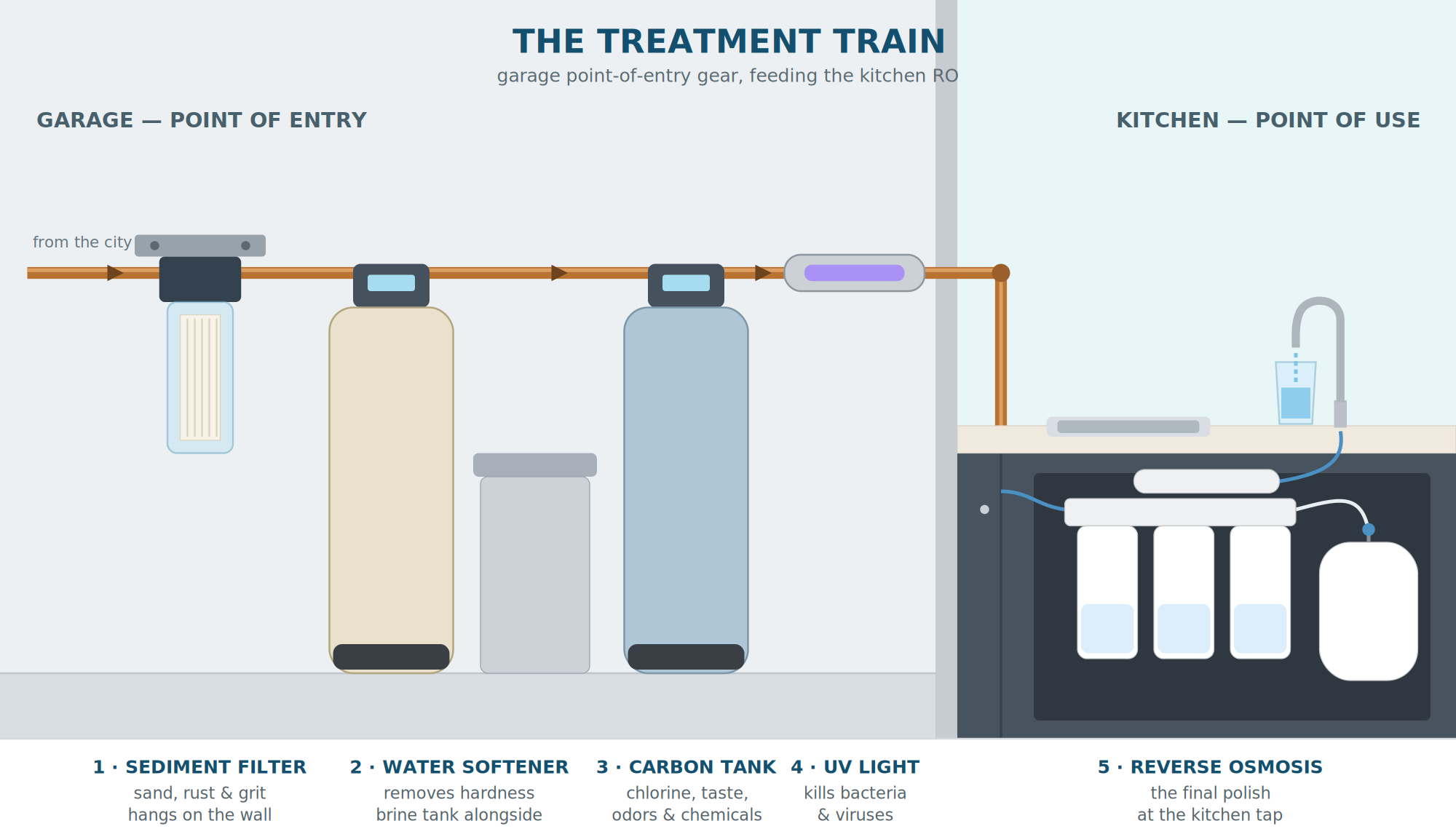
- Carbon Filtration, Explained Honestly: Types, Uses, and the Hills and Valleys Nobody Talks About — Water passes through activated carbon that grabs chlorine, bad taste, odors and a long list of chemicals.
- Ion Exchange and Water Softening, Explained Honestly — Swaps the calcium and magnesium that make water hard for sodium or potassium — and scale stops forming.
- Salt-Free Softeners Explained Honestly — Not a softener at all — a conditioner. How TAC stops scale without removing the hardness, and who it’s right for.
- UV Disinfection, Explained Honestly — Ultraviolet light scrambles the DNA of bacteria and viruses so they can’t infect you — no chemicals added.
- Distillation, Explained Honestly — Boils water and catches the steam — almost everything else is left behind in the boiler.
- Desalination, Explained Honestly — Reverse osmosis at industrial scale, built to turn seawater and brackish water drinkable.
- Remineralizing Your Water, Explained Honestly — Adds calcium and magnesium back after reverse osmosis strips them out — for taste and a less flat glass.
- How to Store a Spare RO Membrane (and Why Mine Lives in the Refrigerator) — A new membrane keeps best sealed and cold in the refrigerator — here’s why, and how long it stays good.
- Water Ionizers, Explained Honestly — What electrolysis really does to water, what these machines don’t remove, and what their certifications actually mean — seal by seal.
Facts first, then filter. — Steve