
Understanding Styrene in Drinking Water: Sources, Regulations, and Health Impacts
Most people have held styrene in their hands without ever knowing its name. It is the chemical building block behind the white foam cups used for takeout coffee, the clear plastic packaging around store products, and the synthetic rubber in tires and shoe soles. Because styrene is manufactured and shipped in enormous quantities, the question for homeowners is straightforward: can an industrial chemical this common find its way into drinking water, and if it did, what would actually remove it? The answers are reassuring for most households, but they are worth understanding clearly, especially for anyone whose water comes from a private well.
What Styrene Is
Styrene is a colorless industrial liquid chemical with a sweet, sharp odor. In the chemical industry, it is what manufacturers call a building-block chemical—meaning it is not typically the finished product itself, but the starting ingredient used to make a wide range of everyday materials.
When styrene molecules are linked together into long chains, the result is polystyrene, one of the most familiar plastics in modern life. That is the rigid clear plastic used for disposable cutlery, CD cases, and food containers, as well as the expanded foam used for packing peanuts, insulation board, and disposable coffee cups—sold under the famous trade name Styrofoam (true expanded-foam cups and packaging are polystyrene foam; solid molded items are plain polystyrene). Styrene also goes into synthetic rubbers, resins, coatings, and fiberglass products.
Beyond the factory, small amounts of styrene occur naturally in some foods, and it is also present in cigarette smoke and vehicle exhaust. The form that matters for drinking water, however, is the industrial liquid, moved in bulk by the chemical and plastics industries.
How It Gets Into Drinking Water
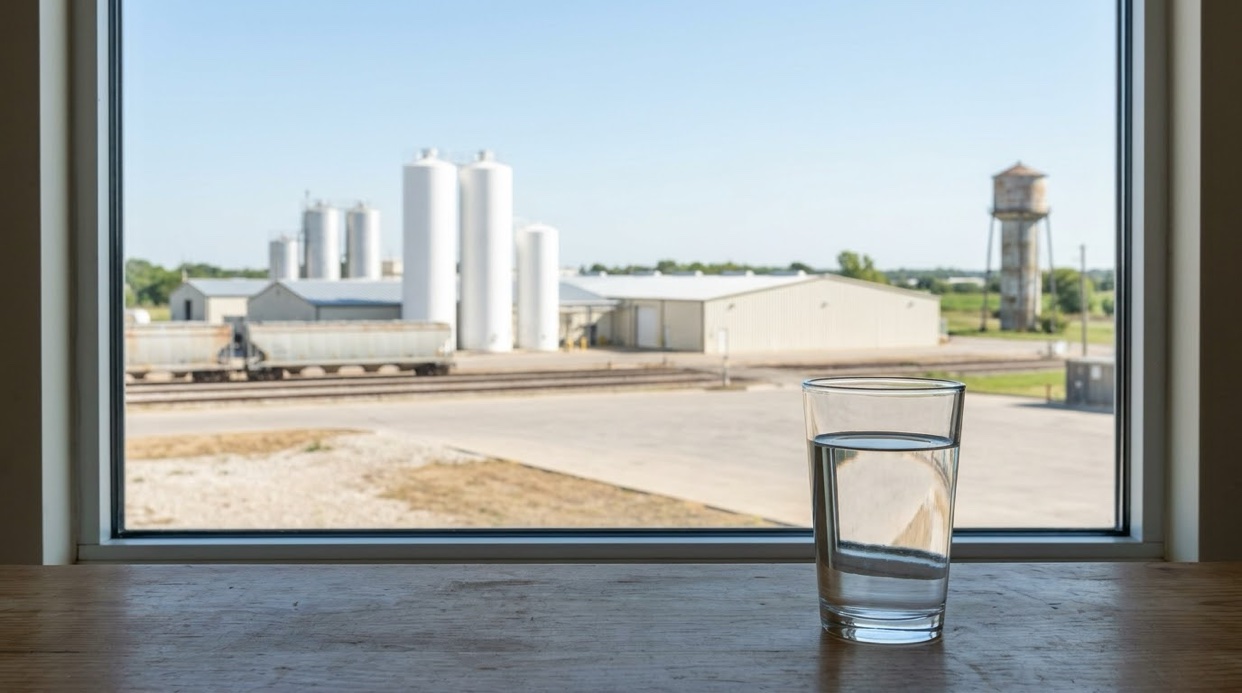
According to the Environmental Protection Agency (EPA), the primary way styrene enters drinking water is through discharge from rubber and plastic factories.
In practical terms, the routes are industrial rather than household. Styrene reaches water supplies when a plastics or rubber manufacturing plant releases wastewater containing the chemical, when bulk styrene leaks or spills during production, storage, or transport, and when rainwater runs off industrial sites where the chemical is handled. Those releases can reach rivers and streams that feed public water intakes, or soak into the ground above aquifers.
Household plastics are not the source. A foam cup or a plastic food container in your kitchen cabinet does not put styrene into your well or your tap in any meaningful way—it is the manufacturing end, not the finished products, that creates the exposure pathway.
Styrene has one more property that works in the public’s favor: it breaks down in the environment. Unlike legacy chemicals that persist in soil and groundwater for decades, styrene degrades when exposed to air and to naturally occurring microbes in soil and water. It does not build up indefinitely the way the old banned pesticides do. That does not make an industrial spill harmless—near a release, concentrations can still matter—but it means styrene contamination tends to be a local, present-day industrial issue rather than a permanent one.
Where it comes from and how it gets into the water
When people hear the word styrene, they usually picture a disposable foam coffee cup. To understand how styrene actually ends up in drinking water, however, you have to start at the factory rather than the kitchen cabinet. Styrene is a colorless industrial liquid chemical with a sweet, sharp odor. In manufacturing, it acts as a “building-block” chemical—a starting ingredient rather than a finished product. When linked into long chains, styrene becomes polystyrene, which forms the rigid clear plastic of disposable cutlery, CD cases, and food containers, as well as the expanded foam of packing peanuts, insulation board, and disposable coffee cups sold under the trade name Styrofoam. Beyond polystyrene, manufacturers also use styrene to make synthetic rubbers, resins, coatings, and fiberglass products. While small amounts of styrene occur naturally in some foods and appear in cigarette smoke and vehicle exhaust, the form that matters for drinking water is the bulk industrial liquid moved and processed by the chemical and plastics industries. According to the EPA, the primary way styrene enters drinking water is discharge from rubber and plastic factories. It reaches local water supplies through three main industrial entry routes:
- Wastewater releases: Process wastewater discharged by plastics or rubber manufacturing plants.
- Leaks and spills: Accidental releases occurring during industrial production, bulk storage, or transport.
- Industrial site runoff: Rainwater washing across industrial sites where bulk styrene is handled.
Through these pathways, industrial styrene either flows into rivers and streams that feed public water intakes or soaks into the ground above aquifers that supply nearby wells. That industrial pathway highlights a crucial correction about everyday household products: a foam cup or a plastic food container does not put styrene into a well or tap in any meaningful way. Drinking water exposure comes from the manufacturing end where bulk liquid styrene is handled, not from finished consumer plastics sitting in your home. Styrene also carries an environmental saving grace compared to old banned pesticides that linger for decades. Styrene breaks down in the environment. When exposed to air and to naturally occurring microbes in soil and water, it degrades rather than building up indefinitely. Near an active release, concentrations can still matter, which makes styrene most relevant to private well owners living near rubber or plastic manufacturing plants, resin producers, or industrial sites where styrene is stored and handled in bulk—especially where a spill or wastewater release is known to have occurred. Because it degrades naturally, however, styrene contamination tends to be a local, present-day industrial issue rather than a permanent one, and homeowners far from plastics and rubber manufacturing—as well as families on tested public systems—mostly do not need to lose sleep over it.
The Numbers: Goals and Legal Limits
When federal regulators evaluate a drinking water contaminant, they establish two specific benchmarks to protect public health. For styrene, those exact numbers are:
- Maximum Contaminant Level Goal (MCLG): 0.1 milligrams per liter
- Maximum Contaminant Level (MCL): 0.1 milligrams per liter (which equals 100 parts per billion)
Understanding what these two terms mean in plain English makes reading any municipal water report much easier.
The MCLG is the pure health goal. It is the level of a contaminant in drinking water below which there is no known or expected risk to human health. Regulators set this number strictly based on health science, building in a margin of safety to protect vulnerable people without worrying about what water treatment costs or how hard a chemical is to measure.
The MCL is the enforceable legal limit. It is the highest concentration of a contaminant that a public water system is legally allowed to deliver to your tap. When setting the legal limit, the EPA starts with the health goal and then evaluates what treatment technologies can realistically achieve and what they cost. Public water utilities are required by law to test their water and keep contaminant levels below this ceiling.
For many contaminants, the health goal is lower than the legal limit. With styrene, however, the health goal and the enforceable legal limit are the exact same number: 0.1 milligrams per liter, or 100 parts per billion.
Health Effects
The reason federal regulators set that limit at 0.1 milligrams per liter comes down to how long-term exposure affects the human body. According to the EPA, the stated health concerns from long-term exposure to styrene in drinking water at levels above the legal limit are liver, kidney, or circulatory system problems.
The liver and kidneys are the body’s main filters, continuously processing and clearing foreign chemicals from the bloodstream, while the circulatory system moves blood—and anything dissolved in it—through every organ. Regulatory limits are set specifically to keep lifetime daily exposure well below the level where those systems come under chronic stress.
How a Homeowner Finds Out
Discovering whether styrene is present in your household tap water depends entirely on where your water comes from.
If you receive your water from a city, town, or regional water utility, your supply is regulated as a public water system. Under federal drinking water law, public systems are required to test regularly for regulated contaminants, including styrene. Every year, your utility must publish those results in an annual water quality report known as a Consumer Confidence Report (CCR). You typically receive this report in the mail around mid-year, or you can read it anytime on your utility’s website. If styrene was detected in your municipal supply, the report must list the amount found right alongside the legal limit of 0.1 milligrams per liter.
If your home relies on a private well, nobody tests your water for you. The EPA does not regulate private wells, and local health departments do not automatically monitor them. A private well is tested for styrene only if the homeowner arranges and pays for the test.
To test a private well, you need to contact a state-certified water testing laboratory and request a volatile organic compound (VOC) analysis. Standard basic well tests—the routine packages that check for bacteria, nitrates, or water hardness—will not detect industrial chemicals like styrene. When scheduling the test, confirm with the certified laboratory that their VOC panel specifically includes styrene.
Finding it: testing and detection
Because styrene is a clear liquid that blends into water, you cannot reliably spot low-level contamination just by looking at a glass drawn from the tap. Finding out whether styrene is present depends entirely on where your water comes from and how it is tested. If you receive your water from a public water system, federal rules require the utility to test regularly for styrene and publish the results in its annual Consumer Confidence Report (CCR). In that yearly report, the utility lists the amount of styrene found right alongside the federal legal limit—the Maximum Contaminant Level (MCL)—of 0.1 mg/L (100 parts per billion). For styrene, the EPA’s health-based Maximum Contaminant Level Goal (MCLG) and the enforceable legal limit are the exact same number: 0.1 mg/L. Public water systems must monitor and control styrene against that limit because the EPA associates long-term exposure above 0.1 mg/L with liver, kidney, or circulatory system problems. If your home relies on a private well, the responsibility shifts completely to you. The EPA does not regulate private wells, and local health departments do not automatically monitor them for industrial chemicals. Nobody tests a private well for styrene unless the homeowner actively arranges and pays for the test. When arranging a private well test, follow a clear three-step order so you get accurate answers:
- Contact a state-certified water testing laboratory: Work with a certified lab equipped to run regulatory drinking water analyses.
- Request a volatile organic compound (VOC) analysis: Standard basic well tests—the routine packages that check for bacteria, nitrates, and water hardness—will not detect industrial chemicals like styrene.
- Confirm that the lab’s VOC panel specifically includes styrene: Before collecting and submitting your water sample, verify directly with the laboratory that styrene is included on the specific VOC panel they plan to run.
What Removes It
If a laboratory test confirms that styrene is in your water, or if you live near a plastics plant and want dependable protection at your kitchen sink, the treatment options are proven and well established. Unlike many contaminants that rely on a single treatment method, styrene carries two official Best Available Technologies designated by the EPA: packed tower aeration and granular activated carbon.
In federal drinking water rules, “Best Available Technology” means the EPA has evaluated available treatment methods and formally identified the most effective, proven processes for removing a specific chemical. For styrene, those two methods—and no other technologies—carry the EPA’s official designation.
Understanding how both technologies work explains why one belongs at a city water plant and the other belongs in your home:
- Packed tower aeration: Styrene is a volatile chemical, meaning it evaporates readily into air. In a packed tower, water cascades down through a tall column filled with packing material that spreads it into a thin film, while blowers push air upward through the water. The styrene transfers out of the water into the passing air and is carried away, leaving treated water behind.
- Granular activated carbon (GAC): Activated carbon is made from carbon-rich materials—such as coconut shells, coal, or wood—that are processed with intense heat to create millions of microscopic pores inside every granule. That process creates an enormous internal surface area. As water passes through a bed of activated carbon, organic chemicals like styrene are drawn out of the water and stick firmly to the carbon’s internal surfaces through a process called adsorption (spelled with a “d”), allowing clean water to pass through.
For a homeowner, carbon filtration is the practical household version of the EPA’s designated technology. Packed tower aeration is large-scale municipal water-system equipment, not something you install under a kitchen sink. A well-built home carbon filter—such as a dense activated carbon block filter at the kitchen tap or a whole-house granular activated carbon tank—delivers the exact same adsorption process the EPA relies on for public water systems. What matters most is the carbon itself and the replacement schedule—replace the filter cartridges on schedule so the carbon surfaces do not fill up.
What actually removes it
When styrene does need to be removed from drinking water, the chemical carries an unusual regulatory distinction. Styrene has two—and only two—EPA-designated Best Available Technologies: packed tower aeration and granular activated carbon. Those two methods, and no other water treatment technologies, carry the EPA’s official designation for removing styrene. Understanding how each technology works shows why public utilities and homeowners rely on different forms of the EPA’s approved methods:
- Packed tower aeration: Because styrene is volatile and evaporates readily into air, public water systems can strip it out physically. In packed tower aeration, water cascades down a tall column filled with packing material that spreads the water into a thin film while blowers push air upward through the tower. As water and air pass each other, the styrene transfers out of the water and into the passing air. While effective at utility scale, packed tower aeration requires large municipal equipment rather than a device installed under a kitchen sink.
- Granular activated carbon (GAC): Activated carbon works through adsorption rather than evaporation. Manufacturers take carbon-rich materials—such as coconut shells, coal, or wood—and process them with intense heat to create millions of microscopic pores and an enormous internal surface area. As water passes through the media, organic chemicals like styrene are drawn out of the water and stick firmly to the carbon’s internal surfaces, allowing clean water to pass through.
For residential treatment, activated carbon is the practical home version of the EPA’s designated approach. Homeowners can use either a dense activated carbon block filter at the kitchen tap or a whole-house granular activated carbon tank to deliver the exact same adsorption process the EPA relies on for public water systems. When using residential carbon filtration, two factors govern performance: the carbon itself and the replacement schedule. Because adsorption works by trapping styrene molecules directly onto the carbon’s internal surfaces, those surfaces have a finite capacity. Once the carbon’s internal surfaces fill up, the filter stops removing incoming styrene. Replacing cartridges or tank media on the manufacturer’s schedule is essential so the carbon surfaces never become saturated. It is also important not to confuse physical particle straining with chemical adsorption. Because activated carbon removes styrene through surface contact and chemical attraction inside its pore network—not by acting as a physical sieve—a filter’s micron rating is not a measure of chemical removal. A tight micron rating measures physical particle size, not whether a cartridge can capture dissolved organic chemicals, and you should never let a nominal micron rating stand in for a verified chemical removal claim.
The claim has to be on the sheet
When shopping for filtration equipment to handle an industrial chemical like styrene, marketing language often blurs the difference between general filter quality and verified contaminant reduction. Follow one strict rule when evaluating any system: name the certification or claim, then look closely at what that claim actually covers in the product’s own paperwork. In water treatment, third-party certification seals and performance claims are specific rather than blanket guarantees. A certification covers only the exact claims printed on that individual product’s Performance Data Sheet. A filter can carry a valid certification seal for improving taste and odor, reducing chlorine, or trapping sediment without ever having been tested or certified to remove styrene. Likewise, seeing a package state that a filter is “made with NSF-certified media” is not the same thing as the finished filter system being certified to remove styrene. Raw media certification simply means the bulk carbon material meets baseline safety standards—it does not verify that the finished cartridge, flow rate, and contact time will reduce styrene down to safe levels. Because the EPA designates packed tower aeration and granular activated carbon as the two Best Available Technologies for removing styrene from drinking water, activated carbon is the proven residential mechanism to look for. Even so, having carbon inside a filter housing is only the starting point. Before buying any under-sink carbon block or whole-house granular activated carbon tank marketed for styrene removal, require the seller or manufacturer to show you that exact claim—for styrene specifically—written directly in the product’s own Performance Data Sheet or official documentation. If styrene is not explicitly listed on the product’s own sheet, do not assume the filter will remove it.
The Honest Bottom Line
Styrene is a high-production industrial chemical, which means its presence in drinking water is tied to present-day manufacturing rather than to history—and it breaks down in soil and water instead of accumulating forever.
Who should actually think about styrene? Primarily homeowners who rely on private wells located near rubber or plastic manufacturing plants, resin producers, or industrial sites where styrene is stored and handled in bulk—especially where a spill or wastewater release is known to have occurred.
Who mostly does not need to lose sleep over it? Homeowners far from plastics and rubber manufacturing, and families connected to public water systems that regularly test and report compliance in their annual water reports. Your foam cups and food containers are not a styrene route into your water.
You never have to guess about what is coming out of your faucet. Take the one practical step that settles the question: read your annual Consumer Confidence Report if you are on city water, and arrange a certified laboratory VOC test for your private well if you live near a potential industrial source.
Facts first, then filter. — Steve
Leave a Reply