
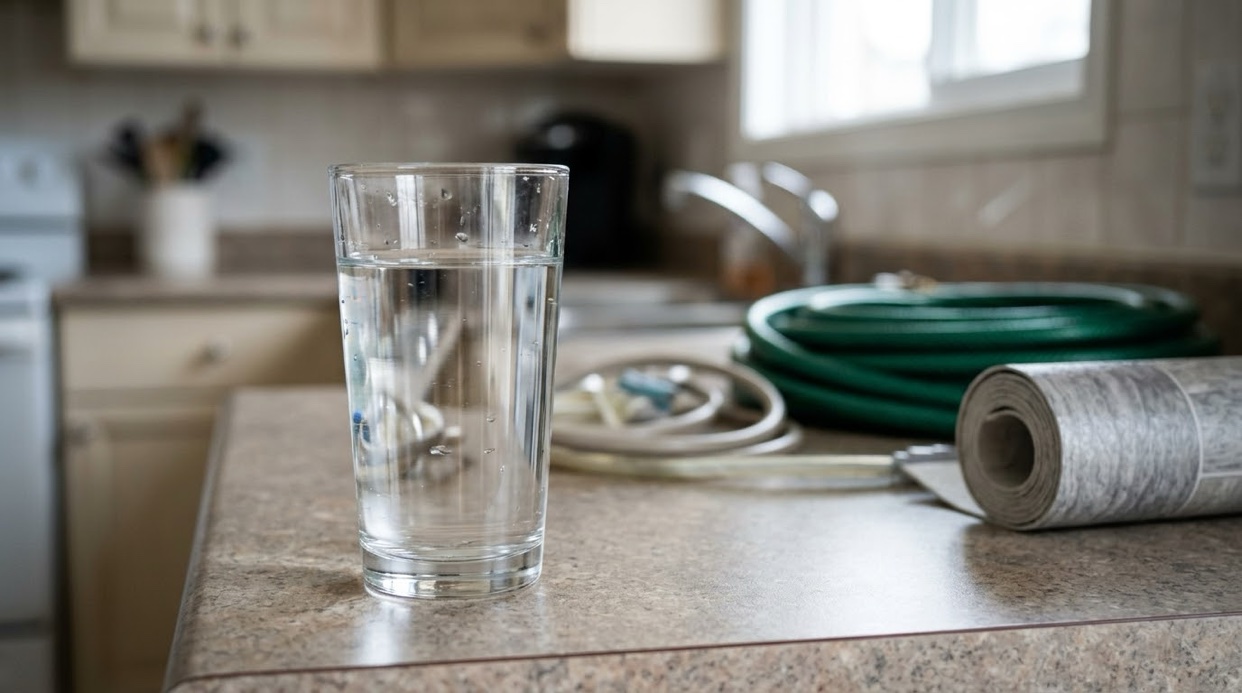
Di(2-ethylhexyl) phthalate—commonly abbreviated as DEHP—is a synthetic chemical that belongs to a family of compounds called phthalates. It is not something nature produces. Chemical manufacturers synthesize DEHP specifically to serve as a plasticizer, an additive mixed into polyvinyl chloride (PVC) resin to transform rigid, brittle plastic into a flexible, durable material.
Because of its flexibility and strength, DEHP has historically been used in a vast range of industrial and commercial goods. You will find it in flexible vinyl flooring, wall coverings, rainwear, footwear, medical tubing, blood bags, garden hoses, and various food packaging materials. The chemical does not form a permanent chemical bond with the plastic matrix; instead, it sits within the polymer structure as a dissolved additive. Over time, DEHP can slowly leach, evaporate, or migrate out of plastic products into surrounding air, liquids, or soil.
When reviewing a local water quality report or an analytical laboratory testing panel, it is easy to stumble over long chemical names. One compound that is frequently confused with DEHP is di(2-ethylhexyl) adipate, or DEHA. While the names sound remarkably similar, DEHP and DEHA are entirely different chemicals with distinct molecular structures, different manufacturing uses, and separate regulatory standards under federal drinking water rules.
Under United States Environmental Protection Agency (EPA) regulations, DEHA has a Maximum Contaminant Level of 0.4 milligrams per liter (mg/L). DEHP, on the other hand, is regulated under a far stricter standard. Confusing these two compounds on a lab report can lead to a significant misunderstanding of your water quality, so it is vital to pay close attention to the exact chemical name listed on your test results.
How DEHP Gets Into Drinking Water
The primary pathway for this chemical to enter public drinking water supplies and private wells stems from industrial activity. As defined by the EPA, the main source of DEHP contamination in water is:
“Discharge from rubber and chemical factories.”
Manufacturing facilities that synthesize phthalates, synthesize PVC plastics, or process synthetic rubber generate industrial wastewater. If that wastewater is improperly treated, spilled, or discharged into surface streams or groundwater aquifers, DEHP enters the raw water supply.
Once released into the environment, DEHP behaves differently than many common water contaminants like nitrate or road salt. DEHP has a very low solubility in water, meaning it does not dissolve easily. Instead of remaining evenly mixed in liquid water, the chemical is hydrophobic (“water-fearing”). When it enters a lake, river, or groundwater basin, DEHP rapidly attaches itself to organic matter, suspended sediment particles, and soil beds.
Because it clings to sediment, DEHP can persist in lake bottoms and riverbeds for long periods. However, fine sediment particles carrying bound DEHP can still be drawn into drinking water intake pipes or private wells during pumping, bringing the contaminant into municipal or home water systems. Additionally, the historic disposal of PVC plastics and industrial waste in unlined landfills can create localized leachate plumes that slowly migrate toward groundwater sources over decades.
Where it comes from and how it gets into the water
DEHP—short for di(2-ethylhexyl) phthalate—is a synthetic chemical in the phthalate family that nature does not produce. Manufacturers synthesize it as a plasticizer, an additive mixed into polyvinyl chloride (PVC) resin to turn rigid, brittle plastic into a flexible, durable material. Historically, that flexibility put DEHP into a wide range of everyday products, including flexible vinyl flooring, wall coverings, rainwear, footwear, medical tubing, blood bags, garden hoses, and various food packaging materials.
The core problem with DEHP lies in how it sits inside those products: DEHP does not form a permanent chemical bond with the plastic. Instead, it remains in the polymer as a dissolved additive and can slowly leach, evaporate, or migrate out into surrounding air, liquids, or soil over time.
When summarizing how DEHP enters public water supplies, the EPA’s defined main source line is direct: “Discharge from rubber and chemical factories.” Facilities that synthesize phthalates, PVC plastics, or synthetic rubber generate industrial wastewater that, if improperly treated, spilled, or discharged, carries DEHP into surface streams or groundwater aquifers. Once released into the environment, DEHP follows several distinct pathways to reach tap water:
- Sediment binding and intake draw: Because DEHP has very low solubility in water and is hydrophobic (“water-fearing”), it rapidly attaches to organic matter, suspended sediment particles, and soil beds, persisting in lake bottoms and riverbeds for long periods. Fine sediment particles carrying bound DEHP can then be drawn into drinking water intake pipes or private wells during pumping.
- Landfill leachate plumes: Historic disposal of PVC plastics and industrial waste in unlined landfills can create localized leachate plumes that slowly migrate toward groundwater sources over decades.
- Plumbing and plastics: DEHP is also a plumbing-and-plastics story—older flexible plastic lines, cheap vinyl hoses, unrated commercial gaskets, older infrastructure, and off-spec plastic fittings can play a role in low-level localized chemical leaching, though modern plumbing codes have tightened significantly.
The Numbers: Understanding the Regulatory Limits
To evaluate DEHP in public drinking water, the EPA establishes two critical figures: the Maximum Contaminant Level Goal (MCLG) and the Maximum Contaminant Level (MCL).
- MCLG (Maximum Contaminant Level Goal): Zero
- MCL (Enforceable Limit): 0.006 mg/L (6 parts per billion)
The Maximum Contaminant Level Goal is set at zero. The EPA establishes an MCLG of zero for a drinking water contaminant when scientific evidence indicates that the compound is a probable human carcinogen and there is no known safe threshold of exposure below which no health risk exists. The zero goal represents a health-focused target where no adverse biological effects would be expected.
The Maximum Contaminant Level is set at 0.006 milligrams per liter, which translates directly to 6 parts per billion (ppb).
It is crucial to understand why the enforceable limit (0.006 mg/L) sits above the health goal of zero. An MCLG is strictly a health-based evaluation without consideration of cost or detection technology. The MCL, however, is a legally enforceable standard set as close to the MCLG as feasible. The EPA determines this limit by evaluating the practical limits of analytical detection equipment in laboratories and the physical performance capabilities of standard municipal water treatment systems. The existence of an enforceable limit above zero does not mean that 6 ppb is a completely risk-free concentration; rather, it reflects the legal balancing point of what environmental testing and industrial filtration technology can reliably measure and remove on a mass scale.
Health Effects
Federal drinking water guidelines outline specific health concerns tied to long-term ingestion of DEHP. The official EPA health-effects evaluation for DEHP in drinking water states:
“Reproductive difficulties; liver problems; increased risk of cancer.”
To understand what this means for consumers, each of these three explicit outcomes can be examined based on how the body processes the compound:
First, reproductive difficulties stem from the classification of DEHP as an endocrine disruptor. When consumed over long periods, the chemical can interfere with the hormone systems that regulate normal reproductive biology, organ development, and tissue function.
Second, liver problems occur because the liver acts as the primary organ responsible for filtering, metabolizing, and clearing synthetic organic chemicals from the bloodstream. Chronic exposure to DEHP forces the liver to continuously process the compound, which can lead to cellular strain, tissue damage, and altered liver enzyme activity.
Third, an increased risk of cancer relates directly to how DEHP and its metabolic breakdown products interact with cellular pathways over a lifetime of exposure. Chronic ingestion of drinking water containing DEHP above the enforceable limit elevates the long-term statistical probability of cellular mutation and tumor development.
Finding it: testing and detection
Before you look at any numbers on a water test report, watch out for a common naming trap: DEHP is frequently confused with di(2-ethylhexyl) adipate (DEHA). Although their names look nearly identical, they are entirely different chemicals with different structures, different uses, and separate regulatory standards—DEHA’s enforceable limit is 0.4 mg/L, while DEHP is regulated far more strictly. Always read the exact chemical name on your report so you do not apply the wrong standard.
How you check for DEHP depends on whether your water comes from a municipal utility or a private supply:
- Public water customers: Check your utility’s annual Consumer Confidence Report (CCR) under the synthetic organic chemicals section.
- Private wells or faucet-level checks: Order independent testing from a state-certified drinking water laboratory and request a panel that includes synthetic organic compounds (VOCs/SOCs) and phthalates.
When your report comes back, compare your results against the two federal benchmarks established by the EPA:
| Benchmark | Concentration | What It Means |
|---|---|---|
| Maximum Contaminant Level Goal (MCLG) | 0 mg/L (0 ppb) | The non-enforceable public health goal, set at zero because evidence indicates DEHP is a probable human carcinogen with no known safe threshold of exposure. |
| Maximum Contaminant Level (MCL) | 0.006 mg/L (6 parts per billion) | The legally enforceable federal limit that public water utilities must meet. |
Understanding the gap between the zero health goal and the 0.006 mg/L (6 parts per billion) legal limit is essential. The enforceable limit reflects the practical limits of laboratory detection equipment and municipal treatment performance—not a finding that 6 ppb is risk-free. In its health-effects evaluation, the EPA warns of “Reproductive difficulties; liver problems; increased risk of cancer.” DEHP is classified as an endocrine disruptor that can interfere with hormone systems regulating reproductive biology, organ development, and tissue function, while the liver—the primary organ that metabolizes it—can suffer strained cells and altered enzyme activity under chronic exposure.
What Removes DEHP from Water
When DEHP is present in raw water supplies, standard municipal clarification and settling processes are often insufficient to remove it entirely. However, two specialized treatment technologies are recognized by the EPA for effective DEHP removal: Granular Activated Carbon (GAC) and Reverse Osmosis (RO).
Granular Activated Carbon (GAC)
Activated carbon is an exceptionally effective treatment method for DEHP because of the chemical’s hydrophobic nature. Granular activated carbon features a vast network of microscopic pores, creating an immense internal surface area—a single gram of activated carbon can have a surface area exceeding 1,000 square meters. Because DEHP does not dissolve easily in water, it strongly prefers to adsorb (bind chemically and physically) to the carbon surface as water passes through the filter bed.
Reverse Osmosis (RO)
Reverse osmosis systems push water under high pressure through a dense, semi-permeable membrane. The microscopic pore structure of an RO membrane allows water molecules to pass through while physically blocking larger organic molecules. Because DEHP has a relatively large molecular size compared to water, the membrane mechanically screens out the compound, routing it away in the reject waste stream while clean water passes through to the storage tank.
Boiling Water Does Not Work
A common misconception is that boiling water makes it safe from all contaminants. While boiling kills biological pathogens like bacteria and viruses, it does not remove DEHP. Because DEHP has a significantly higher boiling point than water (over 700°F / 385°C), boiling your water will cause pure water to evaporate into steam while leaving the DEHP behind. This process actually concentrates the chemical in the remaining water, raising the exposure level.
What actually removes it
Standard municipal clarification and settling are often insufficient for removing DEHP, and common household shortcuts will make the problem worse. In particular, boiling does not remove DEHP: its boiling point is over 700°F / 385°C, meaning boiling simply evaporates pure water and concentrates the chemical in whatever water remains in the pot.
To actually remove DEHP at the tap, the EPA recognizes two effective treatment technologies:
- Granular Activated Carbon (GAC): A single gram of activated carbon can have an internal surface area exceeding 1,000 square meters. Because DEHP is hydrophobic and does not dissolve easily in water, it strongly prefers to leave the water and adsorb directly onto the carbon surface.
- Reverse Osmosis (RO): An RO system pushes water under high pressure through a dense, semi-permeable membrane. Because DEHP has a relatively large molecular size, the membrane mechanically screens it out into the reject waste stream.
When inspecting pre-filters or carbon cartridges used in these setups, you will frequently see a micron rating printed on the product specifications. A micron rating measures the size of the pores in the filter media—the smaller the micron number, the finer the physical openings. However, two cartridges with the same micron number perform very differently depending on whether that rating is nominal or absolute:
- Nominal micron rating: Indicates the filter traps a general percentage (roughly 60% to 85%, such as 85%) of particles of a given size and can let larger particles pass under pressure fluctuations.
- Absolute micron rating: Provides a strict laboratory guarantee of trapping 99.9% or more of particles at the specified size or larger.
Understanding nominal versus absolute ratings helps you judge how well a pre-filter blocks fine sediment particles carrying bound DEHP, but you must never let a nominal rating stand in for a certified removal claim. Only verified chemical performance testing proves that a filter reduces dissolved DEHP down below federal limits.
Filter Ratings and Certifications Explained
When evaluating carbon block or post-filters, you will frequently encounter micron ratings. A micron is one-millionth of a meter. A filter’s micron rating measures the size of the openings in the filter media:
- Nominal Micron Rating: Indicates that the filter can trap a general percentage (such as 85%) of particles of a given size. It allows some larger particles to pass through under pressure fluctuations.
- Absolute Micron Rating: Represents a strict laboratory guarantee that the filter will trap 99.9% or more of particles at that specified micron size or larger.
When shopping for home treatment, never rely on a generic claim of being “NSF certified.” A plain label statement like that tells you nothing about what the filter actually removes. Always look for the specific standard number:
- NSF/ANSI Standard 53 (Health Effects): This certification verifies that a drinking water system has been independently tested and proven to reduce specific health-related contaminants—such as volatile organic chemicals and heavy metals—to levels below federal safety limits.
- NSF/ANSI Standard 58 (Reverse Osmosis): This certification specifically applies to reverse osmosis point-of-use systems, verifying structural integrity, safety of materials, and proven performance in reducing health-related contaminants under high-pressure filtration.
The claim has to be on the sheet
Front-of-box marketing claims will not protect your household. Whenever you evaluate a filtration system, follow a strict rule: say the seal, then say what the seal means. Never rely on a generic “NSF certified” label on a carton—that bare phrase tells you nothing about what the filter actually removes. Always look for the specific standard number and translate what it covers:
- NSF/ANSI Standard 53 (Health Effects): Verifies that a system has been independently tested and proven to reduce specific health-related contaminants—such as volatile organic chemicals and heavy metals—to levels below federal safety limits.
- NSF/ANSI Standard 58 (Reverse Osmosis): Applies to RO point-of-use systems, verifying structural integrity, safety of materials, and proven performance in reducing health-related contaminants under high-pressure filtration.
Certification covers only the specific claims printed for that exact product. For practical protection at home, install a quality point-of-use RO system or an NSF/ANSI Standard 53 certified activated carbon filter at your kitchen drinking tap, and maintain the cartridges on a strict replacement schedule. Before buying, check the official product documentation and select a unit carrying explicit certification under Standard 53 or Standard 58 for the reduction of di(2-ethylhexyl) phthalate (DEHP) itself.
An Honest Installer’s Take
I’ve been working in the water treatment trade since 1994, installing and servicing residential filtration equipment across all kinds of well and municipal water supplies. Over the last thirty years, I’ve seen just about every water quality issue you can think of.
When people read about DEHP, they usually picture giant chemical plants dumping slop straight into a river. While industrial discharge from rubber and chemical factories is certainly the primary source of raw water contamination, DEHP is as much a plumbing-and-plastics story as it is a factory story.
Back in the day, flexible plastic lines, cheap vinyl hoses, and unrated commercial gaskets were put into service without a second thought about chemical migration. While modern plumbing codes have tightened up significantly regarding what materials can touch potable water, older infrastructure and off-spec plastic fittings can still play a role in low-level localized chemical leaching.
If you test your water and find DEHP near or above the limit, don’t panic or buy into high-pressure sales pitches for massive, over-engineered equipment you don’t need. The practical, real-world answer for a homeowner is straightforward: install a quality point-of-use reverse osmosis system or an NSF/ANSI Standard 53 certified activated carbon filter right at the kitchen drinking tap. Protect the water you actually drink and cook with first. Maintain your filter cartridges on a strict schedule, and you can keep this chemical out of your glass with complete confidence.
What to Do If You’re Concerned
If you want to verify the safety of your home’s drinking water regarding DEHP, follow these three clear steps:
- Check Your Local Consumer Confidence Report (CCR): If you receive water from a public utility, your provider is required by federal law to publish an annual water quality report. Look through the synthetic organic chemicals section of the CCR to see if DEHP has been detected in your municipal supply and at what levels.
- Conduct Independent Laboratory Testing: If you draw water from a private well, or if you want to verify the water coming out of your specific kitchen faucet, order a testing bottle from a state-certified drinking water laboratory. Request a panel that includes synthetic organic compounds (VOCs/SOCs) and phthalates.
- Select Certified Point-of-Use Treatment: If testing confirms the presence of DEHP, select an activated carbon or reverse osmosis treatment unit that carries explicit certification under NSF/ANSI Standard 53 or Standard 58 for the reduction of this specific compound.
Facts first, then filter. — Steve
Leave a Reply