
Understanding Toluene in Drinking Water: Sources, Regulations, and Health Impacts
If you have ever opened a fresh can of paint thinner, worked with heavy-duty construction glue, or walked past a busy auto repair shop, you have already smelled toluene. It is one of the most common industrial solvents in modern manufacturing and a key component of everyday motor fuel. Because it is produced and transported in massive volumes across the country, toluene occasionally turns up in drinking water testing. For homeowners, seeing a petroleum chemical listed on a local water report—or worrying about an old gas station down the road from a private well—naturally raises practical questions. Understanding what toluene is, how it travels underground, and what federal rules say about it gives you the clarity you need to protect your home’s water without guessing.
What Toluene Is
Toluene is a clear, colorless liquid chemical with a distinct, sharp, sweet odor. While it occurs naturally in crude oil and in the tolu tree, the toluene used in industry is a man-made chemical refined directly from petroleum during the gasoline-making process.
In the commercial world, toluene serves two major roles. First, it is a natural ingredient of gasoline, added to boost octane ratings and help engines run smoothly. Second, it is a widely used industrial solvent—meaning a liquid capable of dissolving other substances without changing them chemically.
Because it dissolves oils, resins, and rubbers so effectively, factories use toluene to manufacture paints, lacquers, paint thinners, coatings, adhesives, glues, rubber products, and even nail polish and nail polish removers. If a product needs to stay liquid in a can and dry quickly once brushed onto a surface, there is a good chance toluene helped make it work.
How It Gets Into Drinking Water
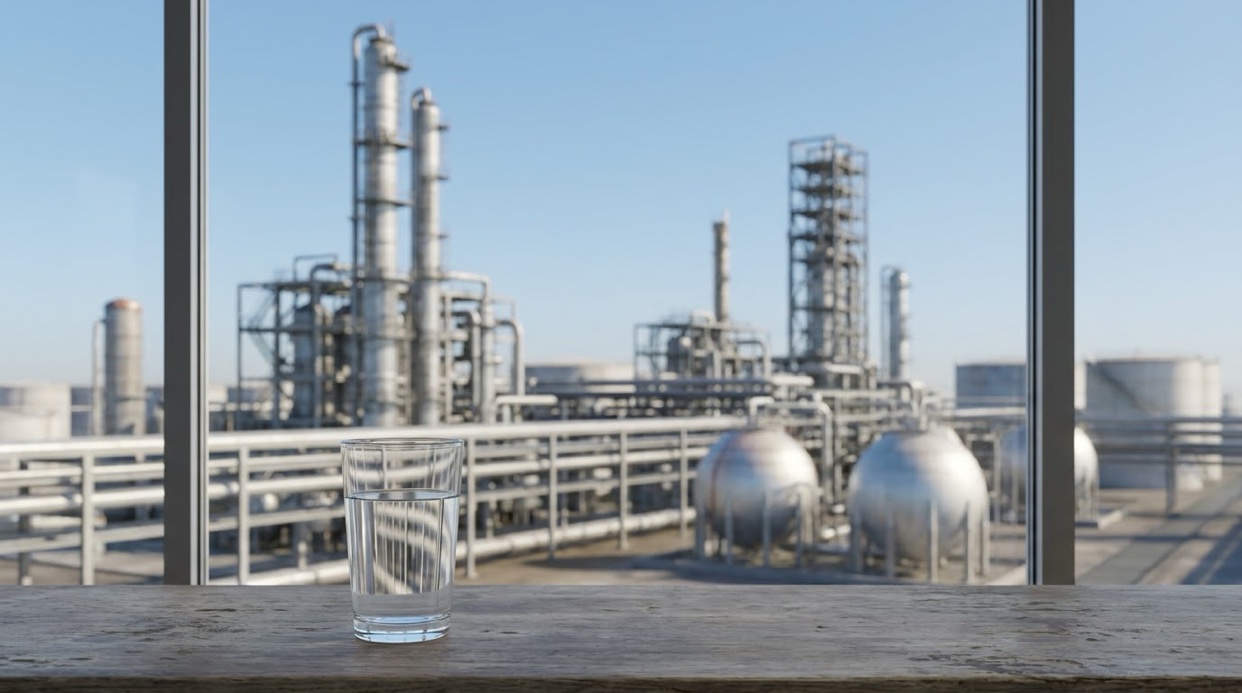
Because toluene is tied so closely to fuel and heavy manufacturing, its path into drinking water starts wherever petroleum products are refined, stored, or used. According to the Environmental Protection Agency (EPA), the primary regulated source of toluene in drinking water is discharge from petroleum factories.
In the real world, toluene reaches tap water through several straightforward routes:
- Leaking fuel storage tanks: Gas stations, fleet yards, and industrial facilities store fuel in large underground tanks. When older steel tanks corrode or piping joints fail, gasoline leaks slowly into the surrounding dirt.
- Gasoline and chemical spills: Accidental spills along highways, rail lines, or industrial loading docks can soak directly into the ground before cleanup crews arrive.
- Refinery and chemical-plant discharge: Wastewater from petroleum refineries or factories that manufacture paints and solvents can carry trace amounts of toluene into nearby rivers or streams if treatment systems fail or overflow.
When gasoline gets into the ground, toluene is one of the primary chemicals that dissolves out of the fuel mixture and moves with water. To understand how it behaves once spilled, you have to understand that toluene is volatile. In plain English, “volatile” means a liquid evaporates rapidly into the air when left exposed on an open surface. If you spill a drop of paint thinner on a driveway on a sunny afternoon, it disappears into the air quickly.
Underground, however, there is nowhere for the chemical to evaporate. When toluene becomes trapped in soil and groundwater beneath the surface, it cannot escape into the atmosphere. Instead, it dissolves into underground water and moves slowly along with the aquifer, persisting long enough to reach nearby private wells or surface water intakes.
The Numbers: Goals and Legal Limits
When federal regulators evaluate a drinking water contaminant, they establish two specific benchmarks to protect public health. For toluene, those exact numbers are:
- Maximum Contaminant Level Goal (MCLG): 1 milligram per liter
- Maximum Contaminant Level (MCL): 1 milligram per liter (which equals 1,000 parts per billion, or one part per million)
Understanding what these two terms mean in plain English makes reading any municipal water quality report much easier.
The MCLG is the pure health goal. It is the level of a contaminant in drinking water below which there is no known or expected risk to human health. Regulators set this number strictly based on health science, building in a margin of safety to protect vulnerable people without worrying about what water treatment costs or how hard a chemical is to measure.
The MCL is the enforceable legal limit. It is the highest concentration of a contaminant that a public water system is legally allowed to deliver to your tap. When setting the legal limit, the EPA starts with the health goal and then evaluates what treatment technologies can realistically achieve and what they cost. Public water utilities are required by law to test their water and keep contaminant levels below this ceiling.
For many contaminants, the health goal is lower than the legal limit. With toluene, however, the health goal and the enforceable legal limit are the exact same number: 1 milligram per liter, or 1,000 parts per billion (one part per million).
Health Effects
The reason federal regulators enforce that 1 milligram per liter limit comes down to how long-term exposure affects the human body. According to the EPA, the stated health concerns from long-term exposure to toluene in drinking water at levels above the legal limit are nervous system, kidney, or liver problems.
In the body, the liver and kidneys do the heavy lifting of filtering the bloodstream, breaking down foreign chemicals, and clearing waste products. Meanwhile, fat-soluble solvents like toluene interact directly with nerve tissues. Regulatory limits are calculated specifically to keep daily consumption over a lifetime well below the point where chronic stress to the nervous system, kidneys, or liver occurs.
How a Homeowner Finds Out
Discovering whether toluene is present in your household tap water depends entirely on where your water comes from.
If you receive your water from a city, town, or regional water utility, your supply is regulated as a public water system. Under federal drinking water law, public systems are required to test regularly for regulated volatile organic chemicals, including toluene. Every year, your utility must publish those results in an annual water quality report known as a Consumer Confidence Report (CCR). You typically receive this report in the mail around mid-year, or you can read it anytime on your utility’s website. If toluene was detected in your municipal supply, the report must list the amount found right alongside the legal limit of 1 milligram per liter.
If your home relies on a private well, nobody tests your water for you. The EPA does not regulate private wells, and local health departments do not automatically monitor them. A private well is tested for fuel-related chemicals like toluene only if the homeowner arranges and pays for the test.
To test a private well, you need to contact a state-certified water testing laboratory and request a volatile organic compound (VOC) analysis. Standard basic well tests—the routine packages that check for bacteria, nitrates, or water hardness—will not detect gasoline components or solvents. When scheduling the test, confirm with the certified laboratory that their VOC panel specifically includes toluene.
What Removes It
If a laboratory test confirms that toluene is in your water, or if you live near a known fuel release and want dependable protection at your kitchen sink, the treatment options are proven and well established. Unlike many contaminants that rely on a single treatment method, toluene carries two official Best Available Technologies designated by the EPA: packed tower aeration and granular activated carbon.
In federal drinking water rules, “Best Available Technology” means the EPA has evaluated available treatment methods and formally identified the most effective, proven processes for removing a specific chemical. For toluene, those two methods—and no other technologies—carry the EPA’s official designation.
Understanding how both technologies work explains why one belongs at a city water plant and the other belongs in your home:
- Packed tower aeration: This method takes direct advantage of the fact that toluene is volatile. Water is pumped to the top of a tall vertical tower filled with specially shaped plastic or ceramic packing material that breaks the water into thin films and tiny droplets. At the same time, powerful blowers push fresh air upward from the bottom of the tower against the falling water. As the air sweeps past the water droplets, the volatile toluene escapes out of the water and into the rising air stream, leaving clean water to collect at the bottom.
- Granular activated carbon (GAC): This method traps the chemical rather than stripping it into the air. Activated carbon is made from carbon-rich materials—such as coconut shells, coal, or wood—that are processed with intense heat to create millions of microscopic pores inside every granule. That process creates an enormous internal surface area. As water passes through a bed of activated carbon, organic chemicals like toluene are drawn out of the water and stick firmly to the carbon’s internal surfaces through a process called adsorption (spelled with a “d”), allowing clean water to pass through.
For a homeowner, carbon filtration is the practical household version of the EPA’s designated technology. Packed tower aeration is large-scale municipal water-system equipment, not something you install under a kitchen sink or in a basement utility room. A well-built home carbon filter—such as a dense activated carbon block filter at the kitchen tap or a whole-house granular activated carbon tank—delivers the exact same adsorption process the EPA relies on for public water systems. What matters most is the carbon itself and the replacement schedule—replace the filter cartridges on schedule so the carbon surfaces do not fill up.
The Honest Bottom Line
Toluene is an everyday industrial solvent and gasoline ingredient, which means its presence in drinking water is almost always tied to a clear, identifiable source rather than appearing randomly.
Who should actually think about toluene? Primarily homeowners who rely on private wells located near petroleum refineries, chemical manufacturing plants, active or retired gas stations, fuel depots, or sites with known underground storage tank leaks. In those locations, fuel spills can seep into the soil and travel through groundwater toward nearby wells.
Who mostly does not need to lose sleep over it? Homeowners living in residential neighborhoods far from industrial corridors and fuel storage sites, as well as families connected to public water systems that regularly test and report compliance in their annual water reports.
You never have to guess about what is coming out of your faucet. Take the one practical step that settles the question: read your annual Consumer Confidence Report if you are on city water, and arrange a certified laboratory VOC test for your private well if you live near a potential fuel or industrial source.
Facts first, then filter. — Steve
Leave a Reply