
A pump with nothing to plug in
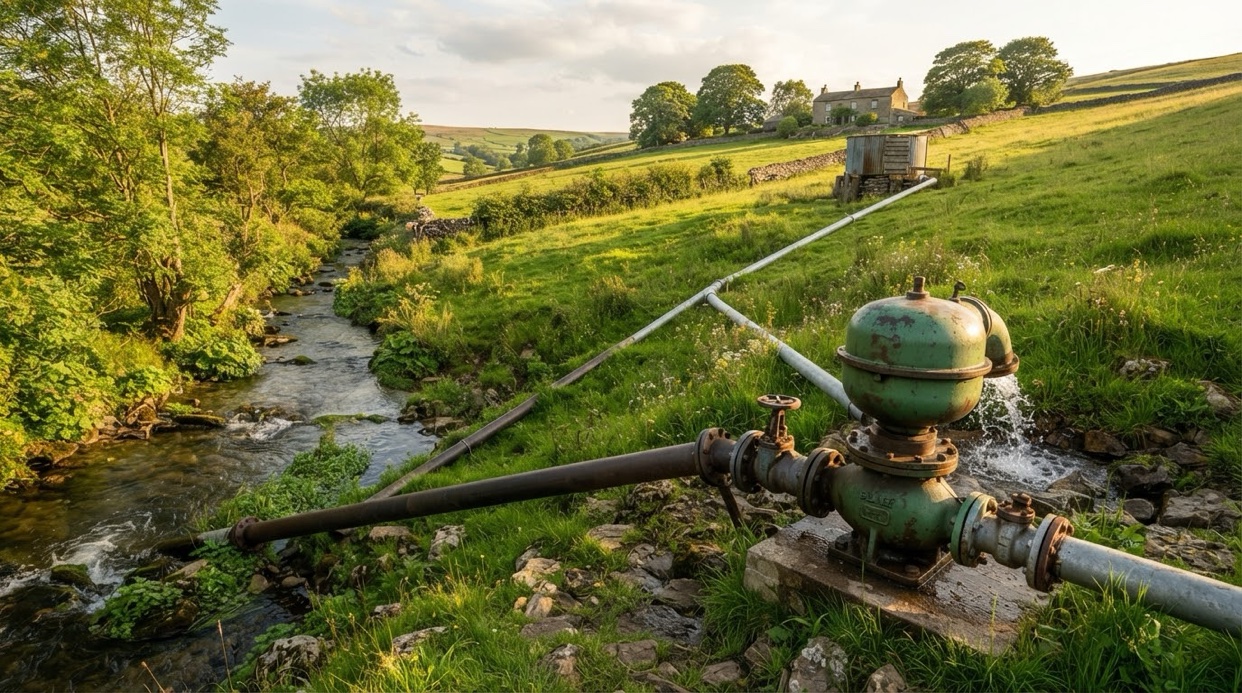
Walk down to a creek on an old farm or an off-grid homestead, and you might hear a steady, metallic clack echoing through the trees. Follow the sound to the water’s edge, and you will find a compact iron device sitting on the bank with pipes running in and out of it. Look around for a power line, a solar panel, a gas tank, or an electric motor, and you will come up empty. There is nothing to plug in, nothing to refuel, and nothing to switch on. Yet that quiet lump of metal is actively pushing water straight up the hill to a house or a storage tank.
It is called a hydraulic ram pump, and it tends to stop people in their tracks the first time they see one in action. Most of us are used to thinking that moving water uphill requires an outside energy source — an electric well pump hummed to life by the grid, a gas-powered transfer pump roaring on a riverbank, or a windmill spinning in the breeze. The ram pump skips all of that. It moves water uphill powered only by flowing water. No motor, no fuel, and no electricity ever enter the picture.
At first glance, it feels like a magic trick, or like a machine trying to get something for nothing. Water flows downhill into the pump, and part of that water gets pushed much higher up the hill than where it started. There is no trick involved, though, and no laws of physics are being broken. The pump simply trades volume for height, taking the everyday momentum of a moving stream and converting it into a focused push.
How it works, step by step
To see how a ram pump pulls this off without a motor, it helps to follow a single heartbeat of the machine from start to finish. The entire process relies on gravity, moving water, and a sudden stop.
- Water picks up speed on the way down. Water enters a sloped pipe from a creek or stream and runs downhill toward the pump. Because the pipe angles downward, gravity pulls the water along, and the column of water inside the pipe builds up speed and momentum.
- The waste valve slams shut. At the bottom of that downhill run, the rushing water flows out through an open valve called the waste valve. As the water moves faster, the force of the flow catches that valve and slams it shut in an instant.
- A sudden pressure spike builds. A long column of moving water carries real weight, and when its exit is blocked all at once, it cannot simply stop gently. That abrupt halt creates a sharp pressure spike inside the pump — the exact physical reaction known as water hammer.
- A gulp of water is forced upward. With the waste valve closed and nowhere else to go, that sudden spike of pressure pushes open a second, one-way valve. A small gulp of water is shoved through that valve and into a closed chamber that has air trapped at the top.
- Trapped air acts like a spring. As water enters the chamber, it squeezes the trapped air at the top. That compressed air pushes right back like a coiled spring, smoothly forcing the water out of the chamber and up a thinner delivery pipe toward a house or a storage tank on higher ground.
- The cycle resets itself. Once that gulp of water is pushed into the chamber, the pressure inside the pump drops. The one-way valve snaps shut so the water that just climbed cannot fall back down. At the same time, with the pressure gone, the waste valve falls back open. Water begins rushing down the pipe from the creek again, and the entire sequence starts over — repeating about once a second, day and night.
Know the parts
A hydraulic ram pump is remarkably simple on the inside. Instead of gears, impellers, or wiring, it relies on five straightforward parts working together in sequence.
- The drive pipe: This is the sloped intake pipe that carries water from the creek or stream down to the pump. Its job is to give the falling water a straight, solid path so it can build up the speed and weight needed to power each beat of the pump.
- The waste valve: Located at the lower end of the pump body, this valve lets water spill out until the flow gets fast enough to slam it shut. By abruptly stopping the moving water, the waste valve creates the pressure spike that drives the whole machine.
- The one-way delivery valve: Often called a check valve, this sits between the main pump body and the air chamber. It opens only in one direction — allowing the pressure spike to shove water into the chamber, then snapping closed so that water cannot drain backward when the pressure drops.
- The air chamber: This is a sealed dome or vertical vessel sitting above the delivery valve with a pocket of air trapped inside the top. It absorbs the harsh shock of the pressure spike and uses that trapped air like a spring to push water steadily up the hill.
- The delivery pipe: This is the thinner outlet pipe running from the base of the air chamber up to the house, barn, or storage tank. Because it is narrower than the drive pipe, the compressed air in the chamber can push the captured water a long way upward through it.
Water hammer doing honest work
If you have ever lived in a house with older plumbing, you probably know water hammer as an annoying — and sometimes alarming — problem. It is that loud bang behind the drywall when someone shuts off a washing machine or snaps a faucet closed too quickly. Inside household pipes, water is moving along at a steady clip until a valve cuts it off without warning. The sudden stop sends a shockwave bouncing back through the plumbing, rattling pipes and shaking fittings loose.
Plumbers spend their careers installing arrestors and securing pipes to stop water hammer from tearing up a home’s plumbing system. The hydraulic ram pump takes the exact same phenomenon and puts it to honest work.
Instead of fighting that shockwave, a ram pump is built specifically to create it on purpose, over and over again. Every time the waste valve slams shut at the bottom of the drive pipe, it triggers a controlled water hammer event. Where a household pipe rattles and complains, the ram pump captures that spike of energy and channels it directly through the one-way valve into the air chamber. What is a nuisance inside your walls becomes the engine of the pump down by the creek.
The numbers
Because a ram pump runs entirely on the energy of flowing water, its performance comes down to a simple trade-off: it uses a lot of moving water at a low drop to lift a smaller amount of water to a much greater height.
Most of the water that enters the drive pipe never goes up the hill at all. Every time the waste valve opens, water spills out before the valve slams shut again. That spilled flow is the price of admission — it is what generates the momentum for the next pressure spike. Only a fraction of the water passing through the pump gets forced through the one-way valve and into the delivery pipe.
In exchange for letting most of the water spill back out, the portion that does get captured can climb remarkably high. Under proper setup, a ram pump can push water up to about ten times higher than the vertical height it fell through the drive pipe. A modest drop from a creek bank can send water climbing a long hillside.
Speed-wise, a typical ram pump cycles at a steady, unhurried pace of about once a second. Because it never stops to rest — running through the afternoon heat, through the middle of the night, and across every week of the month — those small, once-a-second gulps add up steadily in a storage tank over time.
The history
The story of the hydraulic ram pump stretches back more than two centuries, beginning as a clever experiment that still needed a human hand to keep it going.
In 1772, an Englishman named John Whitehurst built an early version of a ram pump. Whitehurst understood that stopping a flowing column of water could create enough pressure to force water higher than its source. However, his design had a major practical catch: it needed a person to stand there and work the valve open and shut by hand. Without someone operating it, the water simply stopped moving.
More than twenty years later, a famous inventor solved that problem. In 1796, Joseph Montgolfier — one of the French brothers renowned for inventing the hot-air balloon — built the first self-running hydraulic ram pump to supply water to his paper mill at Voiron, France. Montgolfier’s breakthrough was designing the waste valve so that the flow of water itself would slam it shut, and the drop in pressure would let it fall back open. By making the valve work on its own, he turned a manual curiosity into an automatic machine that could run completely unattended.
Where it still earns its keep today
More than two hundred years after Montgolfier’s paper mill in France, the basic design has barely needed to change. Farmers and homesteaders still rely on hydraulic ram pumps today for off-grid water supply, especially in rural areas where running electrical lines down to a creek is expensive or impractical. For watering livestock, filling hilltop cisterns, or supplying a remote cabin, a machine that runs around the clock without a utility bill or a fuel can remains hard to beat.
Still, a ram pump is not the right tool for every piece of land, and it pays to be clear-eyed about its limits:
- It needs flowing water with some fall: A stagnant pond or a flat, sluggish ditch will not run a ram pump. The water has to be moving, and the site needs enough vertical drop along the drive pipe to give that water real momentum.
- It delivers modest amounts of water: Because each cycle only pushes a small gulp up the delivery pipe, a ram pump is built for steady, patient tank-filling rather than high-volume, on-demand blasting.
- It uses far more water than it delivers: A small trickle of a creek cannot spare the water needed to keep the waste valve cycling while still sending water uphill. You need a healthy, reliable flow at the source.
- It moves water — it does not clean it: This is the point that matters most for anyone bringing stream water toward a home. A ram pump is purely a mechanical mover. Whatever bacteria, sediment, runoff, or dissolved minerals are in that creek water will ride right up the delivery pipe into your tank. Filtration and proper water treatment still apply to whatever a ram pump delivers.
Living with a ram pump
Owning and running a hydraulic ram pump is a different experience from living with modern electric equipment, largely because the machine communicates directly with anyone within earshot.
- You can check it by ear: A working ram pump makes a steady, rhythmic clack about once a second as the waste valve slams shut and resets. Farmers often check on their pump simply by stepping onto the porch and listening; as long as that familiar beat is echoing up from the creek, they know water is still moving uphill.
- Minimal moving parts: Inside a ram pump, there are essentially only two moving parts — the waste valve and the one-way delivery valve. With no spinning motors, bearings, or electrical switches to burn out, these pumps can run for years at a time. When maintenance is eventually needed, the primary wear points are the valve seals, which take the brunt of that constant opening and closing.
- Keeping the air cushion alive: Over time, the air chamber slowly loses its trapped air because air gradually absorbs into the pressurized water passing through it. If the chamber fills completely with water, the spring effect disappears. To prevent this, many ram pumps include a tiny air valve — known as a snifter valve — that draws in a small sip of air on each cycle to keep that air cushion alive.
- Rigid pipe is a must on the intake: The drive pipe leading into the pump needs to be rigid pipe. If you use a flexible hose or soft tubing, the pipe walls will bulge and absorb the sudden pressure spike instead of passing that shockwave cleanly into the pump, weakening every beat.
- The spilled water is not wasted: Seeing water splash out of the waste valve all day can make it look like the pump is wasting water, but that spilled water is not consumed. It returns directly to the creek and flows on downstream. The pump simply borrows the falling water’s energy; it does not use the water up.
- Winter caution: In cold climates, freezing weather is the biggest threat to the hardware itself. A heavy cast-iron pump body left full of water can crack wide open in a hard freeze, so owners in freezing regions drain the pump or protect it before winter sets in.
The bottom line
The hydraulic ram pump is proof that smart mechanics can go a remarkably long way without a single watt of electricity. By pairing gravity with the simple physics of water hammer, it turns a flowing creek into a tireless, unattended water lifter — provided you have the drop, the water volume, and the right treatment plan waiting at the top of the hill.
Facts first, then filter. — Steve
Leave a Reply