
Understanding Tritium in Drinking Water: Sources, Regulations, and Health Impacts
Most drinking water contaminants are things you can picture floating or dissolving in a glass. Lead flakes off old pipes. Nitrates wash off farm fields. Arsenic leaches out of deep rock. Because those contaminants are separate substances mixed into the water, a good water treatment system can grab onto them and pull them out.
Tritium is completely different. It is regulated differently from almost every other contaminant in your tap water, and it behaves differently in the ground, in rivers, and inside a home water filter. Understanding those differences saves homeowners from unnecessary worry—and keeps them from wasting money on water treatment gear that physically cannot do the job.
What Tritium Is
Tritium is the radioactive form of hydrogen. Every water molecule you drink is made of two hydrogen atoms bonded to one oxygen atom. Normally, those hydrogen atoms are stable and non-radioactive. Tritium is an unstable version of hydrogen—an isotope, meaning a variant of the same element with extra mass in its core—that gives off low-energy radiation as it breaks down over time.
Because tritium is still hydrogen, it does not sit in your glass like a speck of dirt or a dissolved mineral. Instead, a tritium atom takes the place of a regular hydrogen atom and bonds directly into the water molecule itself. Scientists call the result tritiated water. To your eyes, your nose, and your taste buds, tritiated water looks, smells, and tastes identical to ordinary water. Chemically, it is water.
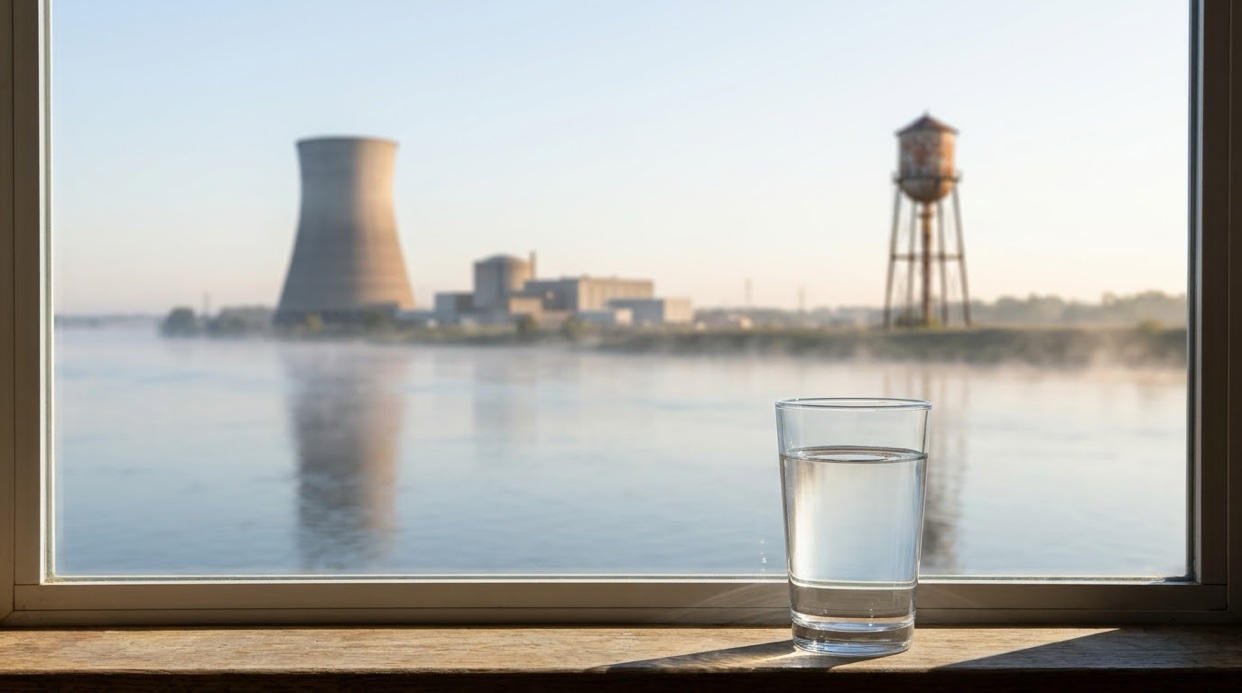
A tiny amount of tritium exists naturally in the environment. It forms high in the upper atmosphere when cosmic rays—high-energy particles streaming through space—collide with atmospheric gases. Larger amounts are produced and released by human activity, primarily from nuclear power plants, nuclear research facilities, and certain specialized industrial operations, such as facilities that manufacture self-luminous exit signs or scientific instruments.
How It Gets Into Drinking Water
Tritium enters the water cycle through two main pathways. Naturally formed tritium in the upper atmosphere mixes with moisture and washes down to earth in rain and snow, entering lakes, rivers, and shallow groundwater at very low background levels. Man-made tritium enters surface water or groundwater through controlled, permitted liquid releases from nuclear power plants and research facilities, or occasionally through unintentional leaks from facility piping and storage systems.
Once tritium reaches the ground or a river, it follows a unique path. Most pollutants slow down as they move through the environment. Heavy metals stick to clay particles. Organic chemicals bind to soil. Sediment settles to the bottom of a reservoir.
Tritium does none of those things. It does not settle out to the bottom of a lake, cling to soil grains, or collect in riverbed sediment the way other contaminants do. Because a tritiated water molecule is chemically part of the water itself, it moves through aquifers, streams, and municipal pipes at the exact same speed and in the exact same direction as regular water. Wherever water goes, tritium goes with it.
The Numbers: How Tritium Is Regulated
Federal drinking water rules treat tritium differently from almost every other substance on the Environmental Protection Agency’s (EPA) list. For most contaminants, the EPA sets a Maximum Contaminant Level (MCL)—a strict, single-chemical concentration limit measured in milligrams or micrograms per liter.
There is no tritium-specific federal MCL.
Instead, the EPA regulates tritium inside a broader group limit covering beta particle and photon radioactivity—two forms of radiation emitted by unstable atoms. Within this group rule, the numbers work differently:
- Health Goal (MCLG): The Maximum Contaminant Level Goal—the non-enforceable level below which there is no known or expected health risk—is zero.
- Legal Limit (MCL): The enforceable federal standard is set as an annual radiation dose of 4 millirem per year (written 4 mrem/yr), rather than a simple concentration limit.
- EPA’s Reference Table: To help water utilities apply that dose limit to individual substances, the EPA’s own reference table lists the concentration assumed to produce a dose of 4 mrem/yr—for tritium, that concentration is 20,000 picocuries per liter (pCi/L).
- California’s State Standard: California takes a more direct approach at the state level. California sets a straight, standalone MCL of 20,000 pCi/L specifically for tritium.
To make sense of those two units, it helps to separate what is in the water from what happens in the body:
- A picocurie (pCi) measures radioactivity—specifically, how much radioactive decay is occurring in a liter of water. Think of it as measuring the concentration of radioactive activity present in your glass.
- A millirem (mrem) measures radiation dose—specifically, the amount of energy absorbed by human tissue and its biological effect on the body.
Because the federal limit is based on total dose rather than a single chemical concentration, the math matters when more than one radioactive contaminant is present. If a water supply contains several beta-particle or photon-emitting radionuclides at the same time—such as tritium alongside strontium or cesium—their individual doses add up. Together, the combined dose from all beta and photon emitters in the water cannot exceed that same 4 mrem/yr federal limit.
Over time, tritium naturally loses its radioactivity through radioactive decay, turning into a stable, non-radioactive form of helium. It takes a span of about 12 years for half of a given amount of tritium to decay away.
Health Effects
The EPA regulates tritium and the wider beta-particle and photon radioactivity group for one clear reason: to keep the radiation dose low enough to avoid excess cancer risk.
Radiation emitted by beta particles can damage cells and DNA when radioactive material is ingested in drinking water over long periods. Even though the beta particle given off by tritium is relatively weak—it cannot even penetrate the outer dead layer of human skin from the outside—drinking tritiated water brings those atoms inside the body, where they distribute throughout body water just like regular water. Keeping exposure at or below the federal dose limit is designed to keep lifetime excess cancer risk within the EPA’s protective boundary.
How a Homeowner Finds Out
Finding out whether tritium is in your tap water depends entirely on where your water comes from.
If you receive water from a public utility, the utility is required to monitor its water for radioactivity under federal and state rules and report any detections in its annual Consumer Confidence Report (also called an Annual Water Quality Report). Utilities typically mail this report to customers once a year or post it online. If tritium or other beta/photon emitters were detected during testing, the numbers and the applicable standards will appear in the water quality data table.
If your home relies on a private well, nobody is testing your water for you. A private well is tested only if the homeowner arranges and pays for it. Standard well-water test packages—the ones typically run during a home sale for bacteria, nitrates, lead, and hardness—do not screen for tritium. Testing for tritium requires sending a water sample to a state-certified radiochemistry laboratory capable of running specialized liquid scintillation analysis.
What Removes Tritium: The Honest Answer
For the wider beta-and-photon radioactivity group, the EPA lists two official treatment technologies for water utilities: ion exchange (a process that swaps unwanted charged ions in water for harmless ones using specialized resin beads) and reverse osmosis (a process that pushes water under pressure through an ultra-fine membrane to block dissolved contaminants). Both methods work well on standard radioactive metals and minerals.
Tritium is the exception that breaks the rule.
Because the tritium atom sits inside the water molecule itself rather than floating alongside it, no water filter or treatment device can separate tritium from ordinary water:
- Activated carbon does not remove it.
- Reverse osmosis does not remove it.
- Ion exchange does not remove it.
- Distillation (boiling water into steam and condensing it back into liquid) does not remove it—the tritiated water evaporates and condenses right alongside regular water.
Put plainly: anyone selling a home water filter “for tritium” is selling something that cannot work. No under-sink pitcher, whole-house carbon tank, water softener, or multi-stage reverse osmosis system can strip tritium out of your tap water.
Because filtration cannot separate tritiated water from regular water, real-world tritium management happens at the source rather than inside a home. Water utilities and facility operators manage elevated tritium levels by holding and monitoring water while tritium decays away on its own over a span of years. In addition, groundwater and surface water near nuclear power plants and research facilities are monitored closely by both facility operators and state and federal regulators to track plumes and ensure public drinking water supplies remain protected.
The Honest Bottom Line
For the vast majority of homeowners, tritium is not something to lose sleep over. Most municipal water supplies have either zero detectable tritium or trace background levels from natural atmospheric rainfall that sit far below federal dose limits.
The people who should actually pay close attention to tritium are homeowners living near nuclear power plants, nuclear research laboratories, or industrial facilities that handle radioactive hydrogen—especially those drawing drinking water from a private well downgradient from one of those sites. In those communities, periodic testing through a certified lab provides clear answers.
For everyone else, there is only one practical step worth taking: read your annual water report. Look up your utility’s Consumer Confidence Report, scan the regulated contaminants table, and check whether beta/photon emitters or tritium appear. If tritium is present in your public water supply at all, it is measured and reported right there.
Facts first, then filter. — Steve
Leave a Reply