
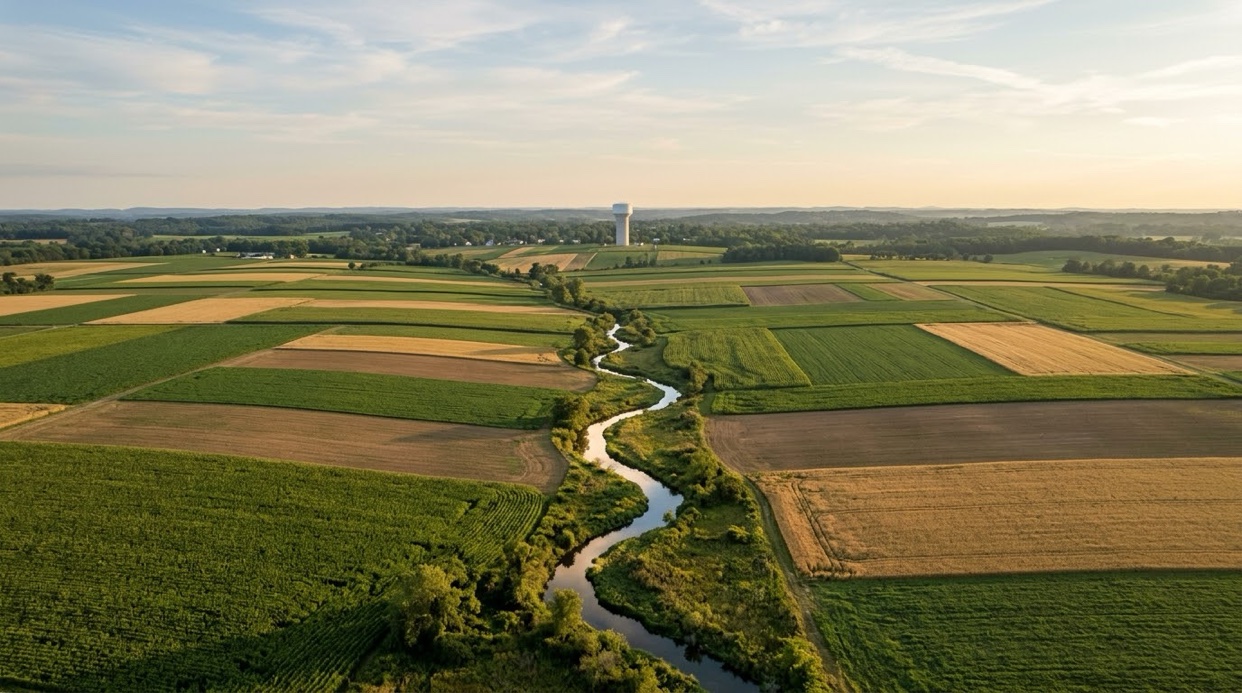
There are pesticides in American drinking water that the federal government has looked at, studied, and chosen not to limit. Not overlooked — decided. The eleven in this article have no federal Maximum Contaminant Level, which means no legal ceiling on how much of them can be in your tap water, and no requirement that your water system test for them or treat for them.
“Unregulated” needs translating, because it does not mean what most people assume. It does not mean the chemical was never evaluated. Several of these were formally reviewed under the Safe Drinking Water Act’s Contaminant Candidate List process, and EPA decided against a standard. It does not mean the chemical is gone — some are still sprayed every year, and some of the cancelled ones persist in soil and groundwater long after the last legal application. And it does not always mean there is no number at all: for some of these, EPA has published a Health Advisory, which is guidance, not law — a benchmark a utility may use voluntarily, with no enforcement behind it. For others, there is no federal number of any kind. A few states, California especially, have stepped in with their own limits on a handful of them.
So here are eleven more pesticides with no federal drinking-water limit — what each one is, what number exists for it if any, and what actually takes it out of water. One thing is true for all eleven up front: because they are unregulated, EPA has designated no Best Available Technology for any of them. There is no official treatment answer. The working answers, where they exist, are activated carbon and reverse osmosis — and I’ll tell you plainly where even those are weak.
3-Hydroxycarbofuran
This one isn’t a product at all — it’s what carbofuran turns into. Carbofuran (Furadan) was a carbamate insecticide; EPA revoked all its food tolerances in 2009 and cancelled its remaining registrations. But as carbofuran breaks down in soil and water, it becomes 3-hydroxycarbofuran, which is roughly as toxic as the parent, works the same way — a potent, reversible acetylcholinesterase inhibitor that overstimulates the nervous system — and persists longer in groundwater than carbofuran itself. The regulatory gap is sharp here: carbofuran has a federal MCL of 0.04 mg/L (40 ppb), but that limit does not include its breakdown product, and 3-hydroxycarbofuran has no MCL, no MCLG, and no EPA Health Advisory of its own. California regulates the parent (state MCL 0.018 mg/L) but has no standard for the degradate either. It is frequently monitored alongside the other carbamates under EPA Method 531.2 — the labs look for it; the law just never set it a limit. Removal: granular activated carbon gives moderate-to-good removal — its higher water solubility compared to carbofuran makes carbon work less efficiently — and tight RO and nanofiltration membranes reject it effectively.
Bentazon
Bentazon (Basagran) is a contact herbicide still registered and widely used on soybeans, corn, rice, peanuts, beans, and turf. It has no federal MCL, but it does have EPA Health Advisories: a Lifetime Advisory of 0.2 mg/L (200 ppb) and a 10-day child Advisory of 0.3 mg/L (300 ppb). California went further and set an actual state MCL of 0.018 mg/L (18 ppb) — more than ten times tighter than the federal lifetime guidance — with a Public Health Goal of 0.2 mg/L. EPA classifies bentazon as Group E, evidence of non-carcinogenicity for humans. Its environmental behavior is the concern: in neutral water it exists as a negatively charged anion, so it barely binds to soil and is one of the most frequently detected herbicides in shallow agricultural groundwater in California’s Central Valley and the Midwest. Removal: reverse osmosis removes it effectively; GAC works moderately well, though that same ionized form reduces how well carbon grabs it compared to neutral herbicides.
Bromacil
Bromacil (Hyvar) is a non-selective herbicide still registered for brush and weed control on industrial sites, railroad rights-of-way, and citrus groves — a textbook groundwater leacher, highly soluble with a long soil half-life, and already restricted in high-leaching zones of California and Florida after detections in private wells in Florida’s citrus belt. It has no federal MCL and no California or New Jersey standard, but EPA’s Health Advisories give it a Lifetime value of 0.07 mg/L (70 ppb) and a 10-day child value of 5 mg/L (5,000 ppb). EPA classifies it as Group C, a possible human carcinogen; chronic animal studies showed decreased body weight gain, thyroid changes, and liver effects. Removal: both GAC and reverse osmosis remove bromacil effectively.
Butachlor
Butachlor (Machete) is the outsider of the eleven: a rice herbicide used heavily across Asia and South America that has never been registered in the United States at all. It has no federal MCL and no EPA Health Advisory — no federal number of any kind — and no California or New Jersey standard. It still shows up on EPA analytical methods and U.S. surface-water monitoring screens because it is one of the highest-volume rice herbicides in the world and a chemical cousin of alachlor and metolachlor; animal studies of its family show liver and kidney toxicity and tumors at high chronic doses. Removal: GAC and reverse osmosis both remove it effectively — it is strongly hydrophobic and a large molecule, which suits both carbon and membranes.
Cyanazine
Cyanazine (Bladex) was a triazine corn herbicide, a chemical cousin of atrazine. Its federal file has the tightest advisory number in this article: no MCL, but a Lifetime Health Advisory of just 0.001 mg/L (1 ppb) — tighter than atrazine’s 3 ppb — and a 10-day child Advisory of 0.1 mg/L (100 ppb). Animal studies showed developmental toxicity and mammary tumors in female rats at high doses, and EPA classifies it as Group C, a possible human carcinogen; California lists it under Proposition 65 for developmental toxicity. Those signals are why it isn’t sold anymore: the phase-out began in 1995 and cancellation was complete by the end of 2002. California and New Jersey never set their own standards for it. Removal: GAC and reverse osmosis both remove it effectively, much as they do atrazine.
Dimethipin
Dimethipin (Harvade) was a plant growth regulator and harvest-aid defoliant used on cotton and potatoes. All U.S. registrations were voluntarily cancelled in 2009 and the remaining tolerances revoked in 2010. It has no MCL, and it does not appear in EPA’s Health Advisory tables at all — no Lifetime or 10-day Advisory exists. The only federal benchmark is the reference concentration of 140 micrograms per liter (0.14 mg/L) that EPA used when monitoring for it under UCMR 4, drawn from the agency’s Human Health Benchmarks for Pesticides. EPA classifies dimethipin as Group C, a possible human carcinogen, based on animal studies showing liver toxicity and equivocal lung tumors in male mice at high doses. It is extremely water-soluble and binds poorly to soil, which is why EPA watched it in cotton country before the cancellation. Removal is the weakest in this article: reverse osmosis rejects it effectively, but GAC is poor-to-moderate — dimethipin is polar and water-loving, so carbon doesn’t grab it well.
Metribuzin
Metribuzin (Sencor) is a herbicide for soybeans, potatoes, tomatoes, alfalfa, wheat, and sugarcane — still registered and still in use. It was one of the first pesticides ever run through the Contaminant Candidate List process, and in 2003 EPA’s Final Regulatory Determination 1 formally decided not to set a federal standard for it. So: no MCL, but Health Advisories exist — a Lifetime Advisory of 0.07 mg/L (70 ppb) and a 10-day child Advisory of 5 mg/L (5,000 ppb). No California or New Jersey standard. EPA classifies it as Group D, not classifiable as to human carcinogenicity; chronic animal studies point to thyroid, liver, and kidney effects. It is highly soluble and leaches readily into shallow groundwater under sandy soils. Removal: reverse osmosis is effective; GAC gives moderate-to-good removal.
Molinate
Molinate (Ordram) was a rice herbicide, used almost exclusively against watergrass in flooded paddies. Its history is written in California water: in the early 1980s, spring runoff from Sacramento Valley rice fields caused fish kills and bitter taste-and-odor complaints in Sacramento’s tap water. California answered with a state MCL of 0.02 mg/L (20 ppb) and a Public Health Goal of 0.001 mg/L (1 ppb) — one of the few chemicals in this article with a real, enforceable state limit. Federally there is no MCL and no numeric Health Advisory. California also lists molinate under Proposition 65 for developmental and reproductive toxicity, and EPA classifies it as Group C, a possible human carcinogen; animal studies showed reproductive toxicity plus neurotoxicity and liver and kidney effects at high doses. U.S. registrations were cancelled effective 2009. Removal: GAC and reverse osmosis both remove molinate effectively.
Oxyfluorfen
Oxyfluorfen (Goal) is a herbicide for orchards, vineyards, nuts, onions, cotton, and forestry — still registered, with an EPA registration review interim decision in 2019. It has no federal MCL and no numeric Health Advisory, and no California or New Jersey standard. EPA classifies it as Group C, a possible human carcinogen; chronic animal studies showed anemia and liver toxicity. Its saving grace is behavior: it binds so tightly to soil particles that it rarely leaches into deep groundwater, reaching drinking-water intakes mainly through erosion and storm runoff — which is why EPA monitored it nationally under UCMR 4. Removal: both GAC and reverse osmosis achieve very high removal, over 99% — it is strongly hydrophobic, so carbon grabs it hard, and it is a large molecule for membranes to reject.
Propachlor
Propachlor (Ramrod) was the first commercial chloroacetanilide herbicide, introduced in the 1960s, used on sorghum and corn before the registrant voluntarily cancelled it in 1998 rather than fund the studies EPA required for reregistration. Federally, it has no MCL and no Lifetime Health Advisory — the one federal number is a short-term one: a 1-day and 10-day Health Advisory of 0.5 mg/L (500 ppb). California goes further than Washington here: it keeps a current notification level for propachlor of 0.09 mg/L (90 ppb) — not an enforceable limit, but a live advisory the state still uses today. EPA classifies it as “likely to be carcinogenic to humans,” and California lists it under Proposition 65 as a carcinogen; chronic rodent studies showed decreased weight gain, liver and kidney effects, and gastric and thyroid tumors at high doses. Removal: GAC and reverse osmosis both remove the parent chemical effectively — with one caution. Propachlor breaks down into a sulfonic acid degradate (propachlor ESA) that is far more water-soluble, and for that breakdown product you need reverse osmosis; carbon alone won’t do it.
Tebuconazole
Tebuconazole (Folicur) breaks the pattern of this article in one way: it’s a fungicide, not a herbicide — a systemic triazole used on grains, fruits, vegetables, peanuts, and turf, and sold in home lawn-and-rose products, so it turns up in suburban runoff as well as farm watersheds. It is still registered. It has no MCL and no numeric Health Advisory, and it belongs to the newest chapter of this story: in March 2026, EPA’s Final Regulatory Determination 5 formally decided not to regulate it in drinking water, after monitoring across thousands of utilities under UCMR 4. EPA classifies it as Group C, a possible human carcinogen; chronic animal studies showed liver toxicity, adrenal effects, and developmental toxicity at high doses. California and New Jersey have no standards for it. Removal: GAC and reverse osmosis both remove it effectively, better than 90%.
Now the teaching point that runs under all eleven. Every chemical here, when it’s in your water, is there dissolved — individual molecules mixed into the water, not particles suspended in it. A sediment filter cannot touch them, and a micron rating is meaningless against them: a micron rating measures hole size, and holes only stop what is bigger than the hole. Trying to strain a dissolved pesticide out with a sediment cartridge is like trying to catch wind in a chain-link fence. What works on dissolved chemicals is adsorption — activated carbon grabbing molecules onto its enormous internal surface — and reverse osmosis, forcing water through a membrane fine enough to leave the molecules behind. Where carbon is weak, as with dimethipin, or where a breakdown product slips past it, as with propachlor’s degradate, RO is the answer. Anybody who quotes you a micron number as pesticide protection does not understand his own product.
The Bottom Line
Eleven pesticides, eleven different stories — a breakdown product that outlives its banned parent, a rice chemical never registered here at all, workhorse herbicides still sprayed today, and chemicals cancelled a decade or more ago that groundwater hasn’t forgotten. What they share is the federal bottom line: no MCL, no enforceable limit, and for several of them no federal number of any kind. Some carry Health Advisories, which are guidance without teeth. A couple carry real limits — but only because California wrote them, and they protect only Californians.
That is the honest picture, and it points at the same conclusion as every article in this series. If your water comes from farm country, or your well sits near fields, orchards, rights-of-way, or rice ground, nobody upstream is required to watch for these chemicals on your behalf. Test your own water, know which of these your region actually uses, and treat with the tools that work on dissolved chemicals — activated carbon, reverse osmosis where carbon runs weak. “Unregulated” is a decision Washington made. Whether it becomes your problem is a decision you get to make first.
Facts first, then filter. — Steve
Leave a Reply