
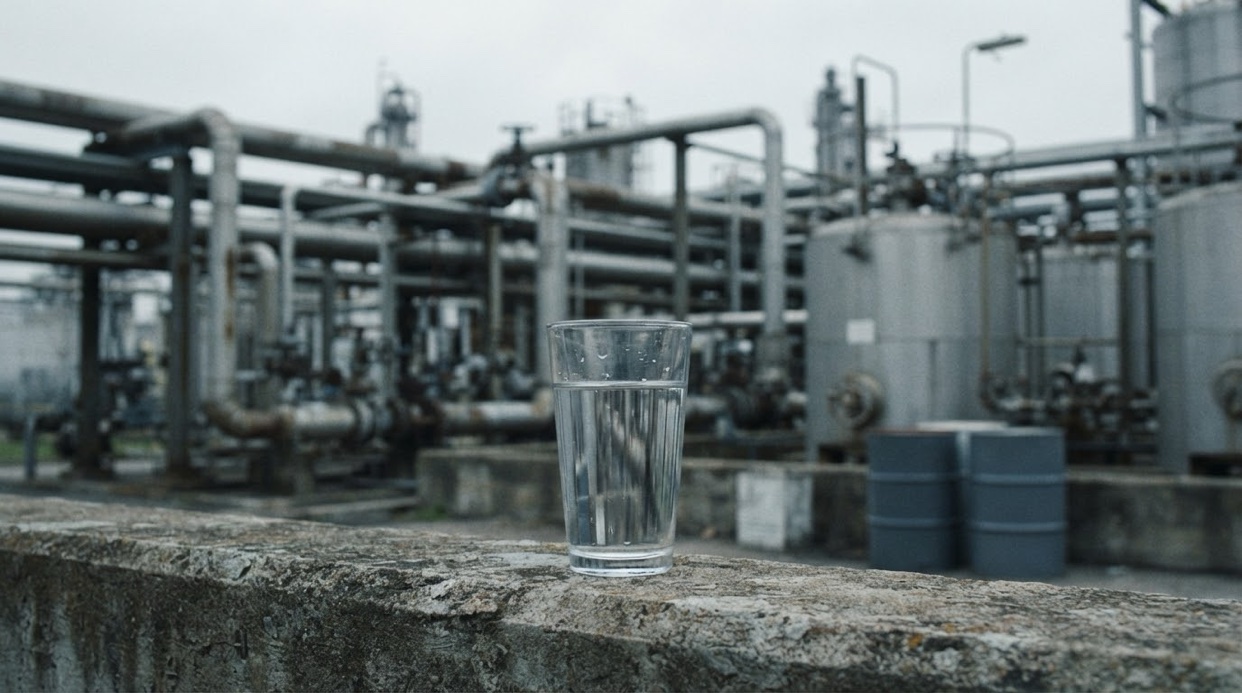
Hexachlorobutadiene is a chemical that almost nobody sets out to make anymore. Instead, it typically shows up uninvited as a chemical byproduct during the manufacturing of other chlorinated compounds, and the global community has formally placed it on a track for total elimination.
What It Is
Hexachlorobutadiene is a dense, colorless chlorinated liquid that carries a turpentine-like odor. Historically, it found use as a chemical intermediate in the production of rubber compounds, lubricants, gyroscopic fluids, and heat-transfer liquids, as well as serving as a solvent. Beyond these deliberate industrial applications, it is also generated as an unwanted byproduct during the manufacture of chlorinated hydrocarbons such as tetrachloroethylene and carbon tetrachloride.
Today, it is no longer commercially manufactured in the United States. Furthermore, the international community has targeted it for global phase-out: hexachlorobutadiene is listed under the Stockholm Convention on Persistent Organic Pollutants, appearing in Annex A for elimination in 2015 and in Annex C for unintentional production in 2017. These actions were taken because the chemical strongly resists natural degradation and has a high propensity to bioaccumulate, building up in the tissue of fish and other aquatic life.
The Numbers
When investigating drinking water regulations for hexachlorobutadiene, the regulatory landscape is defined largely by what is absent. Hexachlorobutadiene has no federal Maximum Contaminant Level (MCL) and no federal health goal (MCLG). There is no legally enforceable national standard governing its presence in public drinking water supplies.
In the absence of a federal standard, water quality professionals rely on calculated benchmarks and international guidelines:
- EPA Risk Calculation (1994): The EPA calculated a drinking-water concentration of 0.5 micrograms per liter (0.0005 mg/L) corresponding to a one-in-a-million cancer risk. This figure represents a theoretical risk calculation, not a standard, an advisory, or a legal limit.
- World Health Organization (WHO): The WHO guideline value for hexachlorobutadiene in drinking water is 0.6 micrograms per liter.
- State Regulations: Neither California nor New Jersey sets an enforceable drinking-water standard for hexachlorobutadiene.
Health Effects
In toxicological evaluations, the kidney is the primary target organ for hexachlorobutadiene toxicity.
According to the U.S. Environmental Protection Agency, animal studies involving chronic oral exposure have demonstrated kidney and liver toxicity, reduced fertility, and lower fetal body weights. Additionally, animal studies showed that exposure caused kidney tumors in rats.
Regulatory agencies view its cancer potential with varying levels of concern:
- EPA Classification: The EPA classifies hexachlorobutadiene as a Group C chemical, meaning it is considered a possible human carcinogen.
- IARC Classification: The International Agency for Research on Cancer classifies it in Group 3, designating it as not classifiable as to its carcinogenicity to humans.
- California Proposition 65: California formally lists hexachlorobutadiene under Proposition 65 as a chemical known to cause cancer, with the listing taking effect in 2011.
What Removes It
When hexachlorobutadiene is detected in water, treatment options are dictated by its chemical properties.
Granular activated carbon (GAC) adsorbs it strongly. Hexachlorobutadiene is highly hydrophobic, possessing an octanol-water partition coefficient (log Kow) of 4.78. Because it strongly prefers non-aqueous environments over staying dissolved in water, it grabs onto activated carbon surfaces readily and effectively.
By contrast, other standard water treatment technologies have significant limitations for this compound:
- Air Stripping: Air stripping is not established as an effective removal method for hexachlorobutadiene.
- Reverse Osmosis: Removal by reverse osmosis is not established for this compound, so do not count on an RO system for it.
What It Means for the Reader
For the average household, hexachlorobutadiene is best understood as an industrial-legacy chemical. Detections in public drinking water are uncommon and are typically tied to industrial areas and old contamination sites rather than everyday consumer activities. It is not something a typical home creates or regularly encounters in standard municipal water supplies. If it is ever reported in a local water report near such a site, carbon filtration is the home-level answer.
Facts first, then filter. — Steve
Leave a Reply