
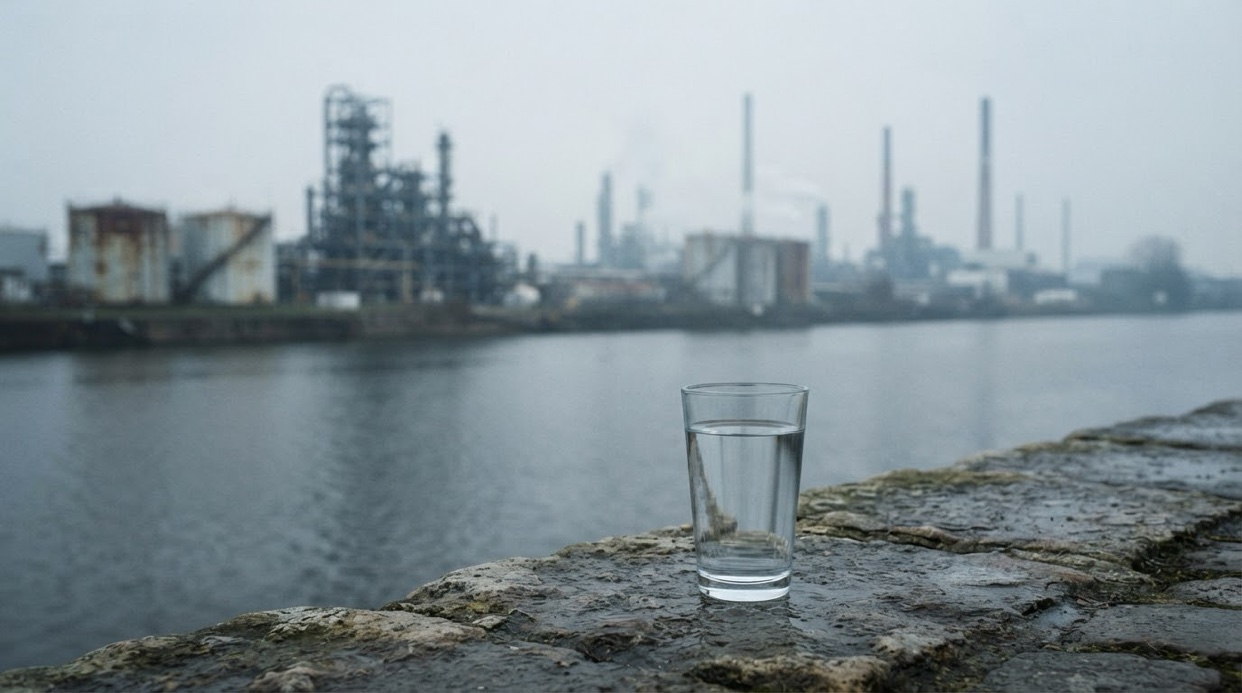
In November 2005, an explosion at a petrochemical plant in Jilin, China, released roughly 100 tons of benzene, aniline, and nitrobenzene into the Songhua River. That spill created an 80-kilometer toxic slick that moved downstream and forced the city of Harbin to shut off tap water to nearly 4 million people for five days. That crisis remains nitrobenzene’s most famous appearance in a public drinking-water supply, illustrating just how disruptive a major industrial release can be when it enters a river system.
What It Is
Nitrobenzene is a synthetic chemical that takes the form of a pale yellow, oily liquid with a distinct bitter-almond odor. Unlike legacy chemicals that have been phased out of production, nitrobenzene is still actively in commerce.
Its primary role in modern industry is overwhelmingly concentrated in a single supply chain:
- Aniline Manufacturing: Roughly 97 to 98 percent of all nitrobenzene used in the United States goes directly into manufacturing aniline, a foundational building block for polyurethanes and other industrial chemicals.
- Other Applications: The remaining 2 to 3 percent is used across several specialized manufacturing sectors, going into pesticides, dyes, pharmaceuticals, rubber chemicals, and metal and shoe polishes.
Because its production and consumption are tied almost entirely to industrial chemical synthesis and manufacturing plants, nitrobenzene is not an ingredient found in standard household cleaners or everyday consumer liquids poured down residential drains.
The Numbers: Standards and Reference Values
When looking up water contaminants, consumers usually expect to find a federal legal limit or at least a formal government health advisory. For nitrobenzene, the regulatory picture is surprisingly sparse. Nitrobenzene has no federal Maximum Contaminant Level (MCL), no federal Maximum Contaminant Level Goal (MCLG), and no EPA drinking-water health advisory. It is confirmed absent from the U.S. Environmental Protection Agency’s 2018 health advisory tables.
The federal government has looked for the chemical in public water systems in the past. The EPA included nitrobenzene in its nationwide monitoring effort under the Unregulated Contaminant Monitoring Rule 1 (UCMR 1), placing it on both the assessment monitoring list and the screening survey list to gather occurrence data. Despite collecting that monitoring data, the agency never established an enforceable drinking-water standard for it.
State-level water regulators follow the same pattern. Neither California nor New Jersey—two states known for setting independent drinking-water limits ahead of federal mandates—sets an enforceable drinking-water standard for nitrobenzene.
While there is no drinking-water standard or health advisory, the EPA’s Integrated Risk Information System (IRIS) program does publish a safe-dose benchmark for oral exposure: an oral reference dose of 0.002 mg/kg/day. This value represents an estimate of a daily oral exposure to the human population that is likely to be without an appreciable risk of deleterious non-cancer effects over a lifetime.
| Agency / Program | Benchmark Type | Status / Value |
|---|---|---|
| U.S. EPA | Federal MCL / MCLG | None |
| U.S. EPA (2018 Tables) | Drinking Water Health Advisory | None (confirmed absent) |
| U.S. EPA (UCMR 1) | Unregulated Monitoring | Monitored on assessment and screening lists; no standard set |
| U.S. EPA (IRIS) | Oral Reference Dose | 0.002 mg/kg/day |
| California | State Drinking Water Standard | None |
| New Jersey | State Drinking Water Standard | None |
Health Effects
The principal toxic effect of nitrobenzene exposure is methemoglobinemia. In plain terms, this is a blood disorder in which the hemoglobin inside red blood cells gets chemically altered so that it can no longer carry and release oxygen properly to the body’s tissues. When oxygen delivery drops, organs and tissues are starved of the oxygen they need to function.
Beyond methemoglobinemia, toxicological studies in both humans and animals have documented several other significant non-cancer health effects:
- Blood Destruction: Exposure can cause hemolytic anemia, a condition where red blood cells are destroyed faster than the body can make them.
- Organ Damage: Studies report enlargement of the spleen and liver, as well as kidney damage.
When evaluating long-term cancer risks and reproductive hazards, major health agencies classify nitrobenzene as follows:
- IARC Classification: The International Agency for Research on Cancer classifies nitrobenzene in Group 2B, meaning it is possibly carcinogenic to humans.
- EPA IRIS Assessment: The EPA’s IRIS program classifies nitrobenzene as “likely to be carcinogenic to humans.” However, the EPA’s numerical cancer risk estimate applies specifically to inhalation exposure; no oral cancer potency value exists for drinking-water ingestion.
- California Proposition 65: California formally lists nitrobenzene under Proposition 65 for two separate endpoints—it was listed for cancer in 1997 and subsequently listed for male reproductive toxicity in 2010.
What Removes It — With Honest Limits
If nitrobenzene enters a water supply, removing it at the tap requires understanding its specific physical and chemical behavior. Unlike heavily chlorinated solvents or oily hydrocarbons that cling effortlessly to filtration media, nitrobenzene sits in a middle ground that creates practical limits for home treatment.
Granular activated carbon (GAC) can adsorb nitrobenzene, but with limited capacity. Carbon filtration works best on chemicals that strongly repel water. Nitrobenzene is only modestly water-hating, with an octanol-water partition coefficient (log Kow) of 1.85, and it is fairly soluble in water at about 1,900 mg/L. Because it dissolves relatively easily and does not desperately flee water to bind to solid surfaces, activated carbon does not grab it as easily as it grabs greasier, more hydrophobic chemicals. As a result, while carbon helps reduce nitrobenzene, the filter media exhausts faster and requires vigilant replacement schedules to remain effective.
Other standard treatment approaches offer poor or unproven results:
- Air Stripping: Air stripping works poorly for nitrobenzene. Because the liquid barely evaporates from water, bubbling air through the water column fails to strip the contaminant out efficiently.
- Reverse Osmosis: For reverse osmosis (RO), no EPA removal data were found. Because federal treatment evaluations have not established performance benchmarks for RO against this chemical, homeowners should not rely on unverified claims that an RO membrane will or will not remove it.
What It Means for the Reader
For someone turning on a kitchen faucet in the United States, nitrobenzene is fundamentally an industrial-spill and legacy-contamination story, not an everyday household plumbing issue. Because 97 to 98 percent of U.S. nitrobenzene goes into manufacturing aniline and the remainder stays inside industrial supply chains, it is not a chemical that typical homes generate or encounter during normal municipal water operations.
The 2005 Harbin water shutdown serves as the clearest real-world lesson on how nitrobenzene risks play out. When this chemical enters a river in large quantities following a plant accident or spill, treatment plants cannot easily strip it out on the fly—the primary defense at the city scale is shutting off the river intake until the toxic plume passes. At the home scale, protecting your tap comes down to paying close attention to emergency notices from your local water utility and maintaining a fresh activated carbon filter to help adsorb trace levels if an industrial release ever threatens your watershed.
Facts first, then filter. — Steve
Leave a Reply