
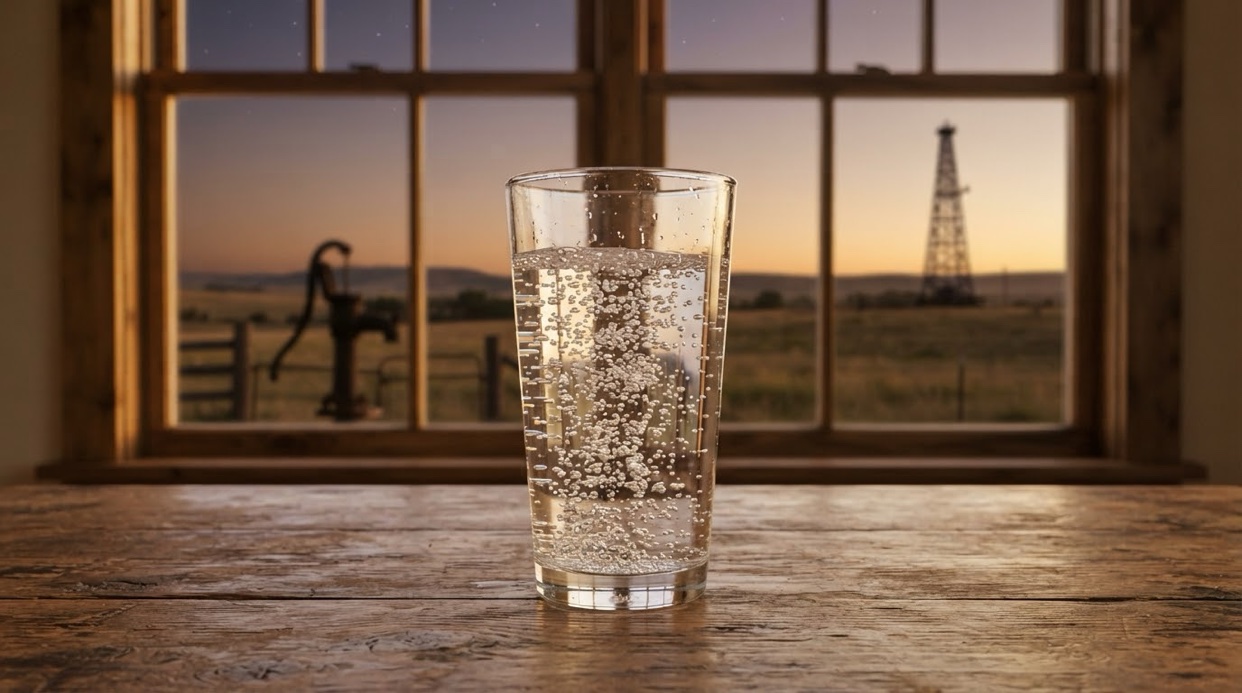
When homeowners bring me a laboratory water report and point to the bottom of the list, they often expect to see heavy metals, industrial solvents, or agricultural runoff. Instead, every once in a while, they see names that sound like they belong on a fuel tank, a plastics line, or a duster can: butane, isobutane, propene, 2-methyl-1-propene, and 1,1-difluoroethane. After a lifetime in professional water treatment, I can tell you that seeing gases print out on a water test surprises a lot of folks—and once you grasp one basic physical rule about how gases behave in water, half the mystery disappears.
The Family
Almost every other chemical we talk about in this series is a liquid or a solid that dissolves into water and stays put until you treat it out. These five are different: they are gases.
On one side, you have fuel gases. Butane and isobutane are components of natural gas and of liquefied petroleum gas. Next to them sit two industrial feedstock gases: propene and 2-methyl-1-propene, which is also called isobutylene. Those are the kinds of building blocks plastics are made from. Rounding out the five is 1,1-difluoroethane, a manufactured refrigerant gas.
Here is the key physical fact you need to keep in mind. A gas can dissolve in water under pressure underground, much the way carbonation stays dissolved inside a sealed bottle of soda. The moment that water reaches your tap and the pressure lets go, the gas wants out. That single fact explains almost everything about how to read these five names on a water report—why they behave differently from liquids and solids, and why their behavior at the tap matters when you look at test results.
The Five Names
When these five show up on a laboratory sheet, each one comes from a very distinct corner of everyday fuel, manufacturing, or consumer chemistry:
- Butane: A four-carbon fuel gas. It is a normal component of natural gas—making up roughly one percent of a typical natural gas stream—and it is also a component of LPG, the bottled gas you find in a camping stove or a lighter.
- Isobutane: Butane’s isomer—the exact same four carbons, just arranged in a branched chain instead of a straight one. Like butane, it is a fuel gas found in natural gas and liquefied petroleum gas.
- Propene: One of the highest-volume chemicals in the world because it serves as the basic starting point for making polypropylene plastic.
- 2-Methyl-1-propene (isobutylene): An industrial feedstock gas used in making butyl rubber and fuel additives. It is also the standard gas laboratories use to calibrate volatile organic compound (VOC) detectors because it is cheap, readily available, and has low toxicity.
- 1,1-Difluoroethane (HFC-152a): Also known as R-152a or Freon 152a, this is a manufactured refrigerant gas and the propellant inside cans of “canned air” keyboard duster as well as many household aerosol products. Unlike hydrocarbons that barely mix with water, it is moderately soluble at about 17.8 grams per liter, which is part of why it can print on a laboratory water test at all.
Why a Gas Is in a Well at All
A homeowner’s first question is always how a gas gets into drinking water in the first place. Underground, leaking and abandoned oil and gas wells can allow natural gas to migrate upward into shallow drinking-water aquifers—a phenomenon water specialists call stray gas. Stray gas is not just methane; it also includes heavier hydrocarbon gases like propane and butane. To give you a sense of scale, in Pennsylvania alone, 133 confirmed cases of gas migration into water wells were attributed to abandoned wells between 1987 and 2013.
Because of that, seeing a light gas on a private well report gives you two practical takeaways. First, it is a diagnostic signal that gas is migrating underground near your well. Second, it is a lesson in laboratory sampling: because these gases escape from an opened sample bottle so fast once pressure is released, detecting them depends heavily on the water sample being sealed tightly at the tap and analyzed promptly by the lab.
The Numbers
If you check the regulatory column beside these five names, you will find zero legal limits. Not one of the five has a federal drinking-water limit—no Maximum Contaminant Level (MCL), no Maximum Contaminant Level Goal (MCLG), and no federal health advisory—and 1,1-difluoroethane is explicitly listed as not regulated under the Safe Drinking Water Act.
The closest thing to a formal government health review in this group is not for drinking water at all. When the EPA reassessed 1,1-difluoroethane as a pesticide propellant in 2005, it concluded there was a reasonable certainty of no harm from the inhalation exposures people actually get from consumer products. No equivalent drinking-water health assessment exists for any of the five gases.
Health Framing
Because no drinking-water health assessment exists for any of these five gases, you have to put their hazards in the proper context. Their documented dangers live in the air, not in the water glass—flammability above all for the hydrocarbon gases. When one of these gases shows up at trace levels in a water sample, that finding is diagnostic information about what is happening in your well and surrounding geology, not a measured drinking-water health risk.
What Removes Them
You do not need an expensive cartridge filter to strip light gases out of tap water. In fact, they largely remove themselves the moment they get the chance. Aeration or a vented storage tank lets dissolved gases off-gas naturally into the air, which is the standard treatment answer for dissolved gases in residential water. Standard carbon filtration is not the tool for this job.
The Bottom Line
Here is my verdict: these are five gases that were never meant to be in a glass of water and do not stay there long once pressure lets go. When one prints on your laboratory report, do not go shopping for a water filter—start asking where the gas is coming from.
Facts first, then filter. — Steve
Leave a Reply