
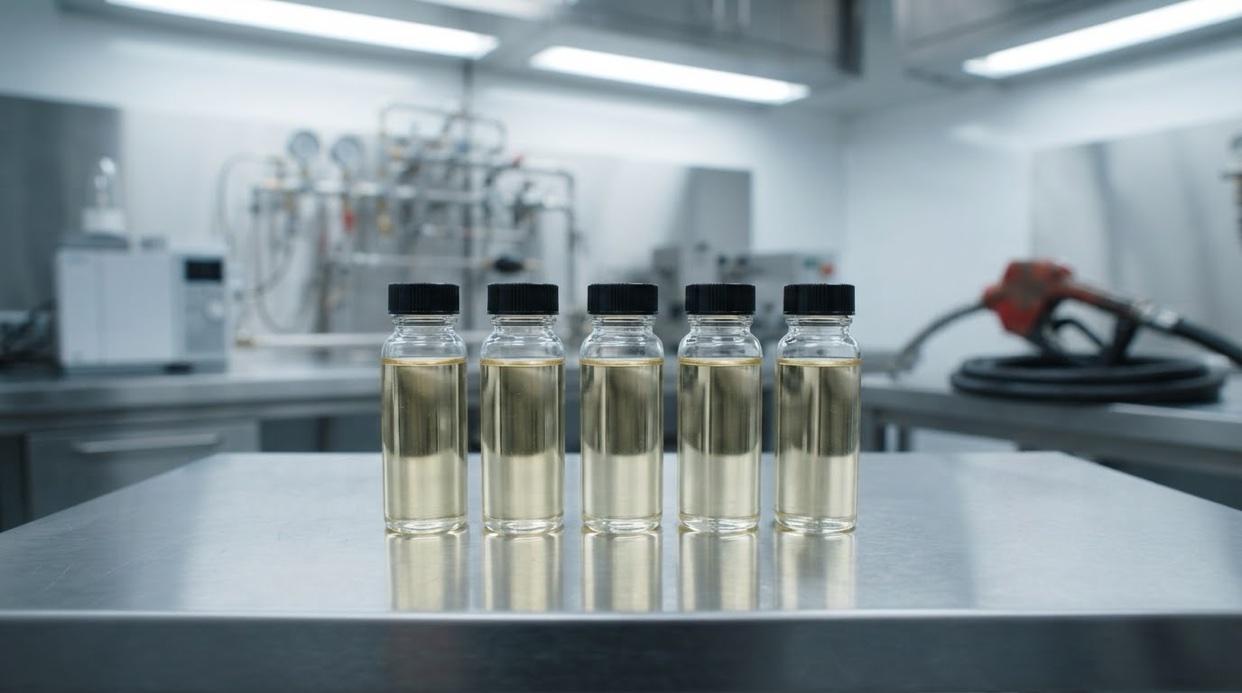
When homeowners spread a full-spectrum laboratory water test across the kitchen table, their eyes usually lock onto the famous fuel chemicals near the top of the volatile organics section—names like benzene or toluene. Keep reading down into the obscure tail of that same scan, however, and you will run into a crowd of eleven lighter, less familiar hydrocarbons: pentane, pentanes, 2-methylbutane, 2-methylpentane, 2,3-dimethylbutane, 3-methylhexane, hexane(s), n-hexane, cyclohexane, methylcyclopentane, and methylcyclohexane. Most homeowners assume they are looking at eleven separate toxic emergencies. After a lifetime in professional water treatment, I can tell you what you are really looking at: the basic carbon skeleton of gasoline, where ten of the names are mostly chemical footnotes and one straight-chain molecule carries a genuine industrial record.
The Family
Gasoline is not a single chemical; it is a complex blend of hundreds of hydrocarbons, and its lightest liquid members are built on five-carbon and six-carbon skeletons. The pentanes make up the five-carbon set, while the hexanes form the six-carbon set. Most of the molecules in these sets are branched, meaning the carbon chain forks off to the side rather than running in a straight line. Meanwhile, two branches of the family curl around and connect into closed rings instead: the cyclo- compounds.
Every single one of these eleven compounds is volatile and barely dissolves in water. When a certified laboratory runs a full volatile scan on water sampled near a fuel source—such as a leaking underground storage tank, a surface spill, or a refinery fence line—these eleven names are what come back on the printout as gasoline’s chemical fingerprint.
The Names, in Three Groups
Rather than reading eleven lines one by one as if they were unrelated threats, it helps to sort them into the three structural groups they actually belong to:
- The pentanes: Pentane is the straight, unbranched five-carbon chain. Its branched twin is 2-methylbutane, which goes by the name isopentane in the fuel world. You will also see “pentanes,” plural, on a report—that is the laboratory’s mixed entry, where the scan reports the pentane isomers together as a group rather than breaking them out one at a time. Because of how lab scans report data, a water report can honestly carry both the singular and plural lines on the same sheet.
- The hexanes: Here, n-hexane is the straight six-carbon chain—the “n” stands for “normal,” meaning the unbranched molecule. Right alongside it sit its branched cousins: 2-methylpentane, 2,3-dimethylbutane, and 3-methylhexane. Just like with the five-carbon set, “hexane(s)” is the lab’s mixed-isomer entry grouping those isomers together.
- The rings: Cyclohexane is a six-carbon ring, methylcyclopentane is a five-carbon ring with a methyl group attached, and methylcyclohexane is a six-carbon ring with a methyl group attached. They belong to the exact same light gasoline family, just folded into circles instead of open chains.
The One With a Record—n-Hexane, and Why the Shape Matters
Of all eleven names on this list, exactly one has a serious health file, and it is the straight chain: n-hexane. Workers who were exposed to n-hexane vapor over long periods—in industries involving glues, solvents, and extraction work—developed peripheral neuropathy, which is nerve damage in the hands and feet. Scientists know the exact mechanism behind it: inside the body, n-hexane is converted into a compound called 2,5-hexanedione, and that specific metabolite is what injures the nerves.
Here is the crucial teaching point, stated just as the industrial-hygiene literature states it: the neurotoxicity of n-hexane is not possessed by the other hexane isomers. Its branched twins do not break down into that same metabolite, so they do not carry the same toxicological record. They are built from the exact same atoms, yet their branched shape leads to a completely different biological verdict.
Even for n-hexane itself, the regulatory science highlights the difference between breathing vapors and drinking water. The EPA’s IRIS program set an inhalation reference concentration for n-hexane of 0.2 milligrams per cubic meter of air, based on slowed nerve conduction observed in exposed workers. However, the agency could not set an oral reference dose at all, because no suitable drinking-water-route studies exist. On top of that, n-hexane is practically insoluble in water, dissolving at only about 9.5 milligrams per liter.
The Numbers
If you look across the regulatory columns for these eleven chemicals, federal numbers are completely absent. Not one of the eleven has a federal drinking-water limit—no Maximum Contaminant Level (MCL) and no Maximum Contaminant Level Goal (MCLG)—and the Environmental Working Group has published no health guideline for any of them either.
One state number does exist in this entire set, and it belongs to n-hexane. Right here in New Jersey, the state sets an enforceable drinking-water standard of 30 micrograms per liter—which is 30 parts per billion—for n-hexane. For homeowners in the Garden State, that makes n-hexane the one line among these eleven that carries actual legal weight on a water test.
Nationally, detections of these compounds are rare, single-state finds, and the map reveals a clear regional pattern. The recurring detections show up in Texas water systems in the Houston area, where the same cluster—2-methylbutane, cyclohexane, methylcyclohexane, methylcyclopentane, and pentane—prints together on utility reports like a shared fingerprint. Methylcyclohexane, the most frequently detected chemical of the eleven, was found in 11 systems, all of them in Texas, averaging about 9.3 parts per billion with a highest measured level of about 80 parts per billion.
Health Framing
When reading these results, you have to keep a bright line between industrial air and residential tap water. n-Hexane’s nerve record is an occupational vapor story rooted in industrial air concentrations, not a scientific finding about parts per billion in drinking water, and no federal drinking-water health assessment exists for any of the eleven compounds. The other ten chemicals have thin toxicological files—they are volatile gasoline components that act as irritants at industrial strength, while remaining unstudied at trace tap-water levels.
What Removes Them
If a fuel spill or nearby tank leak ever pushes these light hydrocarbons into a private well, they are remarkably straightforward to remove. Being both volatile and barely soluble in water is the exact physical profile that aeration was built for—air stripping moves these compounds out of water readily. Granular activated carbon also adsorbs them effectively, capturing the heavier ring compounds most readily of all. Keep in mind that because none of these eleven compounds has a federal drinking-water limit, no federal best-available-technology listing exists for them and there are no official per-chemical removal guarantees.
The Bottom Line
After decades of reading laboratory printouts, my verdict on this group is straightforward: you are looking at eleven pieces of gasoline’s carbon skeleton that a modern lab scan reads like a fingerprint. Ten of them are regulatory footnotes, while one straight chain—n-hexane—carries a real industrial record and the only enforceable state number on the page, right in New Jersey of all places.
Facts first, then filter. — Steve
Leave a Reply