
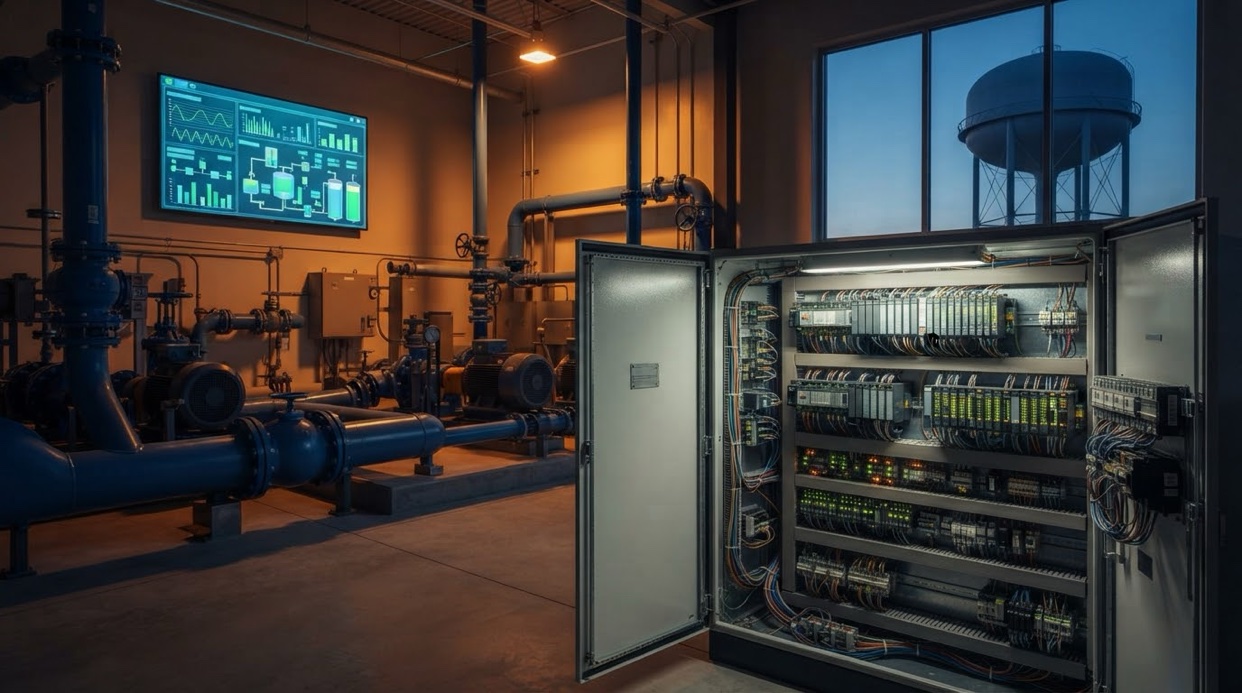
If you have seen recent headlines about hackers targeting municipal water plants across the United States, it is completely understandable to wonder whether the water coming out of your kitchen sink is safe. In water treatment, our first rule is to look clearly at what is actually happening before jumping to conclusions. Separating the real technical facts from the alarmist noise shows that while utilities are facing a serious cybersecurity problem, your home water supply has not been poisoned, and there are practical, level-headed steps you can take to stay prepared.
What happened
Federal authorities have spent the second half of 2026 tracking and responding to a sustained series of cyber intrusions against local drinking water and wastewater facilities. The timeline of events helps put the current news into perspective:
- July 2026 Warning: On July 30, 2026, the FBI and the Environmental Protection Agency (EPA) issued Public Service Announcement I-073026-PSA. The agencies warned that malicious cyber actors were actively targeting internet-facing industrial equipment in the water and wastewater sector. Since July 27, 2026, utilities across at least seven states had reported incidents to the FBI, with some of that activity directly degrading water operations.
- September 2026 Escalation: By September 2026, the EPA issued a broader warning noting that cyberattacks against public water systems were on the rise, ranging from standard ransomware demands to more sophisticated system intrusions.
- November 2026 Fresh Wave: In November 2026, the FBI and EPA began investigating a fresh wave of attacks hitting municipal water systems across several states. Federal authorities described this campaign as one of the most significant cyber operations aimed at U.S. water systems in recent years.
During these incidents, attackers did not need to break through a fenced perimeter or sneak inside a treatment building. Instead, they remotely accessed equipment over the internet and tampered with device configurations. Specifically, the hackers altered IP addresses and turned on and set new passwords on the equipment. By locking operators out and changing network settings, the intruders caused a loss of view—meaning plant operators could no longer see what their machinery was doing—and, in some cases, a loss of function of the connected equipment.
The geographic spread of the November 2026 wave shows how widely smaller and regional utilities were tested. Minnesota reported that more than 30 of its water systems were targeted. In Braham, Minnesota, a community of about 1,700 people, attackers went so far as to shut down the operating controls for both the municipal well and the water treatment plant. Michigan reported attacks on nine of its water systems, and Georgia was also identified by officials as an affected state.
What is a PLC?
To understand how an outsider sitting at a keyboard can interfere with a physical water facility, you have to understand a piece of hardware called a programmable logic controller, or PLC.
In plain English, a PLC is a rugged, specialized small industrial computer that acts as the automated nervous system of a water plant. Modern water treatment does not rely on workers manually turning giant iron wheels all day. Instead, PLCs continuously monitor sensors and automatically run a plant’s pumps, open and close valves, and regulate chemical dosing so that water moves through treatment stages at the right speed and receives the exact treatment required.
The soft spot highlighted by the FBI and EPA is remarkably straightforward: some utilities leave these controllers connected directly to the public internet so technicians can check on them remotely without driving to a distant well house or pump station. When a PLC is exposed directly to the open internet without strong protective barriers, anyone scanning the web with the right tools can find it, knock on its digital door, and attempt to log in or alter its settings.
In their July 30, 2026 advisory, the FBI and EPA specifically noted that attackers were targeting internet-facing Rockwell Automation / Allen-Bradley MicroLogix 1100 and 1400 series controllers. Because these specific models are widely used across the water and wastewater industry to automate basic pumping and treatment tasks, leaving them exposed online gave attackers a direct pathway into plant operations.
How a hack becomes a water problem
When hackers change the IP address or lock the password on a PLC, they are not rewriting the chemistry of the water itself, nor are they magically creating contaminants out of thin air. Rather, they are blinding the operators and disrupting the mechanical equipment that keeps water moving properly.
When operators suffer a loss of view and control, they cannot verify tank levels, pump speeds, or valve positions from their control screens, and they cannot send remote commands to adjust them. In the incidents reported to the FBI, that mechanical disruption led to two primary operational problems: flooding and loss of pressure. Flooding occurs when pumps keep running or valves fail to close as tanks fill up, spilling water inside a facility or out of storage structures.
From a drinking water standpoint, however, loss of pressure is the issue water professionals watch most closely. A municipal water distribution system relies on positive outward water pressure inside the underground pipes to keep clean, treated water flowing toward your home. As the FBI noted in its warning, if a cyberattack shuts down pumps and causes water pressure in the pipes to drop, that protective outward force disappears. Without adequate pressure, untreated groundwater from the surrounding soil can seep into the pipes through tiny cracks, joints, or seals. That is why a mechanical disruption at a pump station can quickly become a water-quality concern if pressure is not restored and verified.
What’s known and what isn’t
When news breaks about critical infrastructure being targeted, rumors tend to travel faster than verified facts. Keeping a clear boundary between what authorities have confirmed and what remains unknown is essential.
First and most importantly: no drinking water contamination has been reported in connection with this wave of attacks. State and local officials moved quickly to verify water safety as incidents were discovered. Michigan officials confirmed that all nine impacted water systems in their state continued to operate safely with no known public health concern. Similarly, Minnesota officials reported that despite more than 30 systems being targeted—and controls being shut down in Braham—there were no active requests for residents to change their drinking water usage.
Second, the FBI has not publicly named a specific culprit behind this current wave of intrusions. Attribution in cyber investigations takes time, and federal authorities have not identified the individuals, criminal groups, or state actors responsible for the July and November 2026 incidents.
It is worth noting a separate development solely for background context: CISA, the FBI, the EPA, and other U.S. partners updated a joint advisory regarding Iran-affiliated cyber actors targeting programmable logic controllers across U.S. critical infrastructure, including water and wastewater systems (an advisory originally published in April 2026). That joint advisory is a separate matter involving known threat activity against similar industrial hardware, and federal authorities have not linked it to the unattributed November 2026 campaign. Keeping those two facts distinct prevents unnecessary guesswork.
What utilities are being told to do
Because the vulnerability stems from how industrial controllers are connected to networks, the fixes recommended by federal agencies focus on basic, proven digital hygiene rather than exotic technology. In their joint guidance, the FBI and EPA are instructing water and wastewater utilities to take concrete steps:
- Remove PLCs from direct internet exposure: Utilities are being told to take controllers off the public internet immediately and place them behind secure gateways and firewalls so outside traffic cannot reach them directly.
- Set strong, unique passwords: Operators must ensure password protections are enabled on controllers and use strong, unique credentials rather than weak or default logins.
- Use access control lists (ACLs): Utilities should configure network rules so that only pre-authorized devices are permitted to communicate with the controllers, blocking unauthorized computers from sending commands or changing settings.
- Monitor control systems closely: Utilities should watch their industrial control systems for unusual activity, so an intrusion is spotted early instead of after equipment has already been tampered with.
- Apply security updates promptly: Operators should install security updates as they become available, rather than leaving known weaknesses sitting unpatched on internet-facing equipment.
What it means at your tap
For an ordinary homeowner, the core takeaway from all of this is reassuring: your local water treatment plant is the primary barrier protecting your tap, and even under a widespread wave of cyber probes and control disruptions, that barrier held. Utilities have manual overrides, backup procedures, and water-quality monitoring protocols designed specifically to keep unsafe water out of the distribution system when automated equipment goes offline.
That said, being a prepared homeowner does not require panic—it simply means treating a cyber-induced water disruption the same way you would treat a major winter storm, a power outage, or a broken water main down the street. Here is what you can sensibly do:
- Know your water system’s name and sign up for its alerts: Find out the exact name of the municipal utility or water district that supplies your home, and register for its text, email, or phone alert system so you hear directly from the source if pressure ever drops.
- Keep some stored water on hand: Maintaining a modest supply of clean bottled or stored drinking water in your home ensures your household is covered if a local system ever loses pressure or experiences a temporary mechanical shutdown.
- Follow local notices first during any incident: If your utility ever issues a boil-water advisory or usage notice, follow those official local instructions immediately until testing confirms the system is back to normal.
Finally, be clear-eyed about what home water filtration can and cannot do. A point-of-use or whole-house filter is designed to treat specific contaminants that are physically present in your water—such as sediment, chlorine taste, or regulated impurities—under normal operating conditions. A home filter is not protection against a cyberattack, and you should never trust anyone claiming a filter will “cyber-proof” your plumbing. If a distribution system loses pressure and local officials issue a boil-water notice because untreated groundwater may have entered the pipes, a standard household filter will not make that water safe to drink on its own; you must follow your utility’s official emergency instructions first.
Facts first, then filter. — Steve
Leave a Reply