
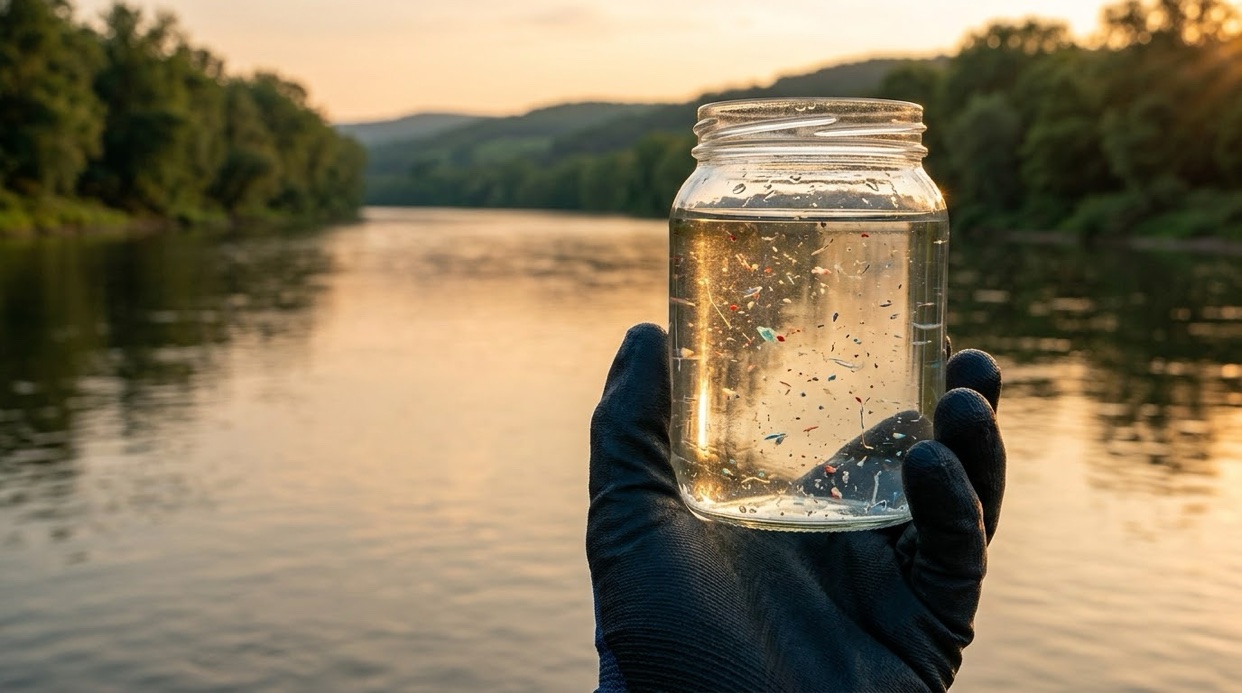
If you live anywhere near the Delaware River Basin, you have likely seen headlines reporting that researchers found microplastics in every single waterway they tested. For an ordinary homeowner, news like that naturally raises a straightforward question: if plastic particles are showing up throughout the river system, what does that mean for the water coming out of your kitchen faucet? Looking closely at what the researchers actually measured, how municipal water rules currently work, and the basic physics of home filtration gives you a clear, grounded answer without the alarmism.
What the study found
In September 2026, researchers with the PennEnvironment Research & Policy Center and the Environment New Jersey Research & Policy Center conducted a field sampling study of rivers and streams across the Delaware River Watershed. Their findings were published in a formal report in November 2026.
The Delaware River Watershed spans across five states: New York, New Jersey, Pennsylvania, Delaware, and a small portion of Maryland. To get a broad picture of plastic presence throughout the basin, the research team sampled 22 separate waterway locations.
The headline result was unambiguous: microplastics were found in 100% of the 22 locations sampled. Not a single tested site came back completely clear.
Rather than treating plastic as one generic category, the researchers tested water samples for four distinct physical types of microplastic. Here is how often each category appeared across the 22 sites:
- Microfibers: Found at 100% of the sampled waterways.
- Microfragments: Found at 82% of the sampled sites.
- Microfilm: Found at 77% of the sampled sites.
- Microbeads: Found at 27% of the sampled sites.
Where it comes from
When most people picture plastic pollution in a river, they imagine floating bottles, tangled six-pack rings, or trash piled along a riverbank. One of the most telling observations from the September 2026 sampling is that most of the tested waterways had little to no visible litter at the point where researchers accessed the water.
That detail matters because it shows this is largely an invisible pollution problem driven by everyday wear and tear rather than obvious roadside dumping. Each of the four microplastic categories detected in the Delaware River Watershed points back to specific, familiar sources in daily life:
- Fibers: These tiny synthetic threads come primarily from clothing and household textiles. Every time synthetic fabrics are worn or washed, microscopic fibers shed into laundry wastewater and enter the broader water cycle. Because fibers turned up at 100% of the tested sites, they represent the most widespread form of microplastic in the watershed.
- Fragments: Found at 82% of locations, these irregular pieces come primarily from harder plastic items breaking down or from raw plastic feedstock used in manufacturing.
- Film: Detected at 77% of sites, microfilm consists of thin, flexible slivers that originate primarily from plastic bags and flexible plastic packaging.
- Beads: Turning up at 27% of sites, these tiny spherical particles come primarily from facial scrubs and other personal care or cosmetic products.
Because these particles are already microscopic when they enter the water—or shed gradually from larger items—a stream can look clean and free of trash to the naked eye while still carrying all four types of plastic particles.
Why a river study is a drinking-water story
An environmental survey of streams and rivers becomes a practical household topic the moment you look at where municipal tap water comes from. The Delaware River Watershed supplies drinking water to more than 14 million people. When rivers and tributaries serve as the source water for millions of homes, whatever enters those waterways eventually arrives at the intake pipes of local water utilities.
In water treatment, two facts make microplastics particularly important to understand:
First, microplastics do not biodegrade. Unlike organic matter—such as leaves, wood, or natural soil sediments—that breaks down naturally over time through biological activity, plastic persists in the environment. Instead of disappearing, plastic items simply fracture into smaller and smaller pieces, moving from visible debris down into the micrometer and nanometer range.
Second, there is currently no federal EPA drinking-water standard for microplastics. Under federal Safe Drinking Water rules, regulated contaminants have a legally enforceable Maximum Contaminant Level, or MCL, that public water systems must test for and meet. Because no federal MCL exists for microplastics, public water utilities are not required by a national standard to monitor for them or meet a specific numerical limit before sending water into distribution mains.
What actually removes it
If you decide to filter your own drinking water at home, you do not need marketing buzzwords—you need to match the physical size of the particle against the physical pore size of the filter. Filtration is fundamentally a mechanical sorting process: a filter captures particles that are larger than its pore openings.
To evaluate any filter honestly, start with the size range of what you are trying to catch. By definition, microplastics are plastic particles smaller than 5 millimeters across. However, as plastic breaks down, those pieces get dramatically smaller—measuring in micrometers (microns) and even down into the nanometer range, well below 1 micron. (For reference, a single micron is one-thousandth of a millimeter.)
Because microplastics span from visible specks right down to sub-micron fragments, the micron rating on a filter is the single most important specification to check. When reading a filter’s spec sheet, you will encounter two very different types of ratings:
- Nominal Micron Rating: A nominal rating represents an average efficiency. A filter with a nominal rating will trap a portion of particles at that stated size, while still allowing some particles of that size—and even larger—to pass right through into your glass.
- Absolute Micron Rating: An absolute rating is a strict performance standard. It means the filter is verified to capture at least 99.9% of particles at the stated micron size.
Here is the honest limitation every homeowner needs to keep in mind: a filter only captures particles larger than its pore rating. A standard sediment cartridge rated at 5 microns or 1 micron will catch larger microfibers and plastic fragments, which is a helpful first step, but the finest sub-micron fraction of plastic particles will slip straight through those pores. Capturing the smallest fraction requires the tightest physical barrier.
Two proven residential treatment technologies reach far below the 1-micron threshold:
- Reverse Osmosis (RO): A reverse osmosis system uses household water pressure to push water through a semi-permeable membrane. Standard RO membranes reject particles down to approximately 0.0001 micron—a pore size orders of magnitude smaller than the tiniest microplastic or nanometer-scale fragment.
- Distillation: A water distiller works through phase change rather than a physical screen. By boiling water into steam and then condensing that steam back into liquid water in a clean chamber, distillation leaves solid particles—including microplastics of any size—behind in the boiling tank.
What’s being asked, and what a household can do
Because plastic enters rivers from thousands of upstream sources, the November 2026 report emphasizes that lasting progress requires stopping plastic pollution before it reaches the water. As the study’s author, Faran Savitz, noted in a news report on the findings, solving the problem calls for cutting back on plastic as a whole.
To achieve that, the report outlines five specific policy recommendations aimed largely at the source:
- Producer-responsibility laws that place legal responsibility on the producers of plastic packaging.
- Bottle deposit laws to recover beverage containers before they break down in the environment.
- Zero-discharge limits for plastic pellets so raw plastic feedstock is not lost during manufacturing and transport.
- Further restrictions on single-use plastics to reduce unnecessary plastic waste entering the watershed.
- Strict drinking-water filtration standards to establish clear, enforceable rules for water treatment.
Those policy changes take time to debate, pass, and implement across five states. In the meantime, you cannot filter an entire river from your kitchen sink, nor can a homeowner rewrite federal water rules—but you can put a properly rated barrier on your own drinking-water tap.
If you want to reduce microplastics in the water your family drinks and cooks with, skip vague packaging claims that simply say “reduces plastics” without numbers to back them up. Look directly at the technical specifications: check whether the filter carries an absolute micron rating rather than a loose nominal average, or choose a point-of-use reverse osmosis system or distiller that physically blocks particles well below the 1-micron mark. Knowing the exact barrier rating before you buy ensures you get real performance rather than peace-of-mind marketing.
Facts first, then filter. — Steve
Leave a Reply