
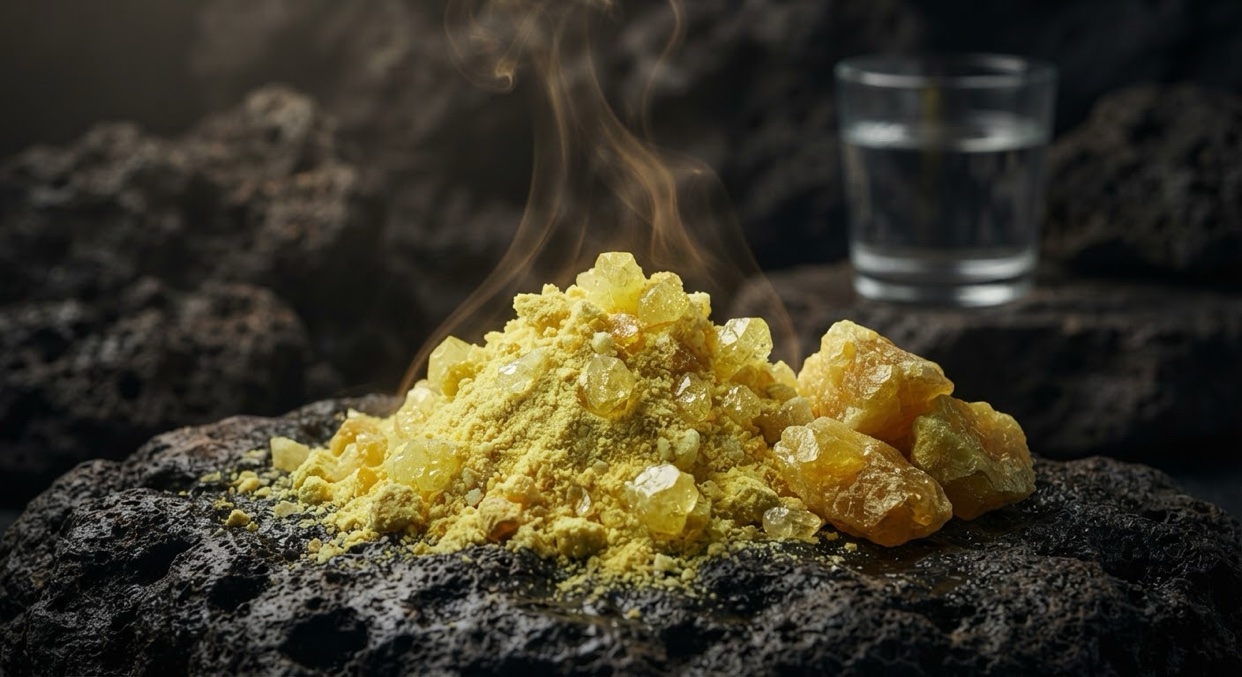
Sulfur is element number 16, a bright yellow element humans have known since ancient times — the “brimstone” of old texts. In drinking water, sulfur almost never appears as itself: it travels as sulfate, a dissolved mineral in nearly every water supply on Earth, and occasionally as hydrogen sulfide, the rotten-egg gas that has its own article.
Sulfur’s drinking-water story is mostly about sulfate — a mineral with no federal health limit, one secondary guideline, and a very old reputation.
1. What sulfur is and where it comes from
Sulfur is a non-metal element, symbol S, abundant in the Earth’s crust and essential to life. It sits inside two of the amino acids your body builds proteins from — methionine and cysteine — which makes it part of your hair, skin, and nails (the protein keratin is rich in sulfur bonds, which is why burning hair smells the way it does). Because those two amino acids are foundational building blocks of proteins across your body, sulfur is woven directly into everyday human biology.
In nature, you do not have to dig deep into a laboratory to see where sulfur comes from. In nature sulfur appears as yellow crystals around volcanoes and hot springs, and locked inside minerals like gypsum and pyrite. Those natural deposits and mineral formations give sulfur both a dramatic visual presence in geology and a steady path into the broader environment.
Brimstone
Sulfur is one of the few elements known since antiquity, with no discoverer — ancient peoples mined it around volcanoes and used it as a fumigant and medicine. Long before modern chemistry existed, people already recognized its distinctive yellow rock and put it to practical use in treating spaces and remedies.
Under its old name “brimstone” (the burning stone) it runs through centuries of religious and literary texts, usually paired with fire. That pairing stuck because sulfur burns readily and leaves a sharp impression whenever heat meets it.
Its practical history is just as fiery: sulfur is one of the three ingredients of gunpowder, alongside charcoal and saltpeter, and it went into early matches. For centuries, workers and craftspeople used it in these roles without understanding its exact place on the periodic table. In 1777 Antoine Lavoisier recognized sulfur as a true element rather than a compound, settling its chemical status after ages of practical use.
2. How it gets into drinking water
Sulfur reaches drinking water mainly as sulfate. Rainwater and groundwater dissolve sulfate out of gypsum and other sulfate minerals, out of soil, and out of oxidizing pyrite in rock and coal seams — which is why nearly every natural water carries some sulfate, from a few mg/L to several hundred. As water moves underground or across rock layers, it picks up those dissolved minerals along the way.
Volcanic regions and hot springs carry more. Where volcanic activity or mineral-rich springs are present, water can encounter higher concentrations than in areas with sparse sulfate deposits.
A second route is biological: in oxygen-starved corners of wells and plumbing, sulfate-reducing bacteria convert sulfate into hydrogen sulfide gas, and sulfur-oxidizing bacteria can turn that gas back into slimy elemental sulfur deposits. That biological loop means water chemistry inside a well or pipe system can shift even after the water leaves the surrounding rock.
The smell isn’t the element
Here is the surprise most people get wrong: pure sulfur is nearly odorless. When people say their tap smells like “sulfur,” they are blaming the wrong thing for the odor.
The infamous rotten-egg smell blamed on “sulfur water” belongs to hydrogen sulfide, a sulfur compound — your nose can detect it at remarkably tiny concentrations, which is why it announces itself so loudly. Even a faint trace is easy to notice right away.
The yellow element itself, and the sulfate in your glass, have no rotten-egg smell at all. Keeping the names straight matters, because the treatments differ: sulfate is a dissolved mineral you filter, while hydrogen sulfide is a gas you oxidize or aerate away. Mixing up the compound and the mineral can send you toward the wrong equipment entirely.
3. What it does in the home
Sulfate’s home story is mild. For most households, dissolved sulfate does not cause dramatic plumbing emergencies or heavy mineral crust on its own.
At high levels it can add a slightly bitter, medicinal taste to water. It contributes modestly to the mineral content that leaves scale, though calcium and magnesium do most of that work. So while sulfate can play a supporting role in taste and mineral buildup, it is rarely the main driver of hard-water scale.
The biological side causes more complaints than the mineral does: sulfur bacteria form stringy, slimy growths in toilet tanks and well systems, and sulfate-reducing bacteria in a water heater’s oxygen-starved corners are a classic source of rotten-egg hot water. Elemental sulfur particles from oxidizing bacteria can also show up as fine yellowish sediment that clogs filters. In many homes, those slimy growths, hot-water odors, and yellowish particles are the real day-to-day nuisance.
The king of chemicals
Sulfur’s biggest industrial product is sulfuric acid — historically the largest-volume industrial chemical in the world, used in fertilizer production, ore processing, and manufacturing of almost everything; economists once used a nation’s sulfuric acid production as a rough gauge of its industrial strength. That sheer scale reflects how deeply sulfuric acid runs through modern industry.
Sulfur’s second famous job is in rubber: heating rubber with sulfur — vulcanization, patented by Charles Goodyear in the 1840s — turns sticky raw rubber into the durable material of tires. That transformation turned a sticky, temperamental material into something tough enough for heavy daily wear.
How that sulfur is obtained has also evolved over time. Most sulfur today comes as a byproduct of oil and gas refining; historically it was mined from underground salt domes by the Frasch process, pumping superheated water down to melt the sulfur and air to lift it out. Both methods show how central sulfur supply has been to industrial production.
4. What it can do to a person’s health: the honest picture
Sulfur is essential — your body carries it in amino acids, in insulin, and in every strand of hair. There is no sulfur poisoning story at drinking-water levels. Because your body already uses sulfur in core biological structures and compounds, ordinary water levels are not a poisoning hazard.
Sulfate’s one real effect is digestive: at high concentrations — several hundred mg/L and up — sulfate acts as an osmotic laxative, and people unaccustomed to high-sulfate water (visitors, new residents) may get temporary loose stools until they adjust; this is the same chemistry as Epsom salt, which is magnesium sulfate. That adjustment period is a well-known effect when someone first drinks water with elevated sulfate.
Infants are the group to be careful with on high-sulfate water, which is one reason the guideline below exists. Paying attention to higher sulfate levels matters most when feeding infants or when someone is newly exposed to high-sulfate water.
5. The federal picture: a secondary guideline only
Sulfur and sulfate have NO EPA Maximum Contaminant Level (MCL) — no health-based federal limit. Instead of a mandatory health standard, federal guidance focuses on aesthetic and digestive effects.
Sulfate carries a Secondary Maximum Contaminant Level (SMCL) of 250 mg/L, which is a non-enforceable guideline aimed at taste and the laxative effect, not a safety threshold. Because it is a secondary guideline rather than an enforceable limit, it sets a benchmark for water quality management rather than a legal health ceiling.
Above roughly 250 mg/L many people notice the bitter taste; the laxative effect generally takes higher levels, especially for people not used to the water. Taste often shows up around that benchmark, while digestive effects tend to appear at higher concentrations or in people newly encountering the water.
6. How a homeowner can test their water
A certified laboratory measures sulfate precisely, commonly by ion chromatography (EPA Method 300.0), as part of a standard mineral panel — that is the number to trust. When you want a reliable reading of dissolved sulfate, lab analysis is the clear standard.
Home test strips exist for a rough ballpark. They can give a quick initial sense of what might be going on, though they are not a substitute for laboratory precision.
Hydrogen sulfide needs different handling: it escapes from water quickly, so it is tested on the spot with a field kit or smelled at the source — the first draw in the morning, at the well head or the water heater drain, tells you where it is being made. Because the gas leaves the water so fast, checking right at the source gives you far better clues than waiting.
7. How to manage sulfur in drinking water
Managing sulfur means managing sulfate, since that is the form in the glass. Once you know sulfate is what you are addressing, you can match the treatment to how and where you want to use the water.
A reverse osmosis membrane at the kitchen tap removes about 95 to 98 percent of dissolved sulfate — sulfate is a large, doubly-charged ion, and membranes reject it especially well. That makes point-of-use reverse osmosis a strong option for drinking and cooking water.
For whole-house treatment or other approaches, several other options apply:
- Anion exchange (the mirror image of a water softener, swapping sulfate for chloride) works whole-house.
- Distillation also removes sulfate.
- Standard activated carbon does not remove sulfate.
- Sediment pre-filters still matter for the particle side — they catch elemental sulfur sediment and protect membranes — and their micron ratings matter: a nominal rating traps roughly 60 to 85 percent of particles at that rated size, while an absolute rating traps 99.9 percent or more.
Choosing among these options depends on whether you want whole-house coverage, point-of-use removal, or protection against suspended particles.
The claim has to be on the sheet
If a system claims sulfate reduction, apply the seal rule with NSF/ANSI 58: a reverse osmosis system is certified only for the specific claims printed on its Performance Data Sheet. Say the seal, then say what the seal means. Looking past marketing copy to the actual sheet is essential when evaluating a system’s certified claims.
Many RO systems are certified for a standard list of claims that does not include sulfate, even though the membrane physically rejects sulfate very well — the physics and the certificate are two different things. A membrane can be capable of rejecting sulfate physically even when that specific claim is not listed on the certification sheet.
If sulfate is not printed on the Performance Data Sheet, the seal does not cover it. Checking the sheet directly tells you what the certification actually backs.
The bottom line
Sulfur in drinking water travels as sulfate — an essential element’s mineral form, with no federal health limit, a 250 mg/L secondary guideline for taste and digestion, and one honest caution for infants and the unaccustomed at high levels. That sums up what dissolved sulfate means in everyday water.
The rotten-egg villain is a different character, hydrogen sulfide, with its own article and its own fixes. Keeping those two separate avoids confusing mineral chemistry with gas odor issues.
Test for sulfate at a lab, and if you ever remove it, reverse osmosis at the kitchen tap handles it decisively.
Facts first, then filter. — Steve
Leave a Reply