
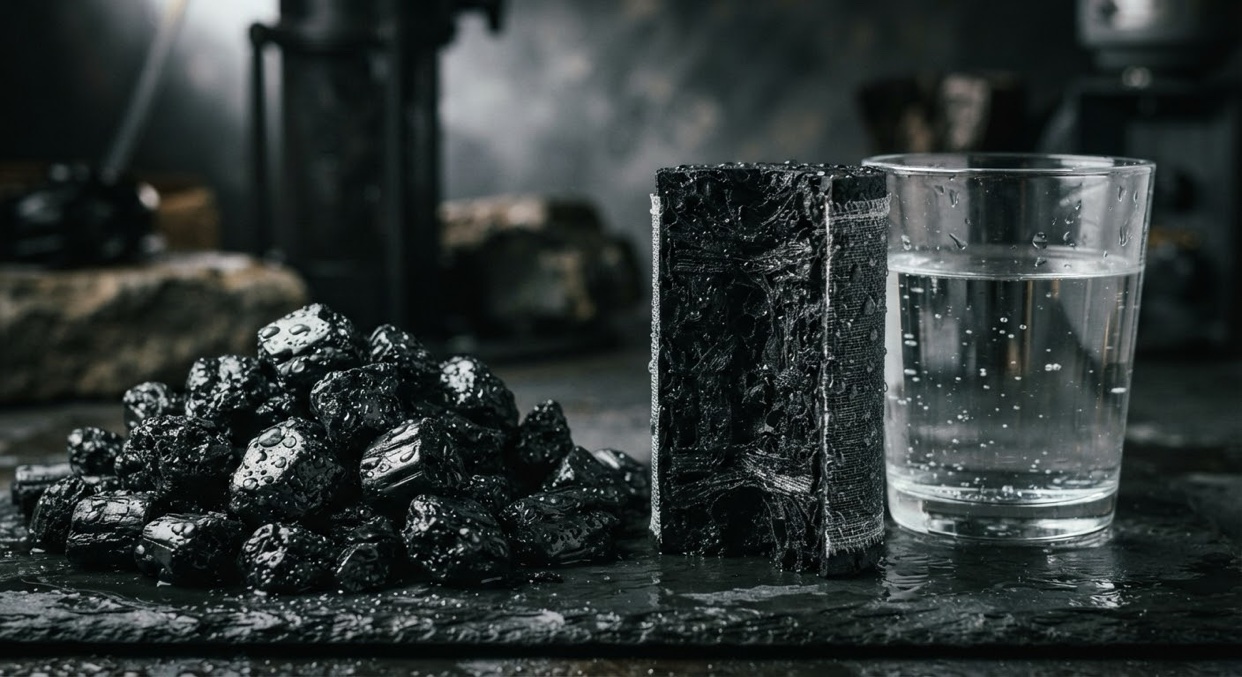
Carbon is element number 6 on the periodic table, and it is the chemical backbone of every living thing on Earth—all life as we know it is carbon-based. Yet when you look at a residential water quality report or shop for home filtration equipment, carbon turns out to be the great exception among the elements.
Nobody tests for or treats for “carbon” by itself, because in drinking water it never travels alone. Instead, carbon arrives bound up inside active chemical compounds, and those compounds quietly run your water’s pH, its corrosiveness toward household plumbing, and its everyday taste and appearance.
Even more uniquely, carbon is not just a passenger in your water—it is also the treatment itself. The black, granular activated carbon inside a pitcher filter, an under-sink cartridge, or a whole-house tank is this exact same element, put to work cleaning the water before it reaches your glass.
1. What carbon is and where it comes from
Carbon is a non-metal element with the chemical symbol C, and it is found almost everywhere you look in the physical world—locked inside lumps of black coal, sparkling inside a cut diamond, pressed into the gray graphite core of a wooden pencil, and woven into the cells of every plant and animal on the planet. Across the cosmos, it ranks as the fourth most abundant element in the entire universe. Closer to home, it is the second most abundant element in the human body by mass, making up about 18 percent of who you are.
In nature, carbon never sits still; it cycles constantly between the atmosphere, the land, living organisms, and the water supply. Green plants pull carbon dioxide gas out of the air to build leaves and stems, animals eat those plants, every living organism breathes and eventually decays, and carbon dioxide dissolves directly into falling rain and flowing surface water. Because of that continuous natural cycle, every river, lake, and groundwater aquifer on Earth carries carbon in one form or another.
Named for charcoal
Long before chemists ever wrote out a periodic table or analyzed a water sample, humans were already burning, drawing with, and heating their homes with carbon. Carbon’s name comes directly from the Latin word “carbo,” which means charcoal and coal. Because human beings have known and used carbon since prehistory in the form of wood charcoal, chimney soot, and mined coal, it stands as one of the few chemical elements with no known discoverer.
In its pure form, carbon is famous for giving us two materials that look and behave like complete opposites:
- Diamond: The hardest natural material known on Earth, crystal clear and rigid enough to cut glass and stone.
- Graphite: A dark, slippery solid so soft that rubbing it across a sheet of paper leaves behind a legible gray mark.
Remarkably, diamond and graphite are made of the exact same carbon atoms—the only difference between a priceless gemstone and a pencil core is how those atoms are arranged and bonded together. That brings up one of the most persistent myths in everyday language: the “lead” in a pencil was never lead at all. A pencil core is actually graphite mixed with clay, and it never contained the toxic metal lead.
2. How it gets into drinking water
Because pure elemental carbon does not dissolve in water, carbon reaches your drinking water in three main dissolved or suspended forms, each with its own origin story and its own effect on your tap:
- Dissolved carbon dioxide: Carbon dioxide gas (CO₂) from the surrounding air and from soil microbes breathing underground dissolves readily into rainwater and groundwater. Once dissolved, a portion of that gas reacts with water to form weak carbonic acid—and this single reaction is the biggest driver of natural water pH and corrosiveness.
- Bicarbonate and carbonate: As slightly acidic, CO₂-rich water percolates underground through limestone and other carbonate rocks, that carbonic acid dissolves the rock and produces bicarbonate and carbonate ions. In water testing, this dissolved bicarbonate is what a laboratory report calls alkalinity—the water’s built-in chemical buffer against sudden pH swings.
- Organic carbon: Leaves falling into streams, decaying soil matter, and aquatic algae all contribute dissolved organic carbon to lakes, rivers, and shallow wells. Laboratories measure this natural load as TOC, or total organic carbon, which is the exact material that gives some surface water a faint yellow tea color and an earthy or swampy taste.
The backbone of every living thing
To understand why organic carbon shows up in so many different forms—from harmless fallen leaves to industrial solvents—you have to look at carbon’s special chemical talent: bonding. A single carbon atom can form four strong chemical bonds at once, allowing carbon atoms to link together into long chains, branched webs, and closed rings of almost unlimited size and variety.
That structural versatility is what makes life possible. Sugars, fats, proteins, and DNA are all built on complex frameworks of bonded carbon atoms. In fact, carbon’s central role in building biological molecules is the entire reason the chemistry of life is called organic chemistry—and why about 18 percent of your own body by mass is carbon.
There is also one famous scientific footnote attached to all that biological carbon that researchers use every single day. A tiny fraction of the natural carbon circulating on Earth is carbon-14, a radioactive isotope with a half-life of about 5,730 years that is continuously created high in the upper atmosphere. While a tree, animal, or cotton plant is alive, it takes in carbon-14 along with ordinary carbon; once it dies, the carbon-14 begins ticking down at a steady, predictable pace. That steady radioactive decay is the natural clock behind radiocarbon dating, allowing archaeologists and scientists to determine the age of ancient wood, bone, and cloth.
3. What it does in the home
When homeowners ask what carbon does inside a house, the answer comes down to water chemistry rather than crusty mineral buildup. Unlike calcium and magnesium, carbon compounds do not coat your showerhead in white scale—instead, they quietly govern whether your water eats away at your pipes or leaves them alone.
Dissolved carbon dioxide makes water slightly acidic. When that acidic water also has low alkalinity—meaning very little dissolved bicarbonate to cushion the acidity—the water becomes corrosive. As low-alkalinity, acidic water sits inside household plumbing, it slowly dissolves copper pipe and lead solder, carrying those toxic metals straight into your drinking glass. That is how a harmless carbon compound becomes a serious metals problem at the kitchen faucet.
Alkalinity acts as the essential counterweight to that acidity. When water carries enough dissolved bicarbonate, it buffers the pH against sharp drops and allows a thin, protective mineral film to form along the interior walls of pipes, keeping pipe metals sealed in place.
Meanwhile, the third form—natural organic carbon—is responsible for most of the aesthetic complaints homeowners notice in surface water supplies, including earthy or swampy tastes, musty odors, and a faint yellow tint. Beyond taste and color, organic carbon creates one major treatment headache for municipal utilities: when chlorine disinfectant meets natural organic carbon in a water plant or distribution main, the two react chemically to form regulated disinfection byproducts. That unwanted reaction is precisely why public water treatment plants work hard to remove as much organic carbon as possible before adding chlorine to disinfect the water.
The element that cleans the water
Here is where carbon flips the script. Carbon is not just something naturally dissolved in the water—it is also the world’s favorite tool for cleaning water.
Activated carbon starts out as ordinary carbon-rich raw material—typically bituminous or lignite coal, coconut shells, or wood. Manufacturers bake that raw material at high temperatures without oxygen and then treat it with steam in a process that hollows out the carbon structure from the inside out. That activation process creates an astonishing network of microscopic pores, cracks, and tunnels; by the time it is finished, a single gram of activated carbon carries on the order of a thousand square meters of internal surface area.
As water flows through a bed of activated carbon, dissolved contaminants stick to that vast internal surface area as the water passes—a physical and chemical process called adsorption, spelled with a “d.” Unlike a kitchen sponge that absorbs liquid by soaking it up into its bulk, an adsorbent surface grabs and holds molecules tightly onto its pore walls while clean water flows right past.
Because of that massive trapping capacity, activated carbon has become the universal standard treatment for removing chlorine taste and odor, many synthetic organic chemicals, and a long list of specific organic compounds. That dual role makes carbon the rare element on the periodic table whose biggest water story is removal, not presence.
4. What it can do to a person’s health: the honest picture
If you see carbon mentioned on a water report or a treatment brochure, you can set aside any worry about elemental toxicity: there is no carbon poisoning story in drinking water. Elemental carbon is completely non-toxic at water levels—after all, your own body is built from it and every bite of food you eat is full of it.
Whenever you hear about health-regulated carbon issues in drinking water, those stories belong to specific synthetic or byproduct carbon compounds, each with its own distinct chemical name and its own risk profile—things like industrial solvents such as benzene, chloroform, and the trihalomethanes formed during chlorination—not to the element carbon itself.
By contrast, the natural carbon forms found in ordinary tap water—dissolved carbon dioxide, bicarbonate alkalinity, and trace natural organic matter—are the exact same everyday chemistry you experience when you drink a glass of sparkling water, and the exact same bicarbonate buffer system your own body uses every second to keep your blood pH steady.
5. The federal picture: no limit for the element
Because carbon itself is harmless and ubiquitous, federal water rules treat it completely differently from regulated metals like lead or arsenic. Carbon has no EPA Maximum Contaminant Level (MCL) and no non-enforceable secondary standard—the element itself is entirely unregulated in U.S. drinking water. Similarly, alkalinity itself carries no federal drinking-water limit either.
What the Environmental Protection Agency does regulate are specific, hazardous carbon-based compounds—such as benzene, carbon tetrachloride, and the regulated disinfection byproducts that form when chlorine reacts with organic matter. In addition, for public water systems that draw from surface water like rivers and lakes, federal disinfection byproduct rules require treatment plants to remove a percentage of total organic carbon (TOC) during treatment, specifically because TOC serves as the raw material from which those regulated byproducts form.
6. How a homeowner can test their water
If you call a water laboratory and ask them to test your tap water for “carbon,” the technician will ask what you are actually trying to solve—because in residential water testing, you do not test for “carbon” as a single number; you test for its working forms:
- Alkalinity: Measured by a simple titration test, either in a laboratory or with an inexpensive home test kit, alkalinity is reported in milligrams per liter (mg/L) as calcium carbonate. This is the key number that tells you whether your water has enough buffering capacity to hold its pH steady and resist pipe corrosion.
- Total Organic Carbon (TOC): If you want a precise measurement of the natural organic load in a well or surface-influenced supply, a certified laboratory can run a dedicated total organic carbon analysis.
- pH: Even pH itself—the simplest, cheapest test in water chemistry—is really a carbon measurement in disguise, since the balance between dissolved carbon dioxide gas and dissolved bicarbonate is what sets the pH of almost all natural water.
7. How to manage carbon in drinking water
Managing carbon in your home comes down to identifying which working form is causing a problem and matching it to the right equipment:
- Raising low alkalinity and pH: For corrosive, low-alkalinity water that threatens copper pipes and lead solder, a whole-house calcite neutralizer is the standard fix. As acidic water flows through a tank filled with crushed limestone, the water slowly dissolves calcium carbonate, lifting both the alkalinity and the pH into a safe, non-corrosive range.
- Filtering organic carbon and tastes: For aesthetic issues caused by organic carbon—such as earthy tastes, swampy odors, yellow color, or disinfection byproduct precursors—activated carbon filtration is the primary tool, installed either as a whole-house backwashing carbon tank or as an under-sink carbon block cartridge.
- Reducing dissolved bicarbonate and organics at the tap: A point-of-use reverse osmosis (RO) system at the kitchen sink also reduces both dissolved bicarbonate alkalinity and organic carbon, delivering clean, low-mineral drinking and cooking water.
- Protecting equipment with sediment pre-filters: Keep in mind that mechanical sediment pre-filters do not touch any dissolved carbon form—gas, bicarbonate, or dissolved organics pass right through them. However, they play an essential supporting role by trapping sand, silt, and rust before that grit can clog carbon beds or foul delicate RO membranes. When choosing a sediment pre-filter, pay close attention to its micron rating: a micron is a measure of pore size, and a nominal rating traps roughly 60 to 85 percent of particles at that stated size, whereas an absolute rating traps 99.9 percent or more.
The claim has to be on the sheet
When you walk down the hardware store aisle to buy an activated carbon filter, you will notice that cartridges carry two different NSF/ANSI certification seals that mean very different things—and confusing them is the oldest mistake in the filter aisle.
- NSF/ANSI 42 certifies purely aesthetic claims, such as reducing chlorine taste, odor, and visible particulate matter.
- NSF/ANSI 53 certifies health-effect claims—proving that a filter reduces specific regulated contaminants like lead, certain volatile organic compounds (VOCs), and PFAS—and it covers only the exact contaminants printed on that product’s Performance Data Sheet.
Whenever you evaluate a filter, apply a simple rule: say the seal, then say what the seal means. A carbon filter certified under NSF/ANSI 42 for chlorine taste and odor says nothing whatsoever about health claims, and an NSF/ANSI 53 seal covers only the specific claims printed on its Performance Data Sheet. If the contaminant you care about is not printed on that sheet, the seal does not cover it—no matter what the front of the box implies.
The bottom line
Carbon in drinking water is the quiet element working behind the scenes of almost everything else in your plumbing—it sets your water’s natural pH, drives pipe corrosion or prevents it, feeds the disinfection byproduct problem at the treatment plant, and then turns right around and cleans your water at the tap as activated carbon. Because of that dual role, you never set out to remove “carbon” itself. Instead, you manage its specific forms—buffering acidity with limestone, trapping organics with activated carbon—and whenever you buy a filter, you read its real capabilities on its Performance Data Sheet, not its box art.
Facts first, then filter. — Steve
Leave a Reply