
What Ethylene Dibromide Is
Ethylene dibromide—commonly abbreviated as EDB and known chemically as 1,2-dibromoethane—is a synthetic, volatile organic compound. In its pure chemical state, it exists as a heavy, colorless liquid with a faint, sweet odor, though it is virtually impossible to detect by smell or taste at the minute trace levels found in contaminated water supplies.
Historically, ethylene dibromide had two widespread commercial and industrial applications. First, it was heavily utilized as a lead scavenger in leaded gasoline formulations. In this role, it was blended into fuel to react with lead combustion byproducts, preventing harmful lead deposits from accumulating inside automotive engine cylinders. Second, EDB was widely deployed across the agricultural sector as a powerful soil fumigant and pesticide. Farmers and agricultural processors injected the chemical into soil to eliminate nematodes, root-damaging worms, and soil-dwelling insects, while also applying it to harvested fruits, grains, and timber to prevent pest infestations during storage and transport.
Because of growing environmental data demonstrating its extreme persistence in soil and severe potential health risks, regulatory bans phased out both major uses. Agricultural soil fumigation and post-harvest applications were largely eliminated by environmental regulators in the mid-1980s, and the broader removal of leaded gasoline from standard automotive use effectively ended its role as a fuel additive. However, despite these bans ending its active production and application decades ago, ethylene dibromide remains a significant legacy contaminant in subterranean water systems.
How It Gets into Drinking Water
Ethylene dibromide makes its way into drinking water sources primarily through two pathways: discharge from petroleum refineries and historical agricultural runoff from past fumigant applications. When industrial petroleum processing facilities handle, refine, or store petroleum fractions and fuel additives, industrial wastewater discharges, underground storage tank leaks, and surface spills can release EDB directly into the surrounding soil and surface water bodies.
In rural and agricultural regions, the widespread soil injection of EDB during the mid-20th century created persistent underground contamination zones. Unlike many agricultural chemicals that bind tightly to topsoil or break down quickly when exposed to sunlight and soil bacteria, ethylene dibromide exhibits high water solubility and very low adsorption to organic soil matter. Consequently, when rain or irrigation water percolates downward through topsoil, it dissolves the residual EDB and transports it straight down into underlying water tables without significant filtration or degradation.
Once ethylene dibromide reaches an aquifer, it lingers for decades. Deep underground, groundwater environments lack direct sunlight, open aeration, and abundant microbial populations needed to break down complex halogenated hydrocarbons. As a result, EDB moves freely alongside natural groundwater flows, migrating across vast subterranean distances into deep municipal supply wells and private residential drinking water wells.
What the EPA Limit Is
The United States Environmental Protection Agency (EPA) regulates ethylene dibromide under the National Primary Drinking Water Regulations to protect public water supplies from chemical contamination. The standards for EDB are among the strictest established for any chemical compound.
| Regulatory Standard | EPA Value | Definition & Significance |
|---|---|---|
| MCLG (Maximum Contaminant Level Goal) | zero | The level of a contaminant in drinking water below which there is no known or expected risk to health. |
| MCL (Maximum Contaminant Level) | 0.00005 mg/L (0.05 ppb) | The highest level of a contaminant that is allowed in drinking water, set as close to the MCLG as feasible using the best available treatment technology. |
An MCLG of zero reflects the EPA’s health-based determination that no safe exposure threshold exists for ethylene dibromide in drinking water. Because EDB is classified as a known animal carcinogen and probable human carcinogen, regulatory science assumes that even minimal exposure carries a theoretical incremental risk to health. Therefore, the ideal health target for drinking water safety is the total absence of the compound.
The MCL of 0.00005 mg/L, which translates to 0.05 parts per billion (ppb), represents one of the tightest numeric limits on the EPA’s entire list of regulated drinking water contaminants. To put 0.05 ppb into visual perspective, it is equivalent to a single drop of liquid chemical diluted in roughly a quarter of a million gallons of water. This enforceable standard is set extremely low because EDB is potent even at trace concentrations, requiring municipal utilities to monitor and treat water supplies using advanced analytical instrumentation and rigorous filtration methods.
What It Does to Health
Ingesting drinking water that contains ethylene dibromide at levels above the EPA’s Maximum Contaminant Level over long periods poses serious long-term health risks. Based strictly on the EPA’s health effects evaluation for drinking water exposure, long-term exposure to EDB above the established standard can cause:
- Liver problems — the liver carries the work of breaking this chemical down, and chronic intake burdens it.
- Stomach problems — prolonged ingestion irritates the digestive tract.
- Reproductive system problems — exposure at elevated concentrations can impair normal reproductive health.
- Kidney problems — the kidneys filter the bloodstream, and chronic chemical exposure burdens them.
- Increased risk of cancer — long-term exposure above the MCL carries a heightened risk of developing cancer over a person’s lifetime.
Because these health impacts develop over years or decades of continuous consumption rather than from an immediate single glass of water, keeping drinking water strictly within EPA guidelines is essential for long-term health protection.
How a Homeowner Finds Out
Because ethylene dibromide cannot be detected by sight, taste, or odor at regulatory threshold levels, accurate testing is the only way to confirm its presence or absence in a household water supply. The steps to find out depend directly on whether a home receives water from a public utility or a private underground well.
1. Municipal and Public Water Customers. Homeowners connected to a public water system can review their utility’s annual Consumer Confidence Report (CCR). Under federal regulations, public water suppliers must deliver this detailed quality report to customers every year by July 1st. The CCR lists every regulated contaminant detected in the water supply during the previous testing cycle, compares the levels against the EPA’s MCL and MCLG, and identifies the primary source of any detected substance. If a public system detects ethylene dibromide near or above the 0.05 ppb threshold, the utility is legally required to disclose the finding in the report and implement corrective treatment.
2. Private Well Owners. Private wells are not monitored, tested, or regulated by the EPA or local public health departments. Consequently, private well owners are entirely responsible for testing their own drinking water. Standard home test kits or basic water tests performed by local retail stores cannot detect micro-gram level volatile organic compounds like EDB.
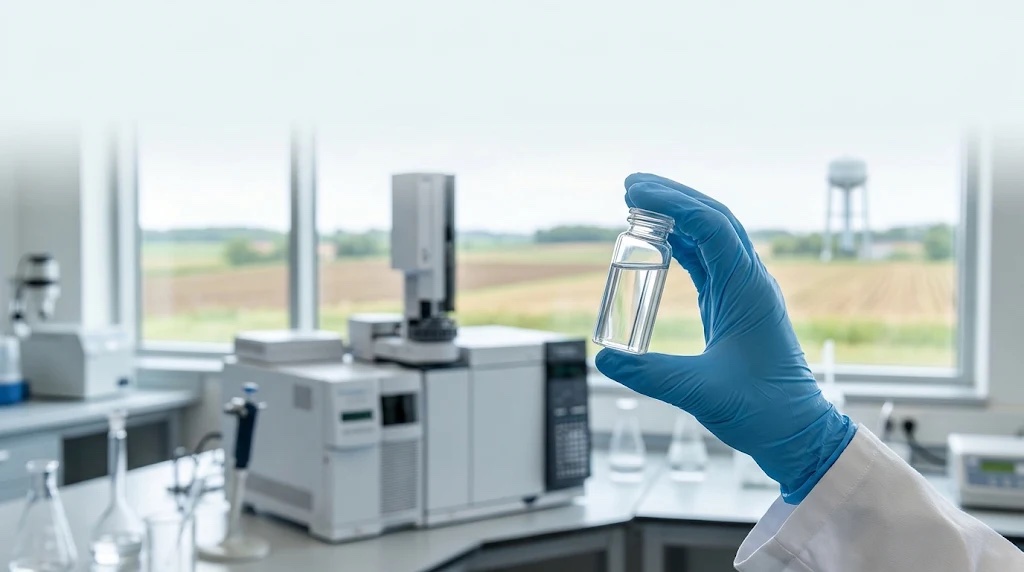
To determine if ethylene dibromide is present in a private well, water samples must be collected and sent to a state-certified environmental testing laboratory. The laboratory analyzes the sample using specialized laboratory procedures—such as EPA Method 504.1 (a microextraction and gas chromatography method designed specifically for detecting EDB and related pesticides down to sub-ppb levels) or EPA Method 524.2 (a capillary column gas chromatography/mass spectrometry procedure for volatile organic compounds). Well owners located near historical agricultural lands, old golf courses, or industrial petroleum sites should periodically request a certified VOC and pesticide laboratory scan to verify their drinking water remains safe.
What Removes It
The EPA’s own best available technology table (40 CFR 142.62) names two treatments for ethylene dibromide: granular activated carbon — water passed slowly through a bed of activated carbon that traps the chemical on the carbon’s surface — and packed tower aeration — an air-stripping tower where water trickles down through packing material while air blows up through it, letting this volatile chemical escape from the water into the air. Those are the two methods the federal government itself recognizes for this contaminant.
What does not remove it matters just as much. A sediment filter cannot touch EDB: sediment filters catch grit and particles, and EDB is dissolved in the water, not floating in it. A water softener does not remove it either: softening swaps hardness minerals for sodium, and it does not trap a dissolved solvent. At a limit of 0.05 ppb — one of the tightest on the EPA’s books — removal is a job for a properly sized carbon system with enough contact time, chosen after a certified lab test shows what is actually in the water. Do not assume a countertop pitcher handles it; a chemical regulated in the parts-per-trillion neighborhood deserves a test first and a system designed for it second.
The Honest Bottom Line
Ethylene dibromide is a legacy chemical: banned decades ago, still traveling through aquifers toward wells. If your home sits on a private well near old farmland, an old golf course, or a petroleum site, a certified lab test is the only way to know whether it is in your glass — you cannot taste it, smell it, or see it. If you are on public water, read your Consumer Confidence Report and look for it by name. Either way, test first, then treat with the methods the EPA itself recognizes. Facts before filters.
Facts first, then filter. — Steve
Leave a Reply