
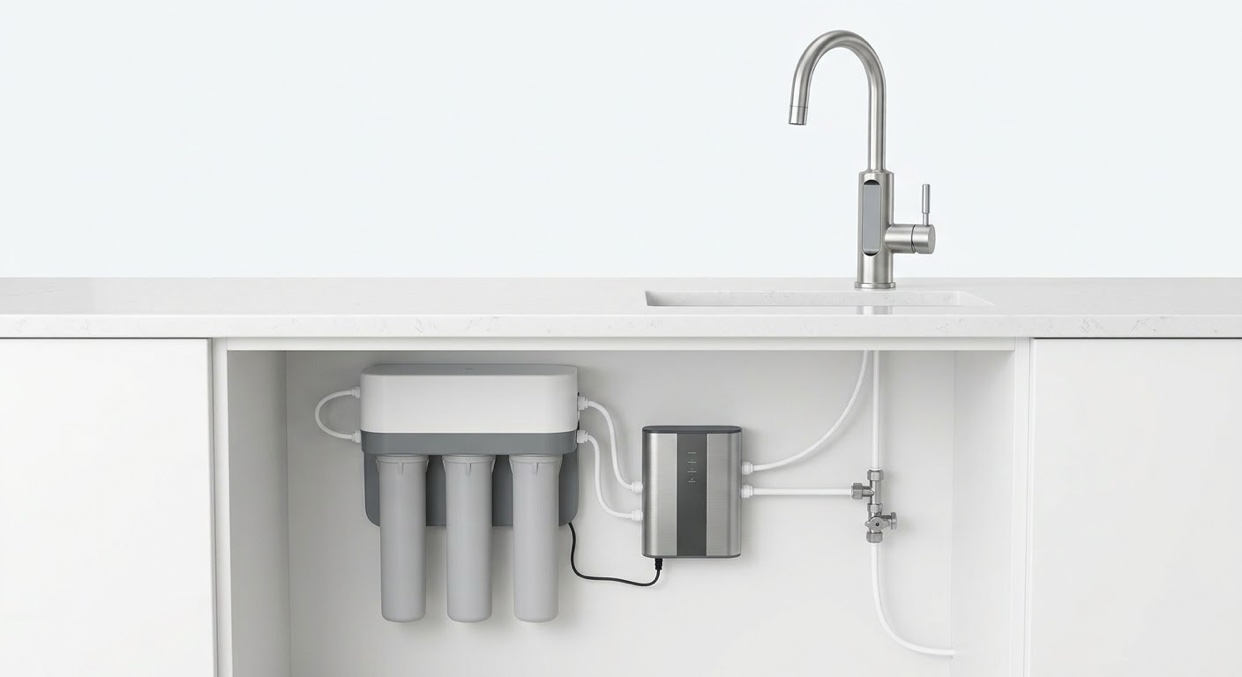
The word “electrolysis” currently sells two opposite things in the water industry. On one end, it is used as a stage trick by door-to-door sales reps who drop a cheap, sacrificial metal rod into a glass of tap water, turn on an electric current, and watch the water turn a disgusting brown to terrify homeowners into buying a filter. On the other end, electrolysis is a genuine, legitimate feature engineered into modern appliances to generate powerful cleaning solutions and surface sanitizers right from your tap.
Understanding the difference between the trick and the feature comes down to basic chemistry. While the demo trick relies on destroying the equipment to create brown sludge, electrolysis as a feature relies on passing electricity through water to transform what is already dissolved inside it.
What Electrolysis Actually Is
At its core, electrolysis is simply using electrical energy to drive a chemical reaction that would not happen on its own. The setup consists of two metal plates — called electrodes — submerged in water and connected to a direct current (DC) power source:
- The Anode (Positive Electrode): Attracts negatively charged ions (anions). At this plate, oxidation occurs, meaning molecules lose electrons.
- The Cathode (Negative Electrode): Attracts positively charged ions (cations). At this plate, reduction occurs, meaning molecules gain electrons.
What comes out of this process depends entirely on what is dissolved in the water passing between those plates. Pure water consists of H2O molecules, along with a tiny fraction of naturally split hydrogen ions (H+) and hydroxide ions (OH-). When electricity passes through pure water, water molecules at the cathode gain electrons to form hydrogen gas (H2) and hydroxide ions, while water molecules at the anode lose electrons to form oxygen gas (O2) and hydrogen ions.
However, tap water is never just pure H2O. It contains dissolved minerals, salts, and gases. When an electric current hits those dissolved components, the chemistry changes dramatically, creating distinct families of electrolyzed water.
Family One: Salt-Based Electrolysis (Hypochlorous Acid)
When water containing dissolved sodium chloride (table salt, NaCl) undergoes electrolysis, the chloride ions (Cl-) migrate to the positive anode. Instead of just producing oxygen gas, the electrical current oxidizes the chloride ions into chlorine gas (Cl2), which immediately reacts with water to form hypochlorous acid (HOCl).
In a single-chamber cell, the products mix into one solution, and what you get depends on the pH: on the acidic side the active germ-killer is hypochlorous acid; at higher pH the same chlorine shifts toward hypochlorite, the bleach form. Makers that want the two streams kept separate — the sanitizer on one side, the alkaline cleaner on the other — use a membrane-divided cell.
Hypochlorous acid is the real workhorse of electrolyzed water. It is the exact same substance produced naturally by human white blood cells to fight off pathogens.
Commercial and Historical Application
Salt-based electrolysis is not a new or unproven technology. Japan led the way: from the 1980s onward, Japanese food plants and hospitals put electrolyzed water to work for hand washing, surface sanitation, and produce rinsing. Alkaline water ionizers, the drinking-water cousins of this technology, had been recognized as medical devices in Japan since 1965.
- Produce Washing: Commercial produce packers use hypochlorous acid rinses to sanitize fresh fruits and vegetables without leaving toxic chemical residues or altering food flavor.
- Dental Care: Dental clinics utilize HOCl to flush water lines and provide gentle, non-irritating oral rinses for wound healing.
- Surface Disinfection: Because HOCl carries no electrical charge, it penetrates bacterial cell walls more readily than traditional household bleach (sodium hypochlorite, NaOCl), making it an exceptionally efficient sanitizer at much lower concentrations.
Family Two: “Active Oxygen” Systems
The second broad category of home electrolysis features involves systems marketed as producing “active oxygen” or reactive oxygen species (ROS). These devices claim to transform tap water into a cleaning agent by generating dissolved ozone (O3), hydrogen peroxide (H2O2), or hydroxyl radicals.
The primary scientific challenge for active oxygen systems is electrical conductivity. Pure water is an insulator, not a conductor. For electricity to flow efficiently between two electrode plates, ions must be present in the water to carry the charge. Low-mineral water means few ions, poor conductivity, and electrolysis that stalls; mineral-rich water conducts and the cell functions smoothly.
- Workaround 1: Solid Polymer Electrolytes (SPE / PEM): Advanced devices use Proton Exchange Membranes (PEM) with specialized platinum-group coated electrodes. The membrane itself provides the ionic conduction path, allowing the system to electrolyze pure or low-mineral water directly without relying on dissolved minerals.
- Workaround 2: Mineral Cartridges: Cheaper systems add mineral reintroduction cartridges to artificially boost total dissolved solids (TDS) so the cell can draw enough current to function.
When functioning properly, these systems generate transient oxygen radicals at the anode. These radicals attack organic molecules, breaking down stains, odor-causing compounds, and organic grime on surfaces.
The Cousins: Alkaline Water Ionizers
Alkaline water ionizers occupy the same technological family tree as salt-based and active-oxygen electrolysis. The primary difference is structural: ionizers use a membrane-separated electrolysis cell.
- Cathode Chamber: Positively charged minerals (calcium, magnesium, potassium) move toward the cathode, while water splitting produces hydroxide ions (OH-). This creates an alkaline water stream rich in mineral cations.
- Anode Chamber: Negatively charged ions (chlorides, sulfates) move toward the anode, while water splitting produces hydrogen ions (H+). This creates an acidic water stream.
While marketed primarily for drinking benefits, the underlying chemistry is identical: splitting incoming water into distinct ionic streams using electrical current.
What the Evidence Supports (and What It Does Not)
- Surface Sanitation — Proven Lane. Freshly generated hypochlorous acid and aqueous ozone are highly effective surface sanitizers for countertops, cutting boards, sinks, and produce.
- Solution Shelf-Life — Extremely Limited. Electrolyzed solutions are chemically unstable, which is why these systems generate them fresh on demand instead of bottling them. Aqueous ozone is the shortest-lived of the lot: its half-life in water is roughly 20 to 30 minutes at room temperature, and it is effectively gone within a couple of hours. Fresh hypochlorous acid loses strength over hours to days unless it is stabilized.
- Purifying Unsafe Water — NOT Supported. Home electrolysis features are not certified methods for converting microbiologically unsafe well or surface water into safe drinking water.
- Primary Disinfection — NOT Supported. Electrolysis appliances are designed for secondary surface cleaning and rinsing. They do not replace certified primary municipal or whole-home disinfection systems (like UV or chlorine injection).
The Feature vs. The Demo Trick
- The Demo Trick: A sales rep places cheap iron and aluminum rods into your tap water. When turned on, the electrical current rapidly corrodes the iron anode, forcing iron ions into the water. Those iron ions react with water to form insoluble iron hydroxide (rust). The brown sludge is not dirt from your tap water — it is the salesman’s electrode dissolving in front of your eyes. In distilled water, which lacks conductivity, the trick fails to produce sludge until salt is added.
- The Engineered Feature: Legitimate electrolysis appliances use inert electrodes (typically titanium coated with platinum or ruthenium oxide). These electrodes do not dissolve or leach metals into the water. Instead, they act purely as electron transfer sites to transform the dissolved compounds in the water.
Same scientific word; completely opposite honesty.
Understanding Certifications
- NSF/ANSI Standards: There is no NSF/ANSI standard that certifies a home electrolysis feature’s ability to disinfect a countertop or kill pathogens on a surface. Two things get confused with it, so name them plainly: NSF/ANSI 61 covers material safety only — that the parts touching your water won’t leach something harmful — and NSF/ANSI 42 covers a carbon filter’s taste-and-odor claims. Neither one tests the electrolysis sanitizer. The one protocol that does test microbiological claims, NSF Protocol P231, tests whether a device makes drinking water itself microbiologically safe — bacteria, viruses, cysts — not whether its spray sanitizes a surface. A P231 claim on a drinking-water purifier is a real thing; it is not a surface-disinfection claim.
- EPA Registration: In the United States, home devices that generate sanitizing solutions (like hypochlorous acid or ozone) are regulated by the Environmental Protection Agency (EPA) as pesticidal devices. That sounds like approval; it is not. Devices are not registered the way pesticides are: an EPA establishment number is an administrative number, granted on request, that says where the device was made — it is not a test of whether the device works, and devices are not required to submit efficacy data to the EPA. A pesticide registration, by contrast, requires the maker to submit product-specific data and pay for review. The EPA polices false claims on device labels, but registration of the factory is not an endorsement of the product. One more wrinkle from the EPA’s own manual: a device sold together with the substance that becomes the pesticide can be treated as a pesticide itself — so how the salt or precursor is sold matters, not just the machine.
- Combination Units (RO + Electrolysis): If an appliance combines reverse osmosis with an electrolysis generator, the RO system itself can be independently certified to NSF/ANSI 58 — the standard for reverse-osmosis drinking water systems, covering the specific contaminant reductions the unit is proven to deliver, such as lead, PFAS, or arsenic. Buyers should check whether the RO core is certified under NSF 58 and recognize that the certification covers the RO membrane, not the downstream electrolysis generator.
A Buyer’s Checklist
- Output Specifications: Does the manufacturer state the exact concentration of the active output in parts per million (ppm), and what use that number matches? Food-contact surface sanitizers are capped at 200 ppm available chlorine, and direct food contact at 60 ppm under the FDA’s notification — a number with no use attached is just a number. Vague marketing terms like “super-oxygenated” are not a specification.
- Consumables and Maintenance: What additive or cartridge does the feature require? Does it need pure salt packets, mineral additives, or periodic electrode descaling cycles to clear hard-water scale buildup?
- Water Chemistry Requirements: Does the device require a minimum total dissolved solids (TDS) level to operate, or does it use an SPE/PEM cell that works in low-mineral or RO water?
- Crowdfunding vs. Proven Hardware: Exercise extreme caution with crowdfunded launches (Kickstarter/Indiegogo). Crowdfunding campaigns are pre-sales for unproven prototypes. Look for established manufacturers with verified warranty support, replacement component availability, and clear technical documentation.
Facts first, then filter. — Steve
Leave a Reply