
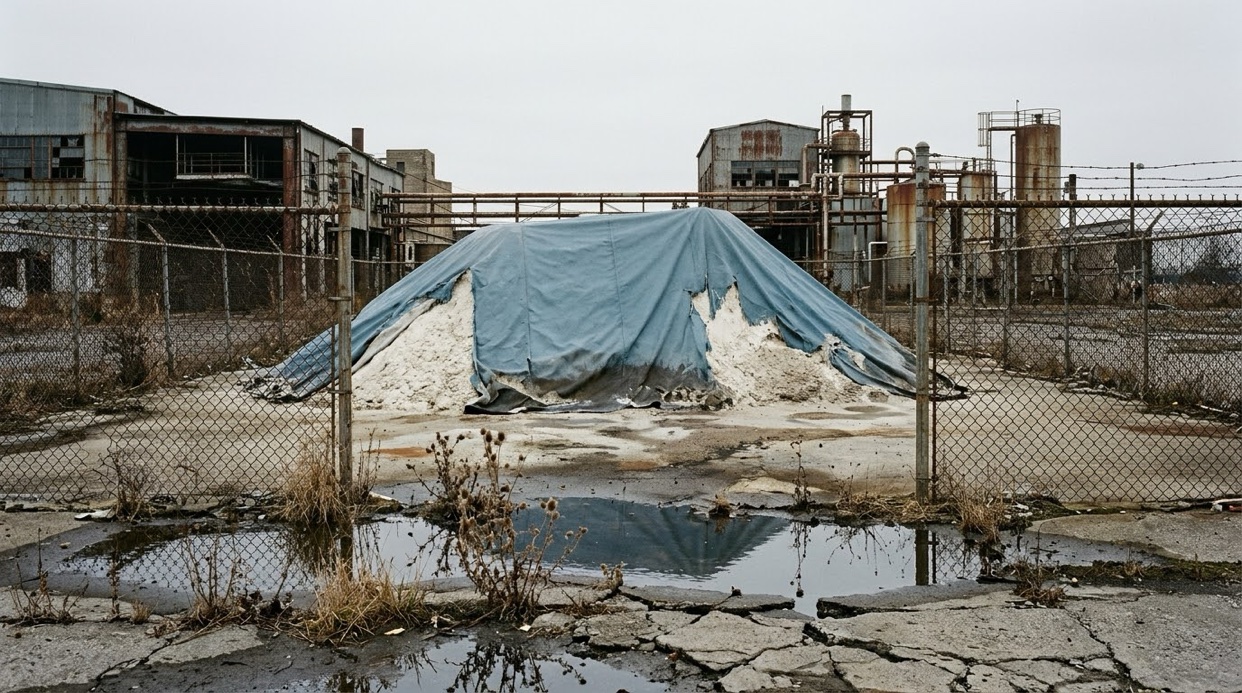
Alpha-HCH has one of the strangest stories in the pesticide world. It made up the majority of one of the most heavily sprayed insecticides on earth — and it was never the ingredient that killed the insects. It was the byproduct, the extra material that came out of the factory alongside the active ingredient, got sprayed over fields and forests anyway, and then refused to go away. It turned up in human breast milk and in Arctic wildlife decades after it was banned. That combination — useless at its job, excellent at lasting — is why this chemical still earns a page of its own.
1. What It Is
Alpha-HCH — alpha-hexachlorocyclohexane, also written α-HCH — is an organochlorine chemical, one of several stereoisomers (same atoms, different arrangement) in the HCH family. It was never manufactured as a product in its own right. It was the major component of technical-grade HCH, also called BHC, a broad-spectrum insecticide used after World War II on crops, in forestry, and on livestock. Alpha-HCH made up 55 to 70 percent of that technical product. It also appears as an impurity from manufacturing lindane, which is the gamma isomer of the same family — the one family member that actually did the insect-killing work.
The regulatory ending came early, as these stories go. Technical HCH registrations in the United States were voluntarily cancelled in 1976, and all remaining uses were banned in 1978. Lindane held on longer in narrower roles, but its agricultural uses were cancelled in 2006. So alpha-HCH has been out of American commerce for nearly fifty years. Its presence anywhere today is pure legacy — residue from an era when it was applied in enormous quantities around the world.
2. Where It Comes From
Alpha-HCH entered the environment on a global scale. Technical HCH was one of the most heavily applied insecticides on the planet after WWII, sprayed across farmland and forests on multiple continents — and every pound of it was more than half alpha-HCH. It also came out of lindane manufacturing, where the alpha isomer was an unwanted companion product.
What makes this chemical a water and food-chain concern is what it does after application. Alpha-HCH is persistent and it bioaccumulates — it builds up in fatty tissue faster than organisms can clear it. Regulators eventually recognized that alpha-HCH, along with its beta isomer sibling, had virtually no insecticidal activity, yet it bioaccumulated in human breast milk and in Arctic wildlife for decades — in places far from any field it was ever sprayed on. A chemical does not need a local source to be a local fact when it travels that well and lasts that long. For drinking water, the realistic picture is old, widely dispersed residue rather than any current use — there is no current use.
Consider the waste built into that history, because it explains the scale of the residue. The active, bug-killing member of this family was the gamma isomer, lindane. But the technical product sprayed around the world was mostly not lindane — 55 to 70 percent of it was the alpha isomer, which did essentially nothing to insects. For every pound of useful ingredient that went onto a crop, more than a pound of this persistent, bioaccumulating byproduct went out with it, into soil and water and food chains, where it stayed. Lindane manufacturing added more, since alpha-HCH came off that production line as an impurity. The contamination problem was never a side effect of the program. By volume, it was most of the program.
3. The Numbers
Alpha-HCH has no federal drinking-water standard of its own. There is no MCL and no MCLG for the alpha isomer.
Plain English on those terms: the MCLG — Maximum Contaminant Level Goal — is the level EPA’s scientists consider safe; it is a goal, not a law. The MCL — Maximum Contaminant Level — is the enforceable legal limit a water system must actually meet. Within this chemical family, only one member has those numbers: lindane, the gamma isomer, carries a federal MCL and MCLG of 0.0002 mg/L (0.2 ppb). That limit belongs to lindane. It does not extend to alpha-HCH, and the two should never be confused on a lab report.
EPA has also not established a non-cancer Lifetime Health Advisory for alpha-HCH — and remember, a Health Advisory is guidance, not law, in any case. What EPA publishes for this chemical is a cancer risk concentration: 0.000006 mg/L (0.006 ppb). That tiny figure is the concentration EPA calculates corresponds to a 10^-6 risk — one added cancer case per million people drinking that water over a lifetime. It is a risk benchmark derived from the chemical’s cancer potency in EPA’s IRIS assessment, not an enforceable limit, and not a line a water system is tested against. Read it for what it is: a measure of how potent EPA considers this chemical, expressed as a concentration.
The states add nothing current. New Jersey has no MCL for alpha-HCH, and California has no current MCL or Public Health Goal for it. California does carry an archived advisory level for it — 0.000015 mg/L (0.015 ppb) — and that number has a history worth knowing: the state first set it at 0.7 ppb in 1982, then revised it down to 0.015 ppb in 2000 as the science firmed up. Archived means the state no longer actively uses it, but it tells you how seriously California took this chemical.
4. What EPA Says About Health
The health record for alpha-HCH comes from EPA’s IRIS assessment and long-term animal studies. In chronic rodent bioassays — animals exposed over most of their lives — alpha-HCH caused liver enlargement and hepatocellular tumors, meaning tumors of the liver cells themselves. At high doses, studies also showed central nervous system stimulation and effects on the kidneys and the reproductive system.
The cancer classifications are firm as these things go. EPA classifies alpha-HCH as Group B2 — “probable human carcinogen” — based on the animal evidence in its IRIS program. IARC, the international cancer agency, places hexachlorocyclohexanes in Group 2B — “possibly carcinogenic to humans.” California lists alpha-HCH under Proposition 65 as a carcinogen. Two agencies using two different scales land in the same neighborhood: treat this chemical as a cancer concern. That judgment, combined with the chemical’s persistence and bioaccumulation, is exactly why it was banned when it was — and why it is still tracked long after.
5. What Removes It
Because alpha-HCH is unregulated in drinking water, EPA has designated no Best Available Technology for it — no official treatment method attached to a legal limit, because there is no legal limit for this isomer. The practical answer comes from the chemical’s properties, and here the news is good.
Both granular activated carbon (GAC) and reverse osmosis (RO) achieve high removal of alpha-HCH — better than 95 percent. The chemistry explains why. Alpha-HCH is strongly hydrophobic, with a log Kow of about 3.8, meaning it strongly prefers a surface like activated carbon over staying dissolved in water; it partitions readily onto carbon. And its molecule — a bulky chlorinated ring weighing about 291 daltons — is large enough for an RO membrane to reject while water passes. A chemical that clings to carbon and cannot slip a membrane is a chemical home treatment handles well.
The standing warning still applies. A micron rating on a sediment cartridge describes solid particles the cartridge can strain out. Alpha-HCH in water is dissolved, molecule by molecule — there is no particle to strain. Filtering for it with a sediment cartridge is like trying to catch wind in a chain-link fence. The tools that work on dissolved chemicals are adsorption, which is carbon, and membrane rejection, which is RO.
6. The Bottom Line
Alpha-HCH is a banned byproduct — 55 to 70 percent of the technical HCH sprayed worldwide after WWII, cancelled in the U.S. in 1976 and fully banned in 1978 — that never killed insects but persisted for decades, bioaccumulating as far away as Arctic wildlife. It has no federal drinking-water limit of its own (its gamma sibling, lindane, holds the family’s only MCL, at 0.0002 mg/L), and EPA’s published figure for it is a one-in-a-million cancer risk concentration of 0.000006 mg/L (0.006 ppb). EPA calls it a probable human carcinogen. If it is ever a concern in your water, granular activated carbon and reverse osmosis both remove more than 95 percent of it — a rare case of a stubborn chemical meeting treatment it cannot outlast.
Facts first, then filter. — Steve
Leave a Reply