
Permethrin is one of those chemicals that lives two lives. It’s sprayed on farm fields and whole neighborhoods, it’s the active ingredient in the lice treatment sold under the name Nix, it’s impregnated into military uniforms, and doctors prescribe it as a cream. It’s also, as of March 2026, a chemical EPA formally decided not to regulate in drinking water — which means there is no federal number for it at all. Not a limit, not a goal, not even an advisory. If you want to understand permethrin and your water, that empty space where the numbers should be is the first thing to understand.
1. What It Is
Permethrin is a synthetic Type I pyrethroid insecticide. Synthetic means it’s made in a lab. Pyrethroid means it’s modeled on the natural insect-killing compounds found in chrysanthemum flowers, rebuilt to last longer and hit harder than the natural version. It’s used widely: in agriculture, in public-health mosquito control, in residential pest control, on livestock, and as a treatment for clothing and gear. You’ll find it under product names like Ambush, Pounce, Astro, and Dragnet — and in the pharmacy as Nix, the medical lice treatment.
It is still actively registered for agricultural, residential, and public-health uses. Its agricultural formulations, though, are Restricted Use Pesticides — products only licensed applicators can buy and apply — because of permethrin’s extreme toxicity to fish and aquatic invertebrates. EPA set that status in its Registration Review Interim Decision in 2020. So this is a chemical in full, legal, everyday use, carrying a restriction that exists because of what it does to life in the water.
2. Where It Comes From
Permethrin reaches the environment from everywhere it’s sprayed and applied — and that’s more places than most people realize: farm fields, livestock operations, yards and homes, clothing and camping gear, and entire neighborhoods when mosquito season bites.
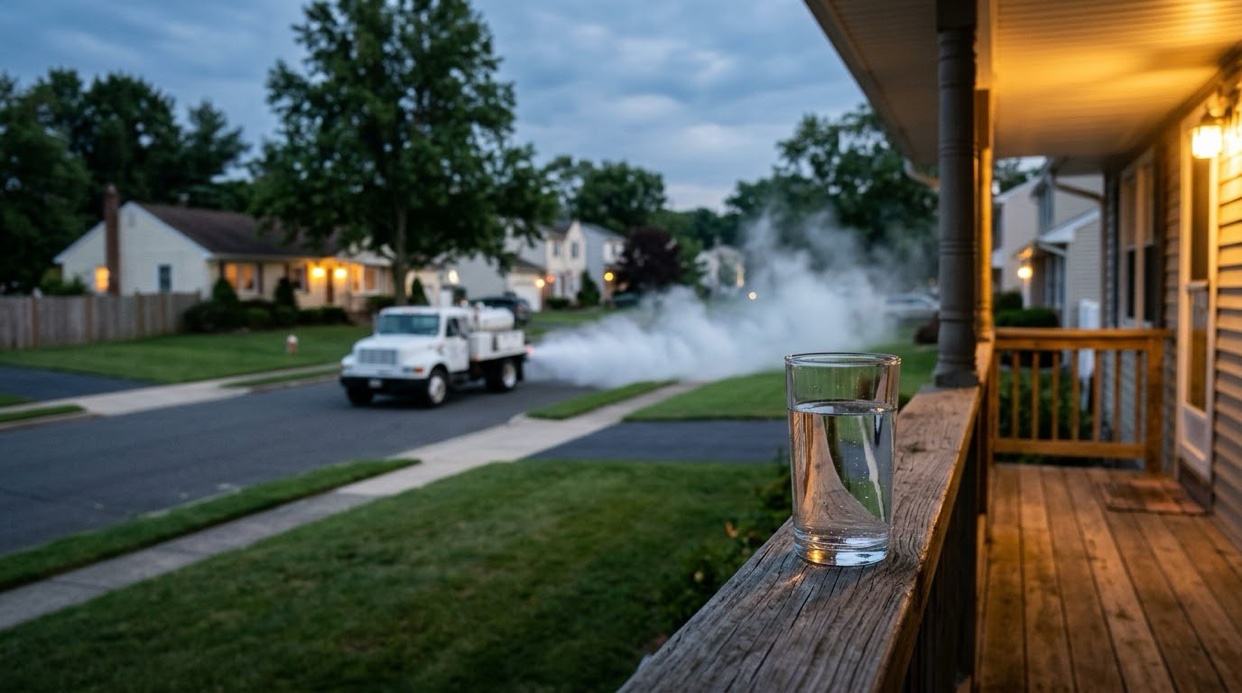
I remember that last one personally. When I was young, the mosquito-fogging trucks would come through our town unannounced — no warning, no schedule posted — and roll down the street trailing a cloud of fog that drifted across the whole neighborhood. I can still see that fog rolling between the houses, and I have it on video to this day. Nobody thought twice about it back then; the truck came, the fog rolled, the mosquitoes died. That kind of public-health spraying never went away. Permethrin is one of the chemicals doing that job today, in mosquito control programs all over the country.
Add it up: a chemical used on crops, on animals, on uniforms and gear, and over whole streets doesn’t stay where it’s put. Some share of it washes off with the rain and works its way toward the drains, the streams, and eventually the same water supply everybody drinks from. That’s not an accusation — it’s just what “used everywhere” means for anything that can be carried by water.
3. The Numbers
There aren’t any — and that is the finding. Let me show you the empty shelf, piece by piece, so you know exactly what’s missing.
There is no MCL for permethrin. The MCL — Maximum Contaminant Level — is the enforceable legal limit, the number a public water system can actually be penalized for exceeding. There is no MCLG either. The MCLG — Maximum Contaminant Level Goal — is the non-enforceable health goal: the level EPA’s scientists consider to carry no known or expected risk, set on health alone. For a regulated chemical you get both numbers. Permethrin has neither. And unlike some unregulated chemicals, it doesn’t even have a numeric Health Advisory — EPA’s 2018 Drinking Water Standards and Health Advisories table lists no advisory value for it. A Health Advisory is guidance rather than law, but for permethrin there isn’t even guidance with a number attached.
Then, in March 2026, EPA closed the door formally. Its Final Regulatory Determination 5 — issued March 17, 2026, and published in the Federal Register on March 19, 2026 (91 FR 13227) — decided not to establish a federal National Primary Drinking Water Regulation for permethrin. A regulatory determination is EPA’s official verdict, after studying a contaminant, on whether to write a drinking-water rule for it. For permethrin, the verdict was no. That doesn’t tell you how much permethrin is or isn’t in any given water system. It tells you the federal government has finished deciding, and there will be no federal rule.
The states don’t fill the gap. California has no MCL, no Notification Level, and no Public Health Goal for permethrin. New Jersey has no MCL for it. California’s Proposition 65 warning list doesn’t include it either. So if a lab ever finds permethrin in your water, understand what you’re holding: a measurement with no official line anywhere — federal or state — to compare it against.
4. What EPA Says About Health
Permethrin attacks the nerve membrane. It acts on the voltage-gated sodium channels — the tiny gates nerves use to fire their signals — and interferes with how those gates close, so the nerve keeps firing when it should have stopped. That’s what makes it lethal to insects. EPA’s human health risk assessment for permethrin describes acute neurotoxicity at high doses: tremors, hyperexcitability, and paresthesia, which is the medical word for abnormal tingling or prickling sensations. At high chronic doses in animal studies, it caused liver enlargement, and benign lung and liver tumors in female mice.
On cancer, the two big scorekeepers disagree, and I’ll give you both rather than pick one. EPA’s Office of Pesticide Programs classifies permethrin as “Likely to be carcinogenic to humans.” IARC places it in Group 3 — not classifiable as to its carcinogenicity to humans — meaning IARC judged the available evidence insufficient to classify it either way. Both statements are on the record at the same time.
Two more facts from the record put the chemical in perspective. Permethrin is highly toxic to cats, because cats lack the liver glucuronidation enzyme needed to metabolize it — a household warning worth knowing if you ever treat a dog with a permethrin product. And it’s highly toxic to aquatic life, which is why its farm formulations are restricted. Yet in controlled doses, this same chemical is prescribed as a topical cream for human scabies and lice, and impregnated into U.S. military uniforms. Dose, route, and species make the difference — which is exactly why the missing drinking-water number matters: the drinking-water route is the one nobody set a line for.
5. What Removes It
Start with the honest part: because permethrin is unregulated in drinking water, EPA has designated no Best Available Technology for it. There is no official “use this” stamp. What we have is the chemistry, and here the chemistry is strongly in the homeowner’s favor: activated carbon and reverse osmosis both take permethrin out at over 99 percent efficiency.
First, understand what you’re trying to catch. Permethrin in water is a dissolved chemical — not a particle floating in the water, but part of the water, the way sugar is part of sweet tea. A sediment filter or a micron rating cannot catch it. A micron rating is a measurement of holes; it tells you the size of particle a filter can strain out. Trying to stop a dissolved chemical with a particle rating is like trying to catch wind in a chain-link fence. The holes aren’t the problem. The wind isn’t a thing the fence was ever built to hold.
Carbon works on a completely different principle: adsorption — the chemical sticks to the carbon’s surface instead of passing through. Permethrin is extremely hydrophobic, with a log Kow of about 6.5, which in plain English means it wants out of the water badly and will grab onto carbon at the first chance it gets. Granular activated carbon gives it an enormous surface to grab, and GAC removes it at over 99 percent. Reverse osmosis works the other way: it pushes water through a membrane tight enough to exclude molecules of permethrin’s size — it weighs in around 391 daltons, big for a dissolved chemical — and RO also removes it at over 99 percent. So if this chemical is on your list, the answers are a good carbon system, an RO system, or both in line — not a finer sediment filter.
6. The Bottom Line
Permethrin is everywhere by design — on fields, on livestock, in lice shampoo, in military uniforms, and over neighborhoods on fogging nights like the ones I grew up with. As of March 2026, the federal government has formally decided it will not write a drinking-water rule for it: no limit, no health goal, no advisory number, and no state backstop in California or New Jersey. EPA’s pesticide office calls it likely to be carcinogenic to humans; IARC says the evidence can’t be classified. If it ever shows up in your water and you want it out, carbon and reverse osmosis remove over 99 percent of it — the chemistry is on your side, even where the rulebook is silent.
Facts first, then filter. — Steve
Leave a Reply