
If you line up America’s broadleaf herbicides, 2,4-DB and dicamba keep ending up on the same shelf — two workhorses for the same weeds, discussed as a pair for as long as either has been sprayed. But when you go looking for their drinking-water numbers, the pair splits in a way nobody tells you about: one of them has an EPA Lifetime Health Advisory, and the other one doesn’t have a Health Advisory at all. Its safety yardstick is a different kind of number entirely.
1. What They Are
2,4-DB — full name 4-(2,4-dichlorophenoxy)butyric acid — is a selective, systemic phenoxy herbicide. Selective means it kills some plants and spares others; systemic means the plant takes it in and moves it through itself. It’s sprayed post-emergence — after the crop is up — to control broadleaf weeds in peanuts, alfalfa, soybeans, and clover. You’ll see it sold as Butyrac, Butoxone, and Embutox.
Here’s the neat trick built into 2,4-DB: by itself, it isn’t really the herbicide. Plants convert it — by a process called beta-oxidation — into 2,4-D, the famous active herbicide. Weeds perform that conversion quickly, poison themselves with what they make, and die. Tolerant crops like alfalfa and peanuts lack the enzymes to perform the conversion rapidly, so the chemical passes through them largely unconverted and harmless. The weed brews its own poison; the crop can’t be bothered. That is the whole basis of its selectivity.
Dicamba is a selective broadleaf herbicide from the benzoic-acid family — the phenoxy pair’s close chemical cousin, doing the same job on the same kinds of weeds. It’s used on corn, soybeans, cotton, pastures, and residential lawns. The names on the shelf include Banvel, Clarity, XtendiMax, and Engenia, and dicamba also appears in Weed-B-Gon formulations — which is how a farm chemical ends up on suburban grass.
Both chemicals go after broadleaf weeds — the wide-leaf invaders — while leaving grasses standing, which is exactly why they can be sprayed over lawns, pastures, and grain fields without killing the field itself.
2. Where They Come From
From fields and lawns, and both are still out there. 2,4-DB remains a registered, active agricultural herbicide; it went through EPA’s reregistration process and received its Reregistration Eligibility Decision in 2005. No court fights, no headlines — it simply keeps working the same fields it has worked for years. Dicamba’s standard products remain registered too, though its over-the-top uses are restricted.
Dicamba’s recent history is bumpier. The over-the-top products — the low-volatility formulations sprayed over the top of growing dicamba-tolerant soybeans and cotton, sold as XtendiMax, Engenia, and Tavium — had their registrations vacated by a federal court in February 2024, which struck down EPA’s 2020 approvals for them and sent them back for new EPA review.
The sources, then, are ordinary: 2,4-DB over peanut, alfalfa, soybean, and clover fields; dicamba over corn, soybeans, cotton, and pasture — and, through those lawn formulations, over a great many suburban yards as well. Between the farm acres and the lawn bags, there is a lot of both chemicals in circulation every season.
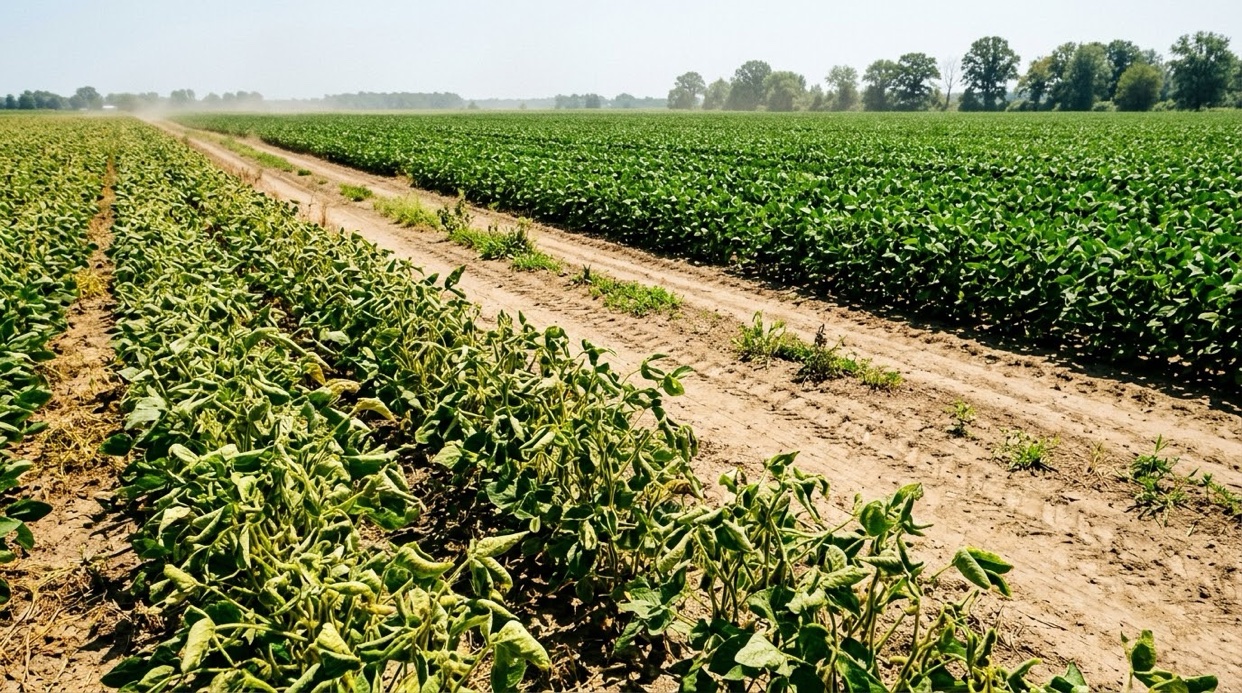
And dicamba is the one with the famous problem: drift. After dicamba-resistant genetically modified crops were introduced, dicamba’s tendency to move off-target caused millions of acres of vapor-drift damage to neighboring orchards, soybean fields, and trees that were never sprayed. The chemical is effective where you put it. The argument has always been about where it goes afterward.
Where it comes from and how it gets into the water
To understand how 2,4-DB and dicamba end up in drinking water, you have to look at where they are sprayed every season. Neither chemical is a relic of the past; both remain in active circulation across agricultural fields and residential neighborhoods. Both chemicals share a specific job: they are selective broadleaf herbicides. They kill broadleaf weeds while leaving grasses standing. Because they spare grasses, applicators can spray them directly over lawns, pastures, and grain fields without wiping out the grass or crop itself. 2,4-DB—whose full chemical name is 4-(2,4-dichlorophenoxy)butyric acid—is a selective, systemic phenoxy herbicide. Farmers spray it post-emergence, meaning after the crop has already sprouted out of the ground, to control broadleaf weeds in peanuts, alfalfa, soybeans, and clover. You will find it sold under shelf names like Butyrac, Butoxone, and Embutox. Interestingly, 2,4-DB is not really the active herbicide by itself. Once absorbed, plants convert it through a process called beta-oxidation into 2,4-D, which is the active weed-killer. Broadleaf weeds perform this conversion quickly and poison themselves. Tolerant crops like alfalfa and peanuts lack the enzymes needed to convert it rapidly, so the chemical passes through them largely unconverted. That difference in metabolism is the entire basis for how 2,4-DB selects weeds over crops. 2,4-DB received its EPA Reregistration Eligibility Decision in 2005 and remains a registered, active agricultural herbicide today. Dicamba is the phenoxy pair’s close chemical cousin, belonging to the benzoic-acid family. Like 2,4-DB, it is a selective broadleaf herbicide, and its footprint stretches from rural farms straight into suburban yards. In agriculture, it is used on corn, soybeans, cotton, and pastures. In residential neighborhoods, homeowners and lawn-care services apply it to lawns through standard lawn-care formulations, including Weed-B-Gon products. On store shelves and in farm supply catalogs, it goes by names such as Banvel, Clarity, XtendiMax, and Engenia. While dicamba’s standard products remain registered, its over-the-top agricultural uses have faced major legal restrictions. Over-the-top products—specifically XtendiMax, Engenia, and Tavium, which were designed to be sprayed directly over growing dicamba-tolerant soybeans and cotton—had their registrations vacated by a federal court in February 2024. That ruling struck down the EPA’s 2020 approvals and sent those uses back for a new EPA review. Even with that restriction on over-the-top spraying, dicamba’s standard formulations remain registered and in regular use across farms and suburban lawns. Beyond ordinary runoff and spraying, dicamba has a famous physical problem: off-target vapor drift. After dicamba-resistant genetically modified crops were introduced, dicamba’s tendency to volatilize and move off-target caused millions of acres of vapor-drift damage. It drifted onto neighboring orchards, non-tolerant soybean fields, and trees that were never sprayed. Because both 2,4-DB and dicamba are applied broadly across crops, pastures, and suburban grass every growing season—and because dicamba has a documented history of moving well beyond its intended spray zone—both compounds remain active environmental inputs that can make their way into water supplies.
3. The Numbers
Start with what’s missing. Neither 2,4-DB nor dicamba has a federal MCL or MCLG. To translate: the MCLG is EPA’s non-enforceable health goal — the level the scientists say is safe — and the MCL is the enforceable legal limit a water system must actually meet. With neither on the books, there is no legal limit for either chemical in your tap water. California and New Jersey have set no state limits for either one, and neither appears on California’s Proposition 65 list.
What exists is the Health Advisory — EPA guidance, not law. Exceeding one breaks no rule, because there is no rule to break.
Dicamba has one: a Lifetime Health Advisory of 4 mg/L (4,000 ppb), from EPA’s 2018 tables. That is a high number as these things go, and it reflects dicamba’s relatively low mammalian drinking-water toxicity. Note what dicamba does not have: EPA lists no 1-day and no 10-day Health Advisory for it — the short-term cells in the table are simply blank.
2,4-DB doesn’t even have that. EPA has published no Health Advisory for 2,4-DB at all — it is not listed in the 2018 Drinking Water Standards and Health Advisories tables. The number that anchors 2,4-DB is its chronic Reference Dose: 0.03 mg/kg/day, established in EPA’s 2005 reregistration decision. A reference dose is a different species of number from everything above. It’s not a concentration in water — it’s a dose: the amount per kilogram of your body weight, per day, that EPA’s scientists judge safe to take in over a lifetime. If anyone tries to compare 2,4-DB’s 0.03 directly against dicamba’s 4 mg/L, they’re comparing a dose to a concentration — apples to orchards.
Sit with what “no Health Advisory at all” means in practice. If a lab finds 2,4-DB in a water sample, there is no EPA advisory number to hold the result up against — no official line that says “below this is fine, above this is a concern” for the water itself. The reference dose is the only yardstick EPA has published, and it measures a dose in a body, not a concentration in a glass. That gap in the paperwork is worth knowing about before somebody waves a test result at you, in either direction.
On cancer, EPA’s word for both is the same: “Not likely to be carcinogenic to humans.” IARC, for its part, has no classification for either chemical — one more blank cell in both files.
Finding it: testing and detection
If you send a water sample to a laboratory and get numbers back for 2,4-DB and dicamba, you cannot read those results the way you would read a report for lead or nitrate. Reading a lab sheet for this pair requires checking the exact units and understanding what kind of federal benchmark—if any—exists for each chemical. First, look at the legal baseline: neither 2,4-DB nor dicamba has a federal Maximum Contaminant Level (MCL) or a Maximum Contaminant Level Goal (MCLG). There is no federal legal limit for either chemical in tap water. State rules offer no extra legal backstop here either; California and New Jersey have set no state limits for either chemical, and neither appears on California’s Proposition 65 list. Because there are no enforceable limits, you have to interrogate your lab result using non-regulatory EPA guidance numbers, and the yardsticks differ completely between the two chemicals:
- How to read a dicamba result: Dicamba has a Lifetime Health Advisory of 4 mg/L (which equals 4,000 ppb), published in the EPA’s 2018 tables. A Health Advisory is EPA guidance, not law. That 4 mg/L benchmark is a relatively high number, reflecting dicamba’s relatively low mammalian drinking-water toxicity. However, if you are looking at a short-term spike—say, right after spring spraying in an agricultural watershed—the EPA tables will not give you a short-term benchmark. The EPA lists no 1-day and no 10-day Health Advisory for dicamba; those short-term cells are left completely blank.
- How to read a 2,4-DB result: 2,4-DB has no Health Advisory at all. It is not even listed in the EPA’s 2018 Drinking Water Standards and Health Advisories tables. When you interrogate a lab detection for 2,4-DB, there is no official EPA water-concentration number sitting next to it for comparison.
Instead, the only federal number anchoring 2,4-DB is its chronic Reference Dose of 0.03 mg/kg/day, established in the EPA’s 2005 reregistration decision. Here is the single most important rule when reading your lab report: never compare 2,4-DB’s 0.03 mg/kg/day figure directly against dicamba’s 4 mg/L figure. They measure two completely different things. Dicamba’s 4 mg/L is a concentration in water (milligrams of chemical per liter of water). 2,4-DB’s 0.03 mg/kg/day is a dose—specifically, the amount of chemical per kilogram of body weight per day judged safe over a lifetime of exposure. Putting a daily body-weight dose side by side with a water concentration is an apples-to-oranges mistake that will misread the risk. Behind these numbers sit specific animal-study findings, though neither chemical is flagged as a human carcinogen. On cancer, the EPA’s classification for both 2,4-DB and dicamba is identical: “Not likely to be carcinogenic to humans,” and the International Agency for Research on Cancer (IARC) has no classification for either chemical. Instead, the EPA’s safety benchmarks are built on non-cancer effects seen at high chronic doses in laboratory animals:
- For 2,4-DB, the 0.03 mg/kg/day reference dose comes from chronic animal studies showing decreased body weight gain, reduced food consumption, and effects on the kidney, liver, thyroid, and adrenal glands.
- For dicamba, the EPA’s 2006 reregistration decision reports that high chronic doses in laboratory animals caused neurotoxicity—specifically ataxia (loss of muscle coordination) and decreased motor activity—along with maternal and fetal body weight reduction and mild liver effects.
4. What EPA Says About Health
For 2,4-DB, EPA’s findings come from chronic animal studies, where at high doses the chemical caused decreased body weight gain, reduced food consumption, and effects on the kidney, liver, thyroid, and adrenal glands. Those are the findings standing behind the 0.03 mg/kg/day reference dose in the 2005 reregistration decision.
For dicamba, EPA’s 2006 reregistration decision reports that in laboratory animals, high chronic doses caused neurotoxicity — specifically ataxia and decreased motor activity — along with maternal and fetal body weight reduction and mild liver effects.
Notice the honest shape of both files: high doses, laboratory animals, long-term studies. That is the record EPA publishes, and it is also why dicamba’s lifetime advisory can sit at 4,000 ppb while 2,4-DB’s file runs on a reference dose instead. Different chemicals, different paperwork, same absence of a legal limit.
5. What Removes Them
Neither chemical is regulated, so EPA has designated no Best Available Technology for either — no official treatment list exists. What works comes from their chemistry, and here the pair splits again.
2,4-DB is the cooperative one. It’s moderately hydrophobic — log Kow about 3.5 — which makes it a good candidate for granular activated carbon, and at about 249 daltons it’s large enough for a reverse osmosis membrane to exclude. Both GAC and RO effectively remove it. Its chemistry sits in the middle ground: greasy enough for carbon to grab, substantial enough for a membrane to stop.
Dicamba is the stubborn one. At neutral pH it exists predominantly as a negatively charged, highly water-soluble carboxylate anion — its pKa is about 1.87, meaning it takes on that charge very readily and stays dissolved and charged. Reverse osmosis removes it effectively: at about 221 daltons and carrying that charge, the membrane rejects it. Granular activated carbon manages only low-to-moderate adsorption, because carbon’s talent is grabbing water-hating chemicals, and dicamba in water is anything but.
Put together, the shopping advice writes itself. A good activated-carbon system already has 2,4-DB covered. Reverse osmosis covers both members of the pair — which matters, because the two are sprayed over much of the same countryside and can plausibly show up in the same water. If a salesman tells you his carbon box handles “the herbicides” as one undifferentiated group, dicamba is the name to ask him about specifically.
And the usual warning, because it applies to both: these are dissolved chemicals — single molecules mixed into the water, not particles suspended in it. A sediment filter’s micron rating measures particle size, and no particle rating catches a dissolved molecule. It’s like trying to catch wind in a chain-link fence: the fence can be excellent and the wind still goes through, because the problem was never the fence’s spacing. If you’re treating for dicamba in particular, reverse osmosis is the dependable answer, and carbon by itself is only a partial one.
What actually removes it
When you shop for water treatment to handle 2,4-DB and dicamba, you cannot treat them as a single, identical target. Even though they are chemical cousins used to kill the same weeds, they behave very differently in water—and those physical and chemical differences dictate which filter technology actually works. First, rule out basic mechanical filtration. Both 2,4-DB and dicamba are dissolved in water. They exist as single molecules mixed thoroughly into the water, not as solid particles suspended in it. A sediment filter works by straining out physical particles down to a specific micron rating. Because a micron rating is a particle-size measurement, a sediment filter catches neither 2,4-DB nor dicamba. To strip dissolved molecules out of water, you have to rely on chemical adsorption or membrane rejection. Here is how the two main household technologies split across this chemical pair:
- 2,4-DB is captured by both carbon and reverse osmosis. In water, 2,4-DB is moderately hydrophobic, with a log Kow of about 3.5. “Hydrophobic” means water-hating—the molecule prefers clinging to a solid surface rather than staying dissolved in water. Because granular activated carbon (GAC) excels at grabbing water-hating chemicals, GAC is a good candidate for removing 2,4-DB. At the same time, 2,4-DB has a molecular weight of about 249 daltons, which makes the molecule large enough for a reverse osmosis (RO) membrane to physically exclude. As a result, both GAC and RO effectively remove 2,4-DB.
- Dicamba resists carbon, leaving reverse osmosis as the clear winner. Dicamba behaves almost the exact opposite of 2,4-DB once it enters tap water. Dicamba has a pKa of about 1.87. Because its pKa is so low, at neutral drinking-water pH it gives up a proton very readily and exists predominantly as a negatively charged, highly water-soluble carboxylate anion. It stays fully dissolved and carries an electrical charge. Granular activated carbon’s talent is grabbing water-hating chemicals, and dicamba in water is anything but water-hating. Consequently, GAC manages only low-to-moderate adsorption of dicamba. Reverse osmosis, however, removes dicamba effectively. At about 221 daltons and carrying that negative charge, dicamba is rejected by the RO membrane on both size and charge.
The practical takeaway for your home system is straightforward: a granular activated carbon system alone has 2,4-DB covered, but it is only a partial answer for dicamba. Reverse osmosis covers both members of the pair.
The claim has to be on the sheet
Because neither 2,4-DB nor dicamba is regulated under federal drinking water law, the EPA has designated no Best Available Technology for removing either chemical. Furthermore, no specific third-party certification standard is established here for either compound. When you are shopping for a filter without an official government technology mandate or a dedicated herbicide seal to fall back on, you have to rely on one strict buying rule: the removal claim has to be printed on the product’s Performance Data Sheet. Manufacturers and marketers often use broad, reassuring language on the front of a box, so you need to separate marketing shorthand from verified testing. Keep three rules in mind when evaluating any filter system:
- Say the seal, then translate what the seal actually means. Whenever a product displays a certification mark or claims compliance with a standard, stop and translate what that seal actually covers in plain English. A certification mark on a filter housing is not a blank check that covers every contaminant in your tap water. It only means the unit passed laboratory testing for the exact list of contaminants written in its testing paperwork.
- Verify the Performance Data Sheet, chemical by chemical. A certification or performance claim covers only the specific contaminants printed on that product’s Performance Data Sheet. Before buying a system to address this pair, open the Performance Data Sheet and read the contaminant table line by line. A removal claim counts only if 2,4-DB and dicamba are explicitly listed by name on that sheet.
- “Made with certified media” is not the same as a certified system. Do not confuse component-level claims with whole-system performance. Seeing a label that says a filter is “made with NSF-certified media” only tells you that the raw carbon or filter material inside the cartridge met basic material safety or structural requirements. It does not mean the finished filter cartridge was tested or certified to remove 2,4-DB or dicamba from your drinking water.
Be especially cautious with carbon-based filters marketed with sweeping category claims. If a carbon box is sold as handling “the herbicides” as one broad group, do not assume dicamba is included. As the water chemistry shows, carbon captures hydrophobic herbicides like 2,4-DB well, while managing only low-to-moderate adsorption of highly water-soluble, negatively charged dicamba. If a vendor or manufacturer sells a carbon filter for “herbicides,” you must ask about dicamba specifically—and demand to see dicamba listed on the Performance Data Sheet before trusting the box to remove it.
6. The Bottom Line
2,4-DB and dicamba are a pair with no legal limits: no MCL, no MCLG, and no state limits in California or New Jersey, for either one. Dicamba at least carries a Lifetime Health Advisory — 4 mg/L, reflecting its low drinking-water toxicity — while 2,4-DB has no Health Advisory at all, just a chronic reference dose of 0.03 mg/kg/day standing guard. Both are still registered and still sprayed, on farms and on lawns, and dicamba still makes headlines for going where it wasn’t invited. If they turn up in your water, carbon handles 2,4-DB well; for dicamba, put your money on reverse osmosis. And if a lab report with either name on it ever lands on your kitchen table, you now know the first question to ask about any result: what are we comparing this number to — a lifetime advisory, a reference dose, or nothing at all? With this pair, the honest answer is different for each chemical, and anyone who gives you one answer for both hasn’t read the files.
Facts first, then filter. — Steve
Leave a Reply