
If you line up America’s broadleaf herbicides, 2,4-DB and dicamba keep ending up on the same shelf — two workhorses for the same weeds, discussed as a pair for as long as either has been sprayed. But when you go looking for their drinking-water numbers, the pair splits in a way nobody tells you about: one of them has an EPA Lifetime Health Advisory, and the other one doesn’t have a Health Advisory at all. Its safety yardstick is a different kind of number entirely.
1. What They Are
2,4-DB — full name 4-(2,4-dichlorophenoxy)butyric acid — is a selective, systemic phenoxy herbicide. Selective means it kills some plants and spares others; systemic means the plant takes it in and moves it through itself. It’s sprayed post-emergence — after the crop is up — to control broadleaf weeds in peanuts, alfalfa, soybeans, and clover. You’ll see it sold as Butyrac, Butoxone, and Embutox.
Here’s the neat trick built into 2,4-DB: by itself, it isn’t really the herbicide. Plants convert it — by a process called beta-oxidation — into 2,4-D, the famous active herbicide. Weeds perform that conversion quickly, poison themselves with what they make, and die. Tolerant crops like alfalfa and peanuts lack the enzymes to perform the conversion rapidly, so the chemical passes through them largely unconverted and harmless. The weed brews its own poison; the crop can’t be bothered. That is the whole basis of its selectivity.
Dicamba is a selective broadleaf herbicide from the benzoic-acid family — the phenoxy pair’s close chemical cousin, doing the same job on the same kinds of weeds. It’s used on corn, soybeans, cotton, pastures, and residential lawns. The names on the shelf include Banvel, Clarity, XtendiMax, and Engenia, and dicamba also appears in Weed-B-Gon formulations — which is how a farm chemical ends up on suburban grass.
Both chemicals go after broadleaf weeds — the wide-leaf invaders — while leaving grasses standing, which is exactly why they can be sprayed over lawns, pastures, and grain fields without killing the field itself.
2. Where They Come From
From fields and lawns, and both are still out there. 2,4-DB remains a registered, active agricultural herbicide; it went through EPA’s reregistration process and received its Reregistration Eligibility Decision in 2005. No court fights, no headlines — it simply keeps working the same fields it has worked for years. Dicamba’s standard products remain registered too, though its over-the-top uses are restricted.
Dicamba’s recent history is bumpier. The over-the-top products — the low-volatility formulations sprayed over the top of growing dicamba-tolerant soybeans and cotton, sold as XtendiMax, Engenia, and Tavium — had their registrations vacated by a federal court in February 2024, which struck down EPA’s 2020 approvals for them and sent them back for new EPA review.
The sources, then, are ordinary: 2,4-DB over peanut, alfalfa, soybean, and clover fields; dicamba over corn, soybeans, cotton, and pasture — and, through those lawn formulations, over a great many suburban yards as well. Between the farm acres and the lawn bags, there is a lot of both chemicals in circulation every season.
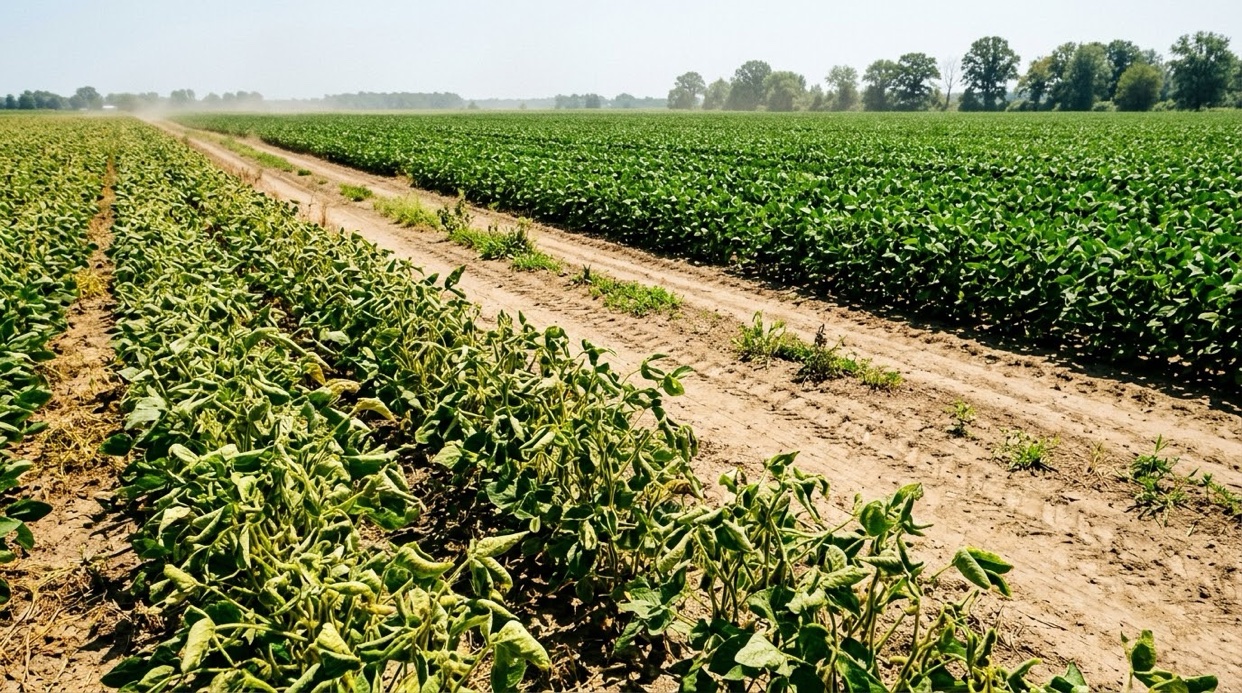
And dicamba is the one with the famous problem: drift. After dicamba-resistant genetically modified crops were introduced, dicamba’s tendency to move off-target caused millions of acres of vapor-drift damage to neighboring orchards, soybean fields, and trees that were never sprayed. The chemical is effective where you put it. The argument has always been about where it goes afterward.
3. The Numbers
Start with what’s missing. Neither 2,4-DB nor dicamba has a federal MCL or MCLG. To translate: the MCLG is EPA’s non-enforceable health goal — the level the scientists say is safe — and the MCL is the enforceable legal limit a water system must actually meet. With neither on the books, there is no legal limit for either chemical in your tap water. California and New Jersey have set no state limits for either one, and neither appears on California’s Proposition 65 list.
What exists is the Health Advisory — EPA guidance, not law. Exceeding one breaks no rule, because there is no rule to break.
Dicamba has one: a Lifetime Health Advisory of 4 mg/L (4,000 ppb), from EPA’s 2018 tables. That is a high number as these things go, and it reflects dicamba’s relatively low mammalian drinking-water toxicity. Note what dicamba does not have: EPA lists no 1-day and no 10-day Health Advisory for it — the short-term cells in the table are simply blank.
2,4-DB doesn’t even have that. EPA has published no Health Advisory for 2,4-DB at all — it is not listed in the 2018 Drinking Water Standards and Health Advisories tables. The number that anchors 2,4-DB is its chronic Reference Dose: 0.03 mg/kg/day, established in EPA’s 2005 reregistration decision. A reference dose is a different species of number from everything above. It’s not a concentration in water — it’s a dose: the amount per kilogram of your body weight, per day, that EPA’s scientists judge safe to take in over a lifetime. If anyone tries to compare 2,4-DB’s 0.03 directly against dicamba’s 4 mg/L, they’re comparing a dose to a concentration — apples to orchards.
Sit with what “no Health Advisory at all” means in practice. If a lab finds 2,4-DB in a water sample, there is no EPA advisory number to hold the result up against — no official line that says “below this is fine, above this is a concern” for the water itself. The reference dose is the only yardstick EPA has published, and it measures a dose in a body, not a concentration in a glass. That gap in the paperwork is worth knowing about before somebody waves a test result at you, in either direction.
On cancer, EPA’s word for both is the same: “Not likely to be carcinogenic to humans.” IARC, for its part, has no classification for either chemical — one more blank cell in both files.
4. What EPA Says About Health
For 2,4-DB, EPA’s findings come from chronic animal studies, where at high doses the chemical caused decreased body weight gain, reduced food consumption, and effects on the kidney, liver, thyroid, and adrenal glands. Those are the findings standing behind the 0.03 mg/kg/day reference dose in the 2005 reregistration decision.
For dicamba, EPA’s 2006 reregistration decision reports that in laboratory animals, high chronic doses caused neurotoxicity — specifically ataxia and decreased motor activity — along with maternal and fetal body weight reduction and mild liver effects.
Notice the honest shape of both files: high doses, laboratory animals, long-term studies. That is the record EPA publishes, and it is also why dicamba’s lifetime advisory can sit at 4,000 ppb while 2,4-DB’s file runs on a reference dose instead. Different chemicals, different paperwork, same absence of a legal limit.
5. What Removes Them
Neither chemical is regulated, so EPA has designated no Best Available Technology for either — no official treatment list exists. What works comes from their chemistry, and here the pair splits again.
2,4-DB is the cooperative one. It’s moderately hydrophobic — log Kow about 3.5 — which makes it a good candidate for granular activated carbon, and at about 249 daltons it’s large enough for a reverse osmosis membrane to exclude. Both GAC and RO effectively remove it. Its chemistry sits in the middle ground: greasy enough for carbon to grab, substantial enough for a membrane to stop.
Dicamba is the stubborn one. At neutral pH it exists predominantly as a negatively charged, highly water-soluble carboxylate anion — its pKa is about 1.87, meaning it takes on that charge very readily and stays dissolved and charged. Reverse osmosis removes it effectively: at about 221 daltons and carrying that charge, the membrane rejects it. Granular activated carbon manages only low-to-moderate adsorption, because carbon’s talent is grabbing water-hating chemicals, and dicamba in water is anything but.
Put together, the shopping advice writes itself. A good activated-carbon system already has 2,4-DB covered. Reverse osmosis covers both members of the pair — which matters, because the two are sprayed over much of the same countryside and can plausibly show up in the same water. If a salesman tells you his carbon box handles “the herbicides” as one undifferentiated group, dicamba is the name to ask him about specifically.
And the usual warning, because it applies to both: these are dissolved chemicals — single molecules mixed into the water, not particles suspended in it. A sediment filter’s micron rating measures particle size, and no particle rating catches a dissolved molecule. It’s like trying to catch wind in a chain-link fence: the fence can be excellent and the wind still goes through, because the problem was never the fence’s spacing. If you’re treating for dicamba in particular, reverse osmosis is the dependable answer, and carbon by itself is only a partial one.
6. The Bottom Line
2,4-DB and dicamba are a pair with no legal limits: no MCL, no MCLG, and no state limits in California or New Jersey, for either one. Dicamba at least carries a Lifetime Health Advisory — 4 mg/L, reflecting its low drinking-water toxicity — while 2,4-DB has no Health Advisory at all, just a chronic reference dose of 0.03 mg/kg/day standing guard. Both are still registered and still sprayed, on farms and on lawns, and dicamba still makes headlines for going where it wasn’t invited. If they turn up in your water, carbon handles 2,4-DB well; for dicamba, put your money on reverse osmosis. And if a lab report with either name on it ever lands on your kitchen table, you now know the first question to ask about any result: what are we comparing this number to — a lifetime advisory, a reference dose, or nothing at all? With this pair, the honest answer is different for each chemical, and anyone who gives you one answer for both hasn’t read the files.
Facts first, then filter. — Steve
Leave a Reply