
Organophosphates are a family of pesticides built around one trick: they block an enzyme called acetylcholinesterase, which your nervous system — and an insect’s nervous system — uses to switch nerve signals off. Block that enzyme and the signals keep firing. That is what makes these chemicals effective killers of insects and nematodes, and it is also what makes them serious poisons at high doses. They have been workhorse farm chemicals for decades.
Here is the part most homeowners never hear. On March 17, 2026, the EPA issued its Final Regulatory Determination 5, published in the Federal Register at 91 FR 13227, and in it the agency formally decided not to regulate three organophosphates in drinking water: ethoprop, profenofos, and tribufos. They were three of nine contaminants on the fifth Contaminant Candidate List that EPA evaluated and declined to set a national drinking-water standard for. That means no federal Maximum Contaminant Level (MCL) — no legal limit a water system has to meet — and no Maximum Contaminant Level Goal (MCLG) either. EPA’s reasoning, in each case, was that these chemicals do not show up in public water systems at levels of health concern often enough to justify a national rule.
Understand what that decision is and is not. It is not a finding that these chemicals are harmless. It is a judgment about national occurrence — how often, and how high, they were found in the monitoring data. If you are on a public system, your utility has no federal obligation to test for them or treat for them. If you are on a private well near farmland, nobody is testing for them at all unless you do it yourself. So let’s go through the three of them, one at a time.
Ethoprop
Ethoprop (also spelled ethoprophos) is a non-fumigant organophosphate nematicide and soil insecticide, sold under names like Mocap and Prophos. It goes on potatoes, sweet potatoes, sugarcane, bananas, corn, and ornamentals to kill the nematodes and soil insects that chew up roots. Because of its high acute toxicity, it is registered for agricultural use only as a Restricted Use Pesticide — the category reserved for products that can only be handled by certified applicators. It is still registered today, and EPA issued a Proposed Interim Registration Review Decision on it in 2023 before the drinking-water question landed in Regulatory Determination 5.
The numbers on ethoprop are mostly a story of absence. There is no federal MCL or MCLG. There is not even a numeric EPA Health Advisory in the agency’s 2018 Drinking Water Standards and Health Advisories table — no official short-term or lifetime benchmark number at all. California has no state MCL, Notification Level, or Public Health Goal for it, and New Jersey has no MCL either. What does exist is a cancer record: the EPA’s pesticide office classifies ethoprop as “likely to be carcinogenic to humans,” and California lists it under Proposition 65 as a chemical known to cause cancer. On health effects, EPA’s human health risk assessment describes what this class of chemical does at elevated doses — it inhibits acetylcholinesterase in blood and brain tissue, causing acute cholinergic neurotoxicity: nausea, tremors, salivation, and respiratory depression. And yet, after evaluating it under UCMR 4 monitoring and Regulatory Determination 5, EPA concluded in March 2026 that detections in national drinking water were too rare to warrant a federal limit. A likely carcinogen with no federal drinking-water number — that is the gap this series exists to point at.
On removal: because ethoprop is unregulated, EPA has designated no Best Available Technology for it — there is no official treatment answer on the books. In practice, both granular activated carbon (GAC) and reverse osmosis remove it effectively. It is moderately-to-strongly attracted to carbon (its log Kow is about 3.59, a measure of how much a chemical prefers oil-like surfaces over water), and at roughly 242 daltons it is a large enough molecule for an RO membrane to exclude.
Profenofos
Profenofos is a broad-spectrum organophosphate insecticide and acaricide, sold as Curacron and Selecron, that was used mainly against caterpillars and mites on cotton. Its American story is mostly over: it was a Restricted Use Pesticide, and in 2007 the sole U.S. registrant voluntarily cancelled its registrations. EPA revoked all remaining food tolerances except for imported commodities such as cottonseed oil. There are no active U.S. registrations today.
Even so, profenofos landed on EPA’s fifth Contaminant Candidate List and was screened under UCMR 4, and in March 2026 Regulatory Determination 5 formally closed the question: no federal standard. Like ethoprop, it has no MCL, no MCLG, and no numeric Health Advisory in EPA’s 2018 table. California has no MCL, Notification Level, or Public Health Goal for it; New Jersey has no MCL; and it is not listed under Proposition 65. On cancer, EPA’s pesticide office calls it “not likely to be carcinogenic to humans.” Its health profile is the family profile: it inhibits acetylcholinesterase in red blood cells and brain tissue, and EPA’s reregistration decision describes acute cholinergic nervous system toxicity at elevated exposures — nausea, dizziness, muscle twitching, and respiratory distress. EPA’s RD 5 conclusion was that profenofos does not occur in U.S. public water systems at levels requiring regulation — which, for a chemical cancelled here in 2007, is a conclusion about a pesticide this country largely stopped using.
Removal follows the same pattern. No EPA Best Available Technology is designated, because the chemical is unregulated. But both GAC and reverse osmosis achieve better than 95% removal: profenofos is highly hydrophobic (log Kow about 4.68), so it binds strongly to activated carbon, and at about 374 daltons it is a big molecule that an RO membrane rejects easily.
Tribufos
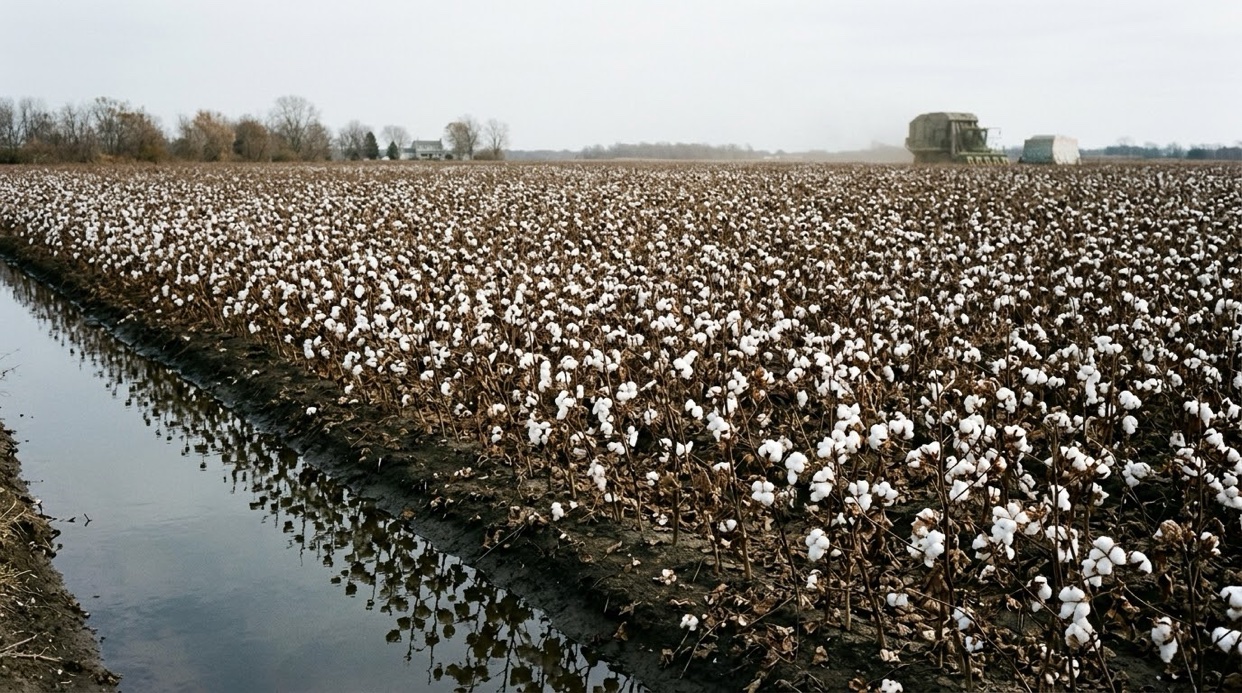
Tribufos is the one of the three you can smell. Sold as DEF, DEF 6, and Folex, it is an organophosphate cotton defoliant — sprayed before mechanical harvest so the leaves drop cleanly and don’t stain the fiber. (Its close relative merphos rapidly oxidizes into tribufos in the environment.) It is still actively registered in the U.S., for cotton defoliation only, as a Restricted Use Pesticide. In farm country it is notorious for a pungent, skunk-like mercaptan odor during the autumn cotton harvest, which regularly triggers odor complaints and spray-drift concerns in places like California’s San Joaquin Valley and the Mississippi Delta.
Its regulatory file matches its cousins: no federal MCL or MCLG, a formal decision not to regulate in the March 2026 Regulatory Determination 5, and no numeric Health Advisory in EPA’s 2018 table. The one number that does exist comes from monitoring: when EPA screened for tribufos under UCMR 4, the reference concentration it compared results against — drawn from the 2017 Human Health Benchmarks for Pesticides — was 0.6 micrograms per liter. That is a screening benchmark, not a legal limit and not a Health Advisory, but it tells you the level EPA’s own health benchmarks work around. On health effects, EPA’s risk assessment describes acetylcholinesterase inhibition in blood and brain tissue causing cholinergic neurotoxicity, and in chronic rodent studies, gastrointestinal lesions in the small intestine and vascular tumors.
For removal, again, there is no designated EPA Best Available Technology — the chemical is unregulated, so no official treatment standard exists. The working answers are the same: GAC and reverse osmosis both achieve better than 95% removal. Tribufos is highly hydrophobic (log Kow about 5.7), which makes it an excellent candidate for activated carbon, and at roughly 315 daltons an RO membrane excludes it readily.
One piece of teaching applies to all three of these chemicals, and to most pesticides in this series. Ethoprop, profenofos, and tribufos in water are dissolved chemicals — individual molecules mixed into the water itself, not particles floating in it. That is why a sediment filter or a micron rating cannot help you here. A micron rating measures the size of holes in a filter, and holes only stop things bigger than the holes. Asking a sediment cartridge to catch a dissolved pesticide is like trying to catch wind in a chain-link fence. The tools that work on dissolved chemicals are different: activated carbon, which grabs the molecules onto its surface, and reverse osmosis, which pushes water through a membrane tight enough to leave the molecules behind. If a salesman tries to sell you a micron rating as pesticide protection, he is selling you the fence.
The Bottom Line
In March 2026, the EPA looked at ethoprop, profenofos, and tribufos and decided, formally and on the record, not to regulate any of them in drinking water. One is a likely carcinogen still in restricted agricultural use. One was cancelled in this country in 2007 and lingers mainly as an import and monitoring question. One is still sprayed on cotton every fall, skunk smell and all. None of them has a federal limit, a federal goal, or even a numeric federal Health Advisory — and because they are unregulated, EPA has designated no Best Available Technology for removing them.
What that means at your tap is simple. Your water system is not required to look for these chemicals, and if they were found, no federal number would say how much is too much. If you live near the fields where they are used — potatoes, sugarcane, and corn country for ethoprop; cotton country for tribufos — the testing and the treating are on you. The good news is that the home tools work: a well-maintained activated carbon system and a reverse osmosis unit both take these chemicals out effectively. Just don’t let anyone tell you a sediment filter and a micron number will do it. Know what’s in your water, know what your filter actually does, and the gap between “unregulated” and “unprotected” gets a lot smaller.
Facts first, then filter. — Steve
Leave a Reply