
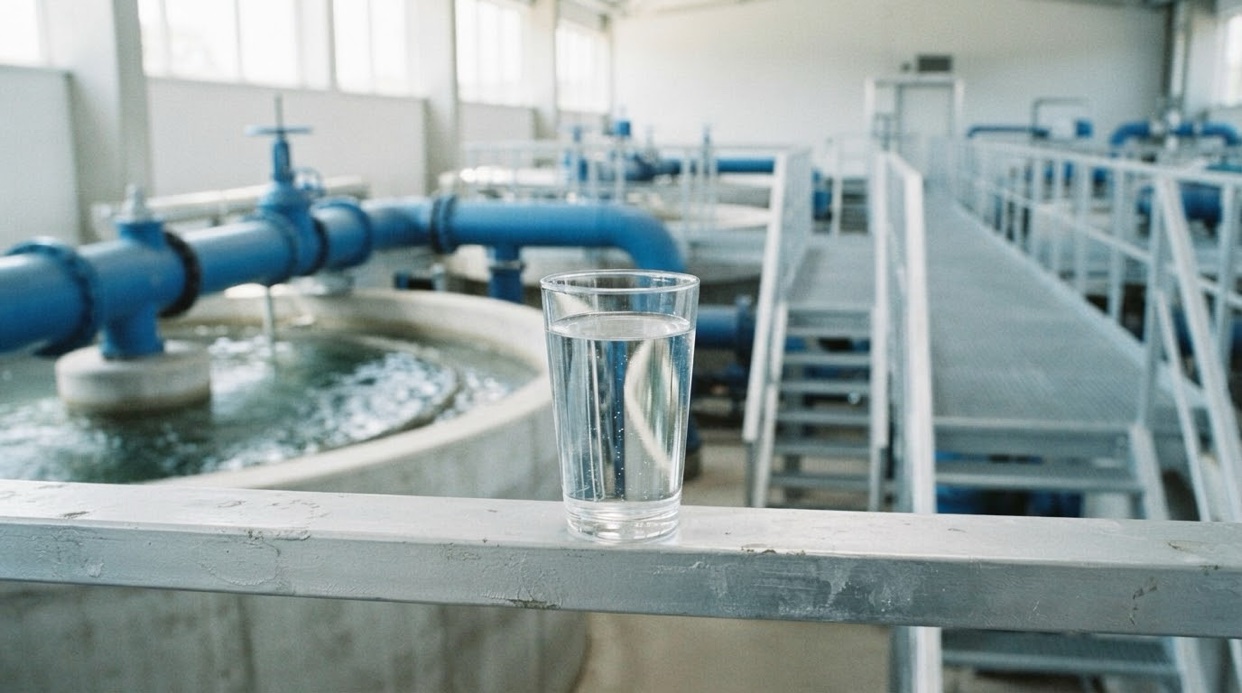
Most drinking-water contaminants arrive at the treatment plant already dissolved in the raw river, lake, or aquifer water. Acetaldehyde, formaldehyde, and glyoxal work the opposite way: they are largely created inside the treatment plant itself.
When a water utility switches from traditional chlorine disinfection to ozone in order to cut down on regulated trihalomethanes, the powerful ozone gas reacts with and shreds naturally occurring organic matter in the source water. That chemical breakdown generates a family of small, biodegradable aldehydes—most notably acetaldehyde, formaldehyde, and glyoxal. Because these three compounds are biodegradable, they create a unique operational headache for water utilities: if left untreated, they travel into the distribution system and act as a food source that fuels bacterial regrowth inside water mains.
Rather than adding more chemicals to solve the problem, water treatment plants rely on biology to control them. Biologically active carbon (BAC) filters—activated carbon beds colonized by beneficial microorganisms—allow microbes to consume and break down these aldehydes before the water leaves the plant. Despite their routine formation during ozonation, none of the three has a federal Maximum Contaminant Level (MCL) in the United States.
Acetaldehyde
Acetaldehyde is a volatile aldehyde used industrially to manufacture acetic acid, pentaerythritol, pyridine derivatives, and peracetic acid. Beyond industrial synthesis, it forms naturally during fermentation and is generated as both an ozonation and chlorination byproduct in drinking water.
On the regulatory front, acetaldehyde operates without binding federal or state tap-water limits:
- Federal Standards and Advisories: Acetaldehyde has no federal MCL and no EPA health advisory. Instead, it sits on the U.S. Environmental Protection Agency’s Contaminant Candidate Lists 3 and 4, placing it on the agency’s watchlist for potential future evaluation.
- State Standards: Neither California nor New Jersey sets a drinking-water standard for acetaldehyde. Readers reviewing state water tables should be careful not to confuse acetaldehyde with formaldehyde, which does have an established California notification level.
Toxicologically, exposure to acetaldehyde causes severe irritation of the eyes, skin, and respiratory tract. When it comes to long-term cancer risk, the scientific evidence derives from inhalation animal studies, which demonstrated nasal and laryngeal tumors. Because the EPA’s toxicological assessment is inhalation-based and no oral reference dose has been derived, there are no established drinking-water ingestion endpoints for acetaldehyde.
Cancer classifications for acetaldehyde require careful reading across three distinct listings:
- EPA Classification: Group B2 (probable human carcinogen).
- IARC Classification (Chemical Alone): Group 2B (possibly carcinogenic to humans) for acetaldehyde itself.
- IARC Classification (Alcohol Link): Group 1 (carcinogenic to humans) specifically for “acetaldehyde associated with consumption of alcoholic beverages”—which IARC maintains as its own separate listing.
At the state level, California has listed acetaldehyde on Proposition 65 for cancer since 1988.
Formaldehyde
Formaldehyde is a pungent gas that is commonly sold dissolved in water as formalin. In manufacturing, it is widely used to produce urea-formaldehyde and phenol-formaldehyde resins for pressed-wood products, adhesives, plastics, textiles, and embalming fluid. In drinking water, formaldehyde forms primarily as an ozonation or chlorination byproduct, though it can also leach directly into tap water from certain polyacetal plumbing fittings. Reflecting broad concern over its uses, the EPA’s chemical-safety program completed a risk evaluation of formaldehyde in December 2024 that reached an “unreasonable risk” finding.
Unlike acetaldehyde, formaldehyde has a comprehensive set of federal health advisories alongside state-level notification benchmarks, even though it still lacks a federal legal limit:
- Federal MCL: None.
- EPA 1-Day Health Advisory (2018): 10 mg/L
- EPA 10-Day Health Advisory (2018): 5 mg/L
- EPA Lifetime Health Advisory (2018): 1 mg/L (1,000 ppb)
- EPA Drinking Water Equivalent Level (DWEL): 7 mg/L
- EPA Oral Reference Dose: 0.2 mg/kg/day
- California Benchmarks: California maintains a Notification Level of 0.1 mg/L (100 ppb) and a Response Level of 1 mg/L. California originally set its action level at 30 ppb in 1983 before revising it to 100 ppb in 2000.
- New Jersey Status: New Jersey’s Drinking Water Quality Institute developed toxicity factors for formaldehyde under its A-280 program, but the state never adopted an MCL for a practical operational reason: the lack of a standardized analytical method for measuring it reliably in drinking water.
Formaldehyde’s health effects depend sharply on the route of exposure. When swallowed in water, it irritates the gastrointestinal tract, with animal studies in rats also showing reduced body weight gain and stomach changes. When breathed in, however, formaldehyde causes nasopharyngeal cancer and myeloid leukemia in humans.
Major health agencies classify formaldehyde’s carcinogenicity as follows:
- IARC Classification: Group 1 (carcinogenic to humans).
- EPA Assessment: The EPA’s 2018 health advisory tables carry a Group B1 classification (probable human carcinogen), and the agency’s 2024 Integrated Risk Information System (IRIS) review concludes that formaldehyde is carcinogenic to humans by inhalation.
- California Proposition 65: California lists “formaldehyde (gas)” on Proposition 65 for cancer (listed 1988).
Glyoxal
Glyoxal is the simplest dialdehyde and is typically sold commercially as a 40% aqueous solution. Industrially, it serves as a crosslinking agent for paper coatings, textiles, leather tanning, and adhesives, as well as a biocide intermediate. In drinking water, just like acetaldehyde and formaldehyde, glyoxal forms as a disinfection byproduct when ozone reacts with natural organic matter. It ranks as one of the main dicarbonyl byproducts of ozonation, appearing alongside formaldehyde, acetaldehyde, and methylglyoxal.
From a regulatory standpoint, glyoxal sits in a complete blank space:
- Federal Standards and Advisories: It has no federal MCL and no EPA health advisory.
- State Standards: Neither California nor New Jersey sets a drinking-water standard for glyoxal.
- Cancer Classifications and Listings: Glyoxal has no cancer classification—IARC has never evaluated glyoxal, and the EPA has no Integrated Risk Information System (IRIS) assessment for it. It is also not listed on California’s Proposition 65.
Toxicologically, glyoxal is the least-charted of the three aldehydes. Compared with formaldehyde’s extensive toxicological record, the data on glyoxal are thin. What is established is modest: glyoxal is an irritant compound, and animal studies report gastrointestinal irritation and reduced weight gain following exposure.
| Chemical | Federal MCL | EPA Health Advisories | State Benchmarks | Cancer Status |
|---|---|---|---|---|
| Acetaldehyde | None | None (sits on CCL 3 and CCL 4) | CA: None / NJ: None | EPA Group B2; IARC Group 2B (Group 1 with alcohol); CA Prop 65 |
| Formaldehyde | None | 1-Day: 10 mg/L; 10-Day: 5 mg/L; Lifetime: 1 mg/L (1,000 ppb); DWEL: 7 mg/L | CA Notification: 0.1 mg/L (100 ppb), Response: 1 mg/L / NJ: None | IARC Group 1; EPA Group B1 / carcinogenic by inhalation; CA Prop 65 (gas) |
| Glyoxal | None | None | CA: None / NJ: None | Not evaluated by IARC; no EPA IRIS assessment; not on Prop 65 |
What Removes Them — and What Doesn’t
When homeowners look for a filter to strip chemicals out of tap water, they usually reach for standard activated carbon or a reverse osmosis system. For the aldehyde trio, both of those conventional household workhorses run into fundamental physical and chemical roadblocks.
- Plain Granular Activated Carbon (GAC): Plain activated carbon performs poorly on all three aldehydes. Carbon relies on hydrophobic attraction to trap contaminants, but acetaldehyde, formaldehyde, and glyoxal are small, highly water-soluble molecules that carbon barely grabs. Formaldehyde, for example, has an extraordinary water solubility of 400,000 mg/L, glyoxal stays tightly dissolved in water without evaporating, and acetaldehyde dissolves far too readily to be pulled out easily.
- Biologically Active Carbon (BAC): What actually works is biologically active carbon—carbon beds colonized by beneficial microbes that consume and biodegrade the aldehydes as water passes through. Instead of relying on physical adsorption, biological filtration turns the carbon into a living ecosystem. Studies show biological filtration removing over 90 percent of ozonation carbonyls before water enters the distribution system.
- Air Stripping: Air stripping is ineffective across this entire family. Because these molecules bond so tightly with water, bubbling air through the water fails to strip them out.
- Reverse Osmosis (RO): Reverse osmosis is weak against this trio. Because acetaldehyde, formaldehyde, and glyoxal are tiny, uncharged molecules, RO membranes fail to block them reliably—measured carbonyl rejection sits at roughly 33 to 58 percent. Because rejection is low and incomplete, reverse osmosis cannot be relied upon to remove aldehydes from tap water.
The operational lesson is clear: the aldehydes represent the rare water-treatment case where the living biological filter beats both standard carbon adsorption and high-pressure membrane filtration.
What It Means for the Reader
Unlike industrial solvents or agricultural runoff that wash into a river upstream, acetaldehyde, formaldehyde, and glyoxal are born inside the treatment plant itself when utilities use ozone to disinfect water. Because utilities running ozone know that these biodegradable compounds fuel bacterial regrowth in water mains, they manage them directly at the plant using biological filtration. At home, their presence in water chemistry is a reason to read and respect what your local water utility reports about its disinfection methods—not a reason to panic.
Facts first, then filter. — Steve
Leave a Reply