
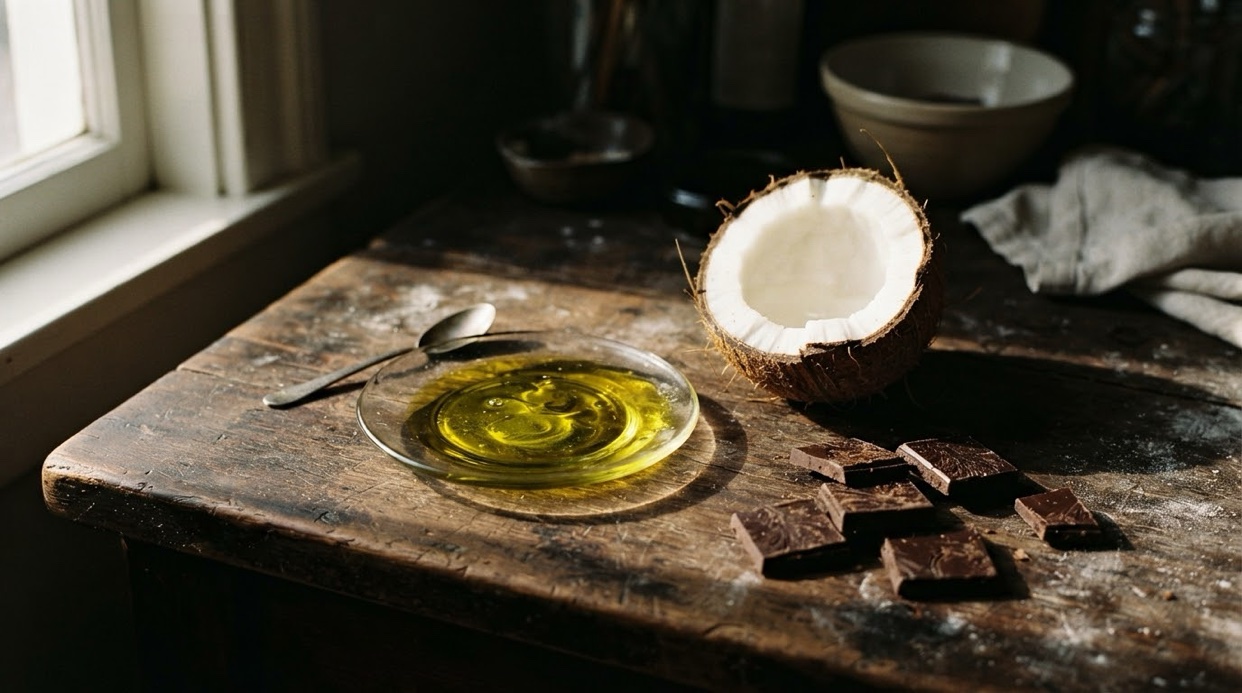
When a laboratory scan prints a string of long chemical names near the obscure tail of a water report, most homeowners assume the worst. They look down the page, past the words they recognize, and hit dodecanoic acid, tetradecanoic acid, hexadecanoic acid, octadecanoic acid, oleic acid, and erucylamide. After a lifetime in professional water treatment—and now teaching homeowners how to read their own tests without getting panicked by laboratory jargon—I can tell you straight away that this list is not what it looks like at first glance.
The Family
Five of those six names share the exact same chemical construction: a chain of carbon atoms with an acid end. Those are the fatty acids, the basic building blocks of every fat and oil on Earth. The sixth name, erucylamide, is their industrial cousin—a fatty-acid amide made from a plant oil and used inside plastic film.
When a laboratory scan prints these names on a water report, it is not reading a spill. It is reading the chemistry of living things. It is picking up the fats that every plant, animal, kitchen, and sewer on the planet sheds into water.
The Names
Once you strip away the formal systematic naming, every single item on that list turns into something you already know:
- Dodecanoic acid — Better known as lauric acid, a 12-carbon chain. It is the signature fat of coconut oil and palm kernel oil, and it is also present in human breast milk. At room temperature, it is a solid, waxy fat.
- Tetradecanoic acid — Better known as myristic acid, a 14-carbon chain named for nutmeg (Myristica), where it was first found. It is present in butter and most animal and plant fats in small amounts.
- Hexadecanoic acid — Better known as palmitic acid, a 16-carbon chain named for palm oil. It is the most common saturated fat in the human diet and in the human body itself—your own body manufactures it.
- Octadecanoic acid — Better known as stearic acid, an 18-carbon chain. It is the hard fat of beef tallow and cocoa butter, and the reason chocolate snaps. Like lauric acid, it is a waxy solid.
- Oleic acid — An 18-carbon chain with one bend in it, making it a monounsaturated fat. It is the signature fat of olive oil, named for it (oleum, oil). That bend is why olive oil stays liquid while stearic acid stays solid.
- Erucylamide — An amide built from erucic acid, the 22-carbon fat of rapeseed. Industry uses it as a slip agent inside plastic films and bags, where it migrates to the surface of the plastic so the film does not stick to itself. In water, it is a fingerprint of plastic, not of food.
Why They Are in the Water at All
Fatty acids barely dissolve in water—they would rather float, coat, and cling—but at trace levels they are everywhere life has been. You find them in decaying plant and animal matter in reservoirs, food-processing and kitchen wastewater, treated sewage effluent, and the general organic background every water source carries.
A laboratory instrument sensitive enough to read parts per billion will find them in almost any real water. Their detection measures the instrument’s sensitivity and the water’s contact with the living world, not contamination in the spill sense. No homeowner test targets these compounds individually; they surface on broad laboratory scans, riding along with the water’s total organic matter.
The Numbers
Not one of the six has a federal drinking-water limit—no Maximum Contaminant Level (MCL), no Maximum Contaminant Level Goal (MCLG)—and no EWG health guideline exists for any of them. There is simply no government number to compare a detection against, because no drinking-water health assessment has ever found a reason to set one.
Context explains why. These are nutrients the body uses in gram quantities every day from food. A trace detection in tap or well water is background chemistry, thousands of times below anything a normal meal delivers.
Health Framing
At a general level, these five fats are food. Your body burns them for energy, stores them, and builds cell membranes out of them; palmitic acid, as noted earlier, your body makes on its own.
Erucylamide is a different category and deserves an honest distinction: it is an industrial additive with a thin regulatory file and no drinking-water assessment. It is the one name in the set that comes from a factory rather than a kitchen, and it belongs in its own bucket rather than being lumped in with dietary fats. At the same time, there is no basis to invent hazards for it when no assessment establishes them.
What Removes Them
Because fatty acids are large molecules that barely dissolve in water, conventional and residential treatment methods handle them through straightforward physical and biological mechanisms: ordinary treatment biology consumes them, granular activated carbon adsorbs them readily, and reverse osmosis rejects them outright—an RO membrane’s pores are on the order of a ten-thousandth of a micron, far smaller than a fat molecule, which is why RO water carries essentially no organic load of this kind.
The Bottom Line
The lab found lunch—five of the most ordinary fats in the human diet, plus one slip agent off a plastic bag. A water report that lists them is telling you the water once touched the living world, which is true of every water worth drinking.
Facts first, then filter. — Steve
Leave a Reply