
When a laboratory water test stretches down into the obscure tail of the contaminant list, the names start sounding less like familiar household plumbing issues and more like an organic chemistry textbook. Seeing acetic acid, benzoic acid, benzaldehyde, acetophenone, 2-methylbenzaldehyde, 2-furancarboxyaldehyde, and butylated hydroxyanisole printed on a report can make any homeowner stop and wonder what has gotten into their supply. After a lifetime in professional water treatment, now spent teaching homeowners how to read these reports clearly, I look at this particular cluster of seven and see something far closer to home than a chemical plant.
The Family
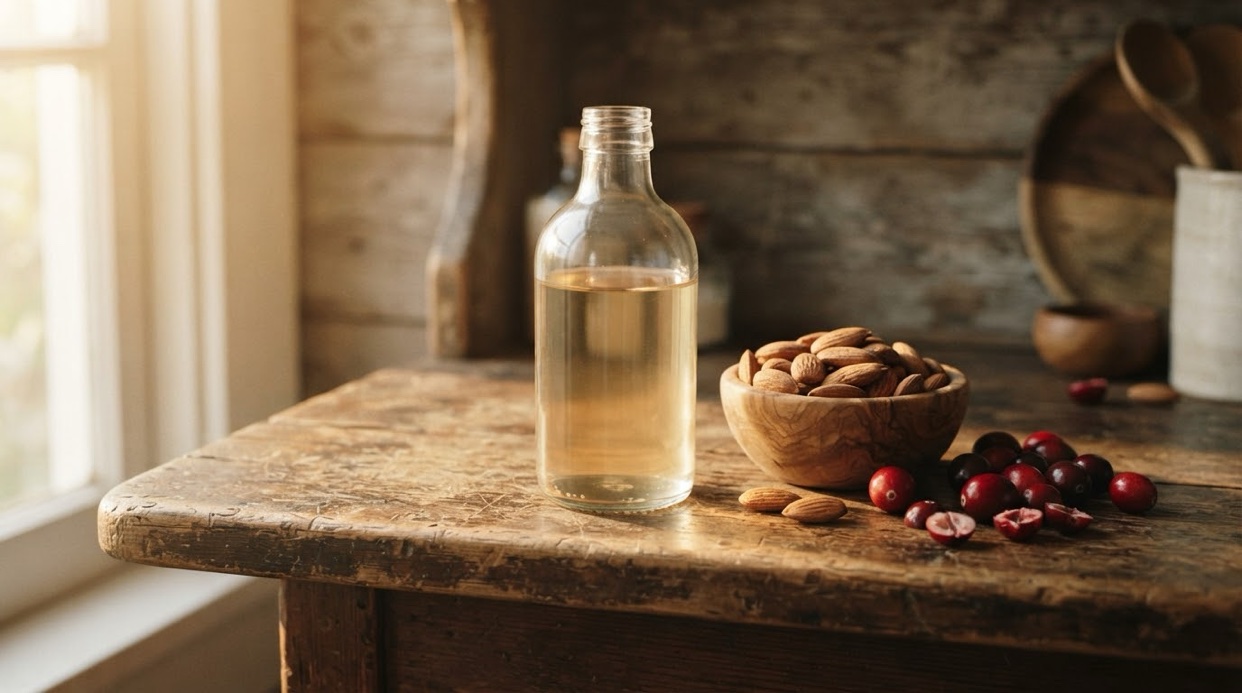
Six of these seven names represent the flavor-and-preservation chemistry of the kitchen itself—the acid in vinegar, the preservative in cranberries and soda, the smell of almonds, and the scent notes of flowers and roasted food. The seventh is a factory-made antioxidant that keeps those same kitchen fats from going rancid. When a lab scan prints these names, it is reading the residue of cooking, eating, and food-making—the most domestic chemistry there is.
The Names
Breaking each chemical down to what it actually is strips away the intimidation right away:
- Acetic acid — The acid of vinegar; ordinary table vinegar is about five percent acetic acid in water. It provides the sharp smell of every pickle jar and salad dressing. It is also one of the simplest organic acids there is—microbes make it, microbes eat it, and the body uses its salt form, acetate, as fuel.
- Benzoic acid — A natural preservative that occurs on its own in cranberries, cinnamon, and cloves, and is added—usually as its salt, sodium benzoate—to sodas and juices to stop mold and yeast. The body clears it readily, converting it and sending it out in urine, making it a compound human metabolism has handled for as long as people have eaten berries and spices.
- Benzaldehyde — The smell of almonds and marzipan, and the flavor of almond extract. It occurs naturally in the kernels of stone fruit—apricot, peach, and bitter almond—and is made for flavor and fragrance use, standing as one of the oldest flavor chemicals in the pantry.
- Acetophenone — A sweet, floral-smelling compound with notes people compare to hawthorn and jasmine. It is used in fragrances and flavorings, and it also serves as an industrial solvent and appears as a breakdown product of other aromatics.
- 2-Methylbenzaldehyde — Benzaldehyde’s close cousin, built with the same almond-family construction plus one extra methyl group bolted on. It is a flavor-and-fragrance intermediate with a thinner file than its famous relative.
- 2-Furancarboxyaldehyde — Better known as furfural. It is born when sugars are heated: roasting coffee, baking bread, and cooking generally all create it, which is why it rides along with cooked food and plant material. Industry also makes it deliberately from farm waste like corncobs and oat hulls. In a water report, it is a fingerprint of cooked and living plant matter.
- Butylated hydroxyanisole — BHA, the one factory name of the set. It is a synthetic antioxidant stirred into cereals, oils, and packaged foods so the fats in them do not go rancid on the shelf. Unlike the other six, it has no kitchen source at all; it arrives from the food industry itself.
Why They Are in the Water at All
Every kitchen, bakery, brewery, and food plant on Earth washes these compounds down a drain. In the environment, they are biodegradable and short-lived—ordinary microbes consume acetic and benzoic acid eagerly, and the flavor aromatics break down as well. However, a laboratory sensitive to parts per billion reads the faint, constant background of a world that cooks. No homeowner test targets these seven individually; they surface on broad laboratory scans among the water’s organic matter.
The Numbers
Not one of the seven has a federal drinking-water limit—no Maximum Contaminant Level (MCL) and no Maximum Contaminant Level Goal (MCLG)—and no EWG health guideline exists for any of them. For six of the seven, no drinking-water health assessment has ever been written, because the exposures from food dwarf anything water could carry. BHA is the exception in one specific way, which needs to be weighed carefully alongside the rest of the group.
Health Framing
Six of the seven are food itself or food’s oldest companions—eaten, drunk, and metabolized by people for centuries. BHA, by contrast, carries real hazard classifications: the U.S. National Toxicology Program lists it as reasonably anticipated to be a human carcinogen, the International Agency for Research on Cancer places it in Group 2B as “possibly carcinogenic to humans,” and California lists it under Proposition 65. Keeping the boundary straight matters here: those classifications rest on high-dose animal studies—including tumors in a rodent organ, the forestomach, that humans do not possess—and they are hazard classifications, not measurements of risk from parts per billion in drinking water, where no federal assessment sets a limit.
What Removes Them
Because these are small dissolved organic molecules, a sediment filter does nothing for any of them—the tools are granular activated carbon, which adsorbs the aromatic flavor compounds and BHA readily, ordinary treatment biology, which consumes the simple acids, and reverse osmosis, whose membrane pores—on the order of a ten-thousandth of a micron—are far smaller than any of these molecules.
The Bottom Line
The lab found the pantry—vinegar, cranberry, almond, and the smell of the oven—plus one factory antioxidant that keeps the pantry from spoiling. It is six names your grandmother would recognize by smell, and one she would recognize by the cereal box.
Facts first, then filter. — Steve
Leave a Reply