
Where city water starts
Turn on the kitchen faucet in almost any town or city, and clean water pours out on demand. Because it arrives effortlessly, it is easy to forget that this water started its day somewhere very different — either out in the open weather of a river, lake, or reservoir, or deep underground in an aquifer tapped by municipal wells.
Surface water and groundwater behave very differently before they ever reach a treatment plant. Water drawn from rivers, lakes, and reservoirs sits open to the sky, the soil, and the surrounding watershed. Rain washes dirt, leaves, and organic debris into it, and wildlife lives right inside it. Groundwater pulled from municipal wells has already spent time moving through rock and soil, which filters out floating debris, though it still comes up out of the earth carrying its own local chemistry.
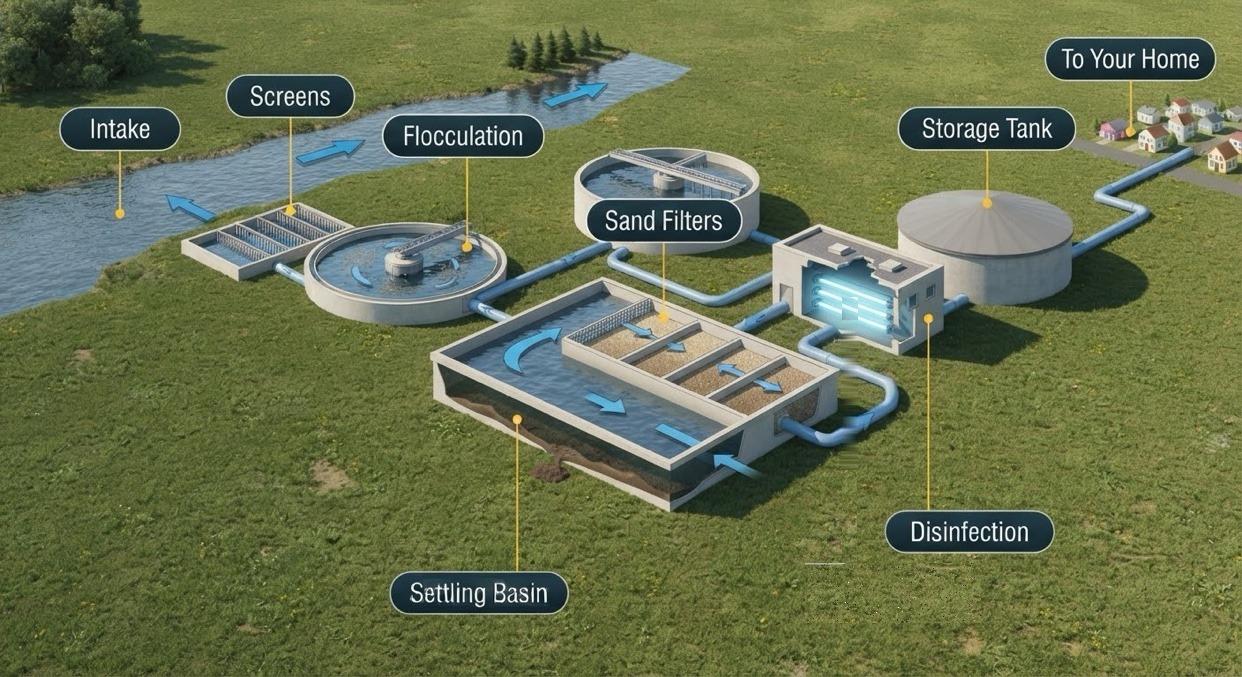
When a city relies on surface water, the treatment process begins right at the shoreline or riverbed. Before water even enters the plant’s pumps, it passes through intake screens. Those screens have one straightforward mechanical job: keeping out fish, sticks, leaves, and large debris so nothing gets sucked into the pipes and damages the equipment downstream. Once the water clears the intake screens, it is pumped inside the treatment plant, where the real chemistry and physical separation begin.
Coagulation and flocculation
Raw river or lake water often looks cloudy, brownish, or slightly murky. That cloudiness comes from tiny suspended particles of dirt, silt, and organic matter. The trouble with these microscopic particles is that they are so light — and carry electrical charges that keep them pushing away from one another — that if you left a jar of that water sitting on a counter, many of those particles would never settle to the bottom on their own.
To solve that problem, the treatment plant makes its first real move: coagulation.
During coagulation, operators rapidly mix a chemical coagulant — such as alum — directly into the incoming water. High-speed mixers disperse the coagulant evenly within seconds so it reaches every drop. The coagulant neutralizes the electrical charges keeping those tiny dirt and organic particles apart. Once those repelling charges are canceled out, the particles stop pushing away from each other and begin to stick together.
Right after rapid mixing comes flocculation. Here, the plant slows way down. The water moves into basins fitted with large, slow-moving paddles that stir the water gently. That slow, deliberate stirring encourages the newly neutralized particles to bump into one another without breaking apart. As they collide and cling together, they grow from invisible specks into visible, heavier clumps called floc. Within a short time, water that looked uniformly cloudy now holds millions of distinct, snowflake-like clusters ready to drop out of suspension.
Sedimentation
Once coagulation and flocculation have bundled those microscopic particles into heavy floc, the plant lets gravity take over. This stage is sedimentation, and it happens inside large, quiet settling basins.
In the sedimentation basins, the water’s forward speed slows down dramatically so the water rests for hours. Without the turbulence of fast-moving pipes or mixing paddles to keep them stirred up, the heavy floc particles gradually sink toward the floor of the basin. As the hours pass, a thick blanket of settled solids — known as sludge — collects along the bottom.
Mechanical scrapers or collection systems draw that sludge off the bottom of the basins so it can be removed and handled separately. Meanwhile, the much clearer water near the top of the basin spills gently over weirs and moves on to the next stage of treatment. By the time water leaves sedimentation, the vast majority of the visible dirt and suspended solids that entered from the river have been left behind on the basin floor.
Filtration
Even after hours of quiet settling in the sedimentation basins, the water is not completely free of suspended material. Very fine particles of floc, silt, and microscopic organisms can remain suspended in the water column. To catch what gravity missed, the plant sends the water through filtration.
In a conventional water treatment plant, water flows downward through deep filter beds built in distinct layers. At the top sits a layer of crushed anthracite coal, beneath that is a layer of fine sand, and supporting them both at the bottom is a layer of gravel. Using anthracite coal over sand gives the filter bed different grain sizes from top to bottom — larger spaces near the top catch bigger remaining particles so the filter does not clog immediately, while the finer sand underneath traps much smaller particles as the water works its way down.
Plant operators watch filter performance closely by measuring turbidity — the cloudiness of the water caused by suspended particles. Under federal rules, conventional treatment plants are required to keep filtered-water turbidity at or below 0.3 NTU (Nephelometric Turbidity Units) in at least 95% of measurements. Keeping turbidity that low is not just about making water look crystal clear in a glass; it is a critical safety benchmark.
Specifically, filtration serves as the plant’s main physical barrier against disease-causing protozoa — hardy microscopic parasites that can enter surface water from animal or human waste. Two of the most important ones are Giardia and Cryptosporidium:
- Giardia cysts measure about 8 to 12 microns across.
- Cryptosporidium oocysts are even smaller, measuring about 4 to 6 microns across.
Properly operated anthracite-and-sand filter beds physically trap these cysts and oocysts as the water passes through, preventing them from moving downstream toward the city’s taps.
Disinfection
Filtration removes physical particles and traps protozoa, but bacteria and viruses are far smaller than Giardia or Cryptosporidium and can slip right through sand and coal. That is why the next step in the plant is disinfection — killing or inactivating whatever living pathogens remain in the water.
Chlorine is the most common disinfectant used in municipal water plants. It is effective against bacteria and viruses, well understood by operators, and straightforward to measure. However, many water systems choose to use chloramine — a combination of chlorine and ammonia — instead of free chlorine, because a chloramine residual lasts longer as water travels through miles of city pipes. Some treatment plants also incorporate ozone or ultraviolet (UV) light into their disinfection process to strengthen pathogen inactivation before the water leaves the facility.
Regardless of the chemical used, treatment operators do not simply guess at how much disinfectant to add. Disinfection strength is measured using a specific standard called CT, which stands for disinfectant concentration multiplied by contact time. A higher concentration of disinfectant needs less time to kill pathogens, while a lower concentration requires holding the water in contact basins for a longer period. By tracking CT carefully, operators verify that the water has received enough disinfection power before it enters the distribution network.
Understanding how disinfection works also highlights why every step in the treatment train depends on the one before it. Cryptosporidium is highly resistant to chlorine — normal chlorine levels in a treatment plant will not reliably kill it. That is precisely why physical filtration in the previous step, rather than chlorine disinfection, is the real barrier against Cryptosporidium.
Finally, disinfection does not end when the water leaves the treatment plant. Under federal rules, a detectable disinfectant residual must remain in the water as it travels through the distribution system. That lingering residual acts as an ongoing safeguard against microbial regrowth inside the miles of underground pipes between the plant and your home.
Fluoride and corrosion control
Once the water has been clarified, filtered, and disinfected, the plant applies its finishing chemistry before sending the water out to the public. Two major adjustments happen here: fluoridation and corrosion control.
In communities where fluoride is added to the public water supply, operators adjust the concentration to about 0.7 mg/L (milligrams per liter), which is the recommended level for dental health.
At the same time, operators carefully tune the water’s chemistry for corrosion control. Raw water leaving a filter bed can be naturally corrosive to metal pipes. If corrosive water flows through the city’s distribution system and into homes, it can eat away at the inside of plumbing and dissolve metals into the drinking water. To prevent that, treatment plants adjust the water’s pH and alkalinity, and they often add orthophosphate. Orthophosphate reacts with the metal inside pipes to form a thin, protective mineral scale along the interior pipe walls, acting as a barrier between the flowing water and the metal itself.
This finishing step at the treatment plant is the single most important factor in preventing lead exposure at the tap. Most lead in tap water comes from lead service lines and home plumbing, not from the source water in the river or aquifer. Proper corrosion control at the treatment plant is what keeps that lead locked inside the pipe walls and out of your drinking water.
Storage and distribution
Treated water does not go straight from the chemical feed pumps into your kitchen sink. First, it flows into large underground or covered basins at the plant called clear wells. Clear wells give the disinfectant plenty of contact time to finish its work and provide a buffer supply of finished water ready to meet changing city demand throughout the day and night.
From the clear wells, powerful high-service pumps push the water into the distribution network and up into elevated storage tanks — the familiar water towers seen rising above neighborhoods and industrial parks. Those elevated tanks serve two vital roles: they store reserve water for peak morning and evening use or fire protection, and the sheer height of the water column uses gravity to maintain steady water pressure across the city’s pipes.
From there, water travels through a vast underground web of large transmission mains, smaller neighborhood street mains, and finally into individual service lines leading to homes and businesses.
However, water quality is not frozen in time once it leaves the treatment plant; it can decline during this trip through the pipes. As water spends hours or days moving through the network, the disinfectant residual fades with time and distance. Older, unlined iron mains can build up scale or sediment, and dead-end streets — where water sits without circulating in a loop — are particularly vulnerable weak points where water ages faster and residuals drop lowest. That is why water utilities regularly open fire hydrants to flush mains, pulling fresh, properly disinfected water out to the far edges of the system and scouring loose sediment out of the lines.
What the plant does NOT remove
To understand your tap water accurately, you need to know what a municipal plant is built to do — and where its design stops. Conventional water treatment — the classic four-step sequence of coagulation, settling, filtration, and disinfection — is built to remove suspended dirt, cloudiness, and biological pathogens like bacteria, viruses, and protozoa. It does NOT remove most dissolved chemicals.
Because dissolved chemicals are mixed at the molecular level right into the water, they do not clump up with alum, they do not sink in a sedimentation basin, they pass straight through anthracite coal and sand filters, and chlorine does not take them out. Several well-known contaminants fall into this category:
- Atrazine, a widely used agricultural herbicide, passes right through conventional treatment. When a utility needs to remove atrazine, the EPA’s best available technology for the job is granular activated carbon (GAC), which adsorbs the chemical onto carbon pores.
- Nitrate — often washed into rivers and aquifers from fertilizers and septic systems — also passes untouched through conventional treatment.
- PFAS (per- and polyfluoroalkyl substances) and many pharmaceuticals likewise move right through standard coagulation, settling, filtration, and chlorine disinfection.
Removing dissolved contaminants like nitrate, PFAS, and pharmaceuticals requires advanced treatment technologies beyond a conventional plant — specifically activated carbon, ion exchange resins, or high-pressure membrane systems. As new federal PFAS limits phase in, more municipal water systems across the country will be pushed to add these advanced treatment stages onto their existing plants.
Read your own plant’s report
Under the Safe Drinking Water Act, the federal government sets enforceable limits — called Maximum Contaminant Levels (MCLs) — for more than 90 contaminants, and municipal utilities test their treated water constantly to make sure they meet those standards.
You do not have to guess what your local plant is finding in those tests. By law, every community water system must publish a Consumer Confidence Report (CCR) by July 1 each year. The CCR is your utility’s annual water quality report, and it lays out the hard facts from the previous calendar year in one place:
- Where your city’s water comes from (river, lake, reservoir, or wells).
- Every regulated contaminant that was detected in the treated water.
- The exact levels at which those contaminants were found compared against federal limits.
- Any treatment or testing violations the utility experienced during the year.
Whether you get your report mailed as a postcard link, tucked into a summer water bill, or posted directly on your utility’s website, the CCR is the single best document a homeowner can read about their own tap water.
The bottom line
A municipal water treatment plant works like a well-rehearsed assembly line — screening out debris, clumping and settling mud, filtering out stubborn parasites, disinfecting against microbes, and tuning water chemistry to protect household pipes — all before delivering water under pressure to your door. Knowing how each step works, and knowing what conventional treatment leaves behind, lets you read your annual water quality report with clear eyes and make smart decisions at your own sink.
Facts first, then filter. — Steve
Leave a Reply