
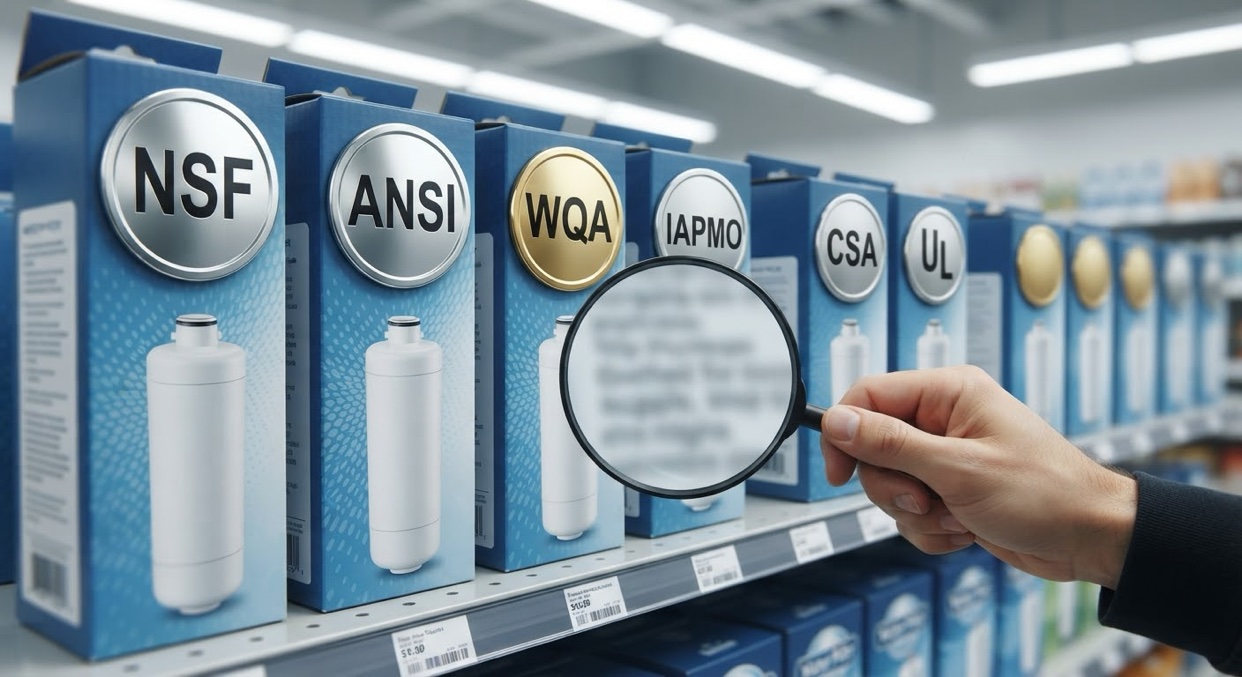
Walk down the plumbing aisle at any hardware store, or scroll through water filters online, and you will see a parade of shiny badges printed on the boxes. Gold seals, blue circles, shields with checkmarks, and strings of letters and numbers like “NSF/ANSI 42” or “Tested to Standard 53”.
They are designed to make you feel safe. And honestly, many of them are backed by serious science and strict factory audits. The problem is that when those badges are stamped onto cardboard packaging without context, they start looking like trophies rather than technical receipts. If you do not know who issued the seal, which standard they tested against, or what specific contaminant was actually measured, you are essentially buying a filter on faith.
Let’s pull back the curtain on who actually writes the rules for your drinking water, what those seals really prove, and how to read a filter box with your eyes open.
1. The Problem With Seals
In the water treatment world, a seal is not a universal stamp of perfection. It is a narrow, legally binding verification that a specific product passed a specific test for a specific claim.
Think of it like a car inspection sticker. Passing an emissions test proves your exhaust is clean, not that your brakes are brand new. Yet on water filter packaging, marketing departments love to let a single badge imply that the filter removes everything.
There are three traps homeowners fall into every day:
- The “Tested To” Trick: Notice the difference between “Certified by NSF to Standard 53” and “Tested by an independent lab to NSF 53 protocols.” One means an accredited third-party organization tested the filter, audited the factory, and continues to inspect it every year. The other often means the manufacturer paid a private lab to run one test on one prototype—with zero ongoing oversight.
- The Halo Effect: A company will get one inexpensive carbon cartridge certified for chlorine taste and odor, put that seal on the front of the box in bold print, and then list lead, PFAS, and heavy metals in the bullet points right next to it—even though those health claims were never certified.
- Standard Confusion: People assume a higher number means a better filter. They see Standard 53 and assume it automatically includes everything in Standard 42, or that Standard 401 is eight times stronger than Standard 53. That is not how the numbering works at all.
2. The EPA and the Law
Before we look at filter seals, we need to look at the tap itself. In the United States, the rules for public drinking water are written and enforced by the U.S. Environmental Protection Agency (EPA) under the Safe Drinking Water Act (SDWA).
The EPA sets legally enforceable limits—called Maximum Contaminant Levels (MCLs)—for roughly 90 contaminants in public water systems, covering everything from lead and arsenic to disinfection byproducts and microorganisms. Every year, your local water utility is required by law to send you a Consumer Confidence Report (CCR), also known as your annual water quality report, showing what they found in your water and whether it met federal limits.
Here is the crucial distinction most people miss: The EPA regulates the water coming out of the treatment plant and through the city mains. The EPA does not test, certify, or approve home water filters. (The rare exception is certain microbiological purifiers using registered antimicrobial pesticides, like silver-impregnated media, which must register with the EPA—and even then, registration only verifies that the pesticide label isn’t making false claims, not that the unit removes lead or chemicals).
Silver ends up in some carbon filters for one specific job. Carbon’s work is removing chlorine — but once the chlorine is gone, a wet carbon bed is a warm, dark place with no disinfectant left in it, which makes it a perfect home for bacteria to settle in and grow. Silver is naturally antimicrobial, so manufacturers bake it into the carbon to stop bacteria from colonizing the filter itself. On a box, that job hides behind one word: bacteriostatic. It means the silver stops bacteria from growing and multiplying on the filter — it does not mean the water coming out of it is disinfected. The water moves far too fast for that. The silver protects the filter, not the glass. That is also why the EPA registration exists — the silver counts as a pesticide claim about the filter media, not a promise about your water.
If you have a private well, the EPA does not regulate your water at all. You are your own water utility. And if you are on city water, the EPA’s responsibility largely ends at your property line—meaning lead solder, aging brass valves, or galvanized pipes inside your own home are your responsibility to test and manage.
3. NSF and What Those Numbers Mean
When people talk about water filter certifications, the first three letters they usually mention are NSF. NSF began life as the National Sanitation Foundation, and the name tells you where it started: sanitation. It was founded in 1944 in Ann Arbor, Michigan, in the basement of the University of Michigan’s School of Public Health, by Walter Snyder, a sanitation official from Toledo, Ohio, together with Henry Vaughan and Nathan Sinai. Its first standards covered the sanitation of the places and equipment America ate and drank from; the drinking-water work began in 1980. Working alongside ANSI (the American National Standards Institute)—and often CAN for Canadian harmonization—NSF develops consensus standards and runs accredited testing labs.
Those numbers after the slash are simply the chronological order in which the standards were written. Here are the ones that actually matter to a homeowner:
- NSF/ANSI 42 (Aesthetic Effects): This is the “taste and smell” standard. It verifies that a filter reduces non-health-related nuisances like chlorine taste and odor, chloramines, or visible rust and sediment particles. Great for making coffee taste better, not designed to protect you from toxic metals.
- NSF/ANSI 53 (Health Effects): This covers contaminants with established health risks—things like lead, cysts (Giardia and Cryptosporidium), volatile organic compounds (VOCs), mercury, and specific PFAS compounds.
- NSF/ANSI 44 (Cation Exchange Water Softeners): This verifies that a traditional salt-based water softener actually reduces hardness minerals (calcium and magnesium) and holds up under pressure.
- NSF/ANSI 55 (Ultraviolet Microbiological Treatment): This applies to UV light systems. Class A systems are strong enough to disinfect microbiologically unsafe water (like an untreated well), while Class B systems are only meant for supplemental bacteria reduction on already disinfected city water.
- NSF/ANSI 58 (Reverse Osmosis Systems): Because RO systems use a semi-permeable membrane and storage components rather than just a carbon block, they get their own dedicated standard covering Total Dissolved Solids (TDS) reduction, membrane efficiency, and heavy metals like arsenic, lead, and hexavalent chromium.
- NSF/ANSI 401 (Emerging Contaminants): This tests for trace levels of up to 15 unregulated “incidental” contaminants, including certain prescription drugs, over-the-counter medications, herbicides, and pesticides.
- NSF/ANSI 61 & 372 (Material Safety & Lead-Free): While the numbers above measure what a filter takes out of your water, 61 and 372 verify what the housing, o-rings, and faucets put in. Standard 61 ensures plastics and resins do not leach harmful chemicals into your drinking water, and Standard 372 verifies compliance with federal “lead-free” plumbing laws (less than 0.25% weighted average lead content).
4. The Water Quality Association and Its Gold Seal
A common misconception is that NSF is the only organization allowed to certify filters to NSF/ANSI standards. In reality, NSF writes the standards through an open consensus process, and any independent certifying body accredited by ANSI and the Standards Council of Canada (SCC) can test products against those exact same rules.
Enter the Water Quality Association (WQA) and its Gold Seal.
WQA is a non-profit trade association representing the residential, commercial, and industrial water treatment industry. The association took its modern form in 1974, but its roots run deeper — its laboratory was testing and certifying water treatment products as far back as 1959, before NSF’s drinking-water program existed. WQA also certifies people, not just products: the dealers and installers who pass its exams carry professional titles of their own. Its Gold Seal Product Certification Program is one of the most respected third-party testing programs in the country.
When a filter carries the WQA Gold Seal, it goes through the exact same three-part gauntlet as an NSF-certified unit:
- Contaminant Reduction Testing: Proving the media actually reduces the claimed contaminants down to safe levels over the full rated life of the filter (and often beyond).
- Structural Integrity: Putting the housing through brutal pressure-spike and cycle tests (simulating ten years of household water hammer) to make sure it won’t crack and flood your kitchen.
- Material Safety & Literature Review: Checking that wet parts don’t leach toxins, auditing the manufacturing plant annually, and reviewing the owner’s manual to make sure the company isn’t making exaggerated claims.
5. The Rest of the Neighborhood
Once you start looking closely at plumbing valves, commercial equipment, and international boxes, you will run into several other acronyms. Knowing who sits on the block keeps you from getting tripped up by alphabet soup:
- IAPMO (International Association of Plumbing and Mechanical Officials): You will often see their IAPMO R&T shield or Platinum Seal on filters and RO systems. Like WQA, IAPMO is fully accredited to test and certify drinking water equipment to NSF/ANSI standards, and they are giants in plumbing code compliance.
- CSA (CSA Group, formerly Canadian Standards Association): Essential for products sold in Canada and widely recognized across North America, CSA tests plumbing fixtures, water heaters, and filtration systems for both electrical/mechanical safety and NSF/ANSI/CAN drinking water standards.
- UL (UL Solutions, formerly Underwriters Laboratories): Best known for electrical and fire safety on UV lamps, booster pumps, and water coolers, UL also runs an accredited water quality certification program testing filters and components to NSF/ANSI standards.
- ASSE (ASSE International): Originally the American Society of Sanitary Engineering, ASSE writes the gold-standard performance rules for plumbing protection devices—specifically backflow preventers, pressure-reducing valves, and mixing valves that keep contaminated water from siphoning backward into your clean drinking supply.
- AWWA (American Water Works Association): Founded in 1881, AWWA sets the engineering standards for municipal water utilities—pipes, storage tanks, treatment chemicals, and water meters—as well as guidelines for point-of-use and point-of-entry treatment programs.
- ASHRAE (American Society of Heating, Refrigerating and Air-Conditioning Engineers): While focused on building mechanical systems, ASHRAE writes Standard 188, the critical risk-management rulebook for preventing Legionella bacteria growth in large building plumbing systems, cooling towers, and commercial water heaters.
- WHO (World Health Organization): The WHO does not certify retail filters, but it publishes the Guidelines for Drinking-water Quality, which serves as the scientific benchmark used by countries worldwide—and often informs U.S. and Canadian standards—when setting health-based targets for contaminants.
6. How to Read a Box: Three Questions to Ask
Next time you are holding a filter box or looking at a product listing online, ignore the glossy lifestyle photos and the big bold promises on the front. Flip the box over to the fine print—or pull up the manufacturer’s Performance Data Sheet—and ask three simple questions:
- Whose standard—and who verified it? Look for an accredited third-party mark from NSF, WQA, IAPMO, CSA, or UL. Make sure the wording says “Certified by [Organization]” rather than “Tested to” or “Meets standards.” Better yet, type the exact model number into that organization’s free online database to verify the listing is active.
- Which standard number is listed? Match the number to your goal. If you only want better-tasting tap water, 42 is plenty. If you want lead, cysts, or VOC protection, you need 53 (or 58 for Reverse Osmosis).
- For what specific claim? This is the secret weapon. A filter certified to NSF/ANSI 53 does not automatically remove every contaminant on the Standard 53 list. It is only certified for the exact contaminants named on its Performance Data Sheet. If a filter is certified under Standard 53 for cysts and turbidity, that does not mean it removes lead or PFAS. Read the line-by-line reduction table.
7. Facts First, Then Filter
A certification seal is a tool, not a magic wand. Even the most heavily certified Reverse Osmosis system on the shelf is the wrong buy if your only water issue is chlorine taste, just like a basic NSF 42 pitcher filter won’t touch arsenic or nitrate in a private well.
The smartest way to shop for water treatment is to work backward from what is actually coming out of your faucet. Pull your town’s free annual water quality report, or get a certified lab test if you are on a well. Check your water’s pH, hardness, and chlorine or chloramine levels.
Once you know the exact numbers in your glass, you can look for the exact standard number on the box—and verify that the specific contaminant you care about is listed in black and white. Facts first, then filter. That is how you stop buying marketing promises and start buying real protection.
Facts first, then filter. — Steve
Leave a Reply