
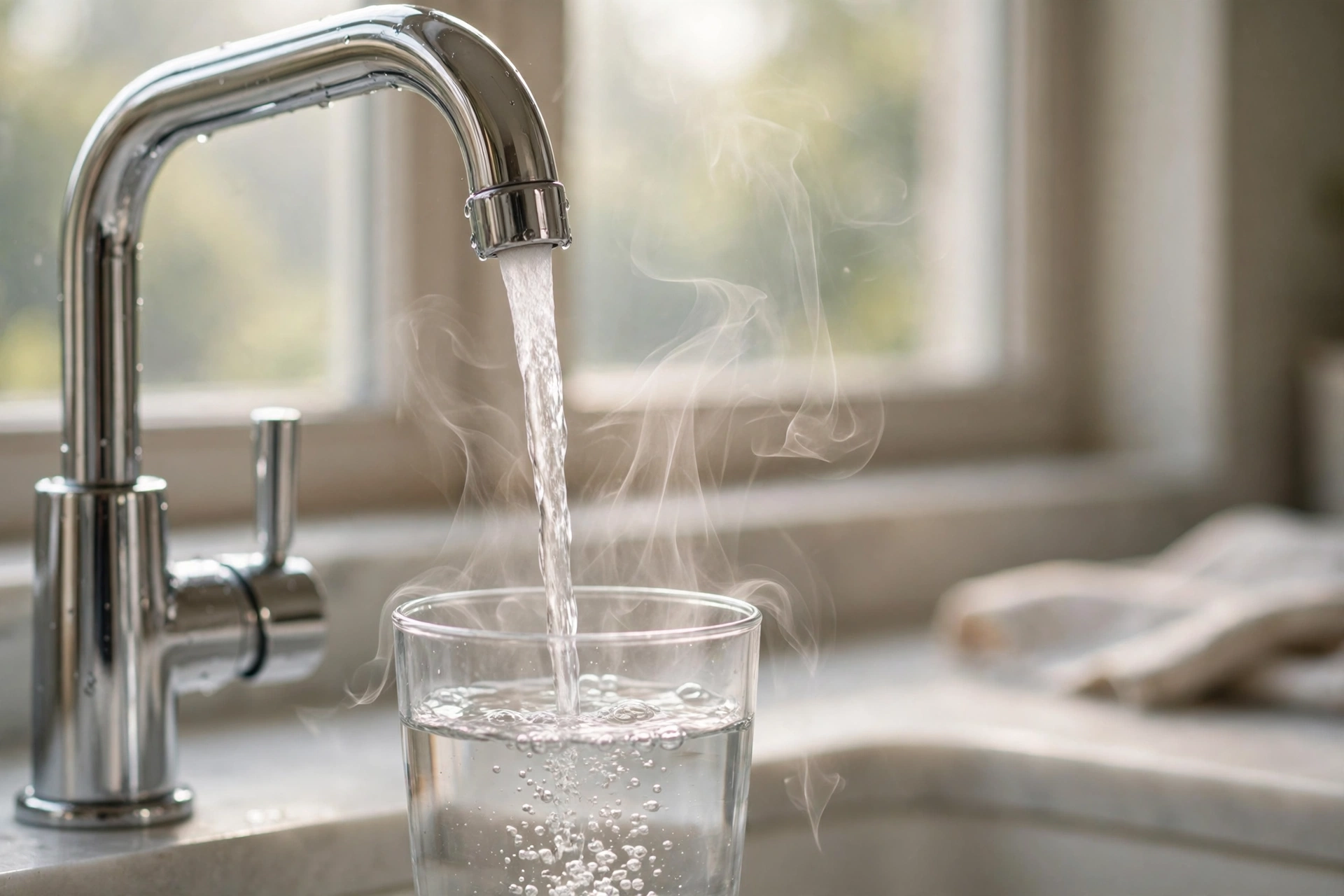
Your city adds chlorine to your water to kill germs. Good. But chlorine doesn’t just disappear after doing its job — it reacts with natural organic matter in the water and forms a family of chemicals called trihalomethanes. The most common one has a name you probably know from movies: chloroform.
Yes, that chloroform. It’s in your tap water right now, most likely. Let me explain why that’s less alarming than it sounds — and what to do about it anyway.
How it gets there
Chlorine is added at the treatment plant. On its way to your faucet, it meets leaves, algae, soil runoff — natural organic stuff that’s always in source water. The reaction creates disinfection byproducts, and chloroform is the headliner. The more organic matter in the source water and the longer the water sits in the pipes, the more forms.
This is overwhelmingly a city-water issue. If you’re on a well with no chlorination, chloroform generally isn’t your problem.
The health picture, honestly
The EPA regulates total trihalomethanes (TTHMs) at 80 parts per billion. Your water utility has to stay under that, and most do.
But “under the legal limit” and “zero” aren’t the same thing. Long-term exposure to chloroform is linked to liver and kidney effects, and it’s classified as a probable human carcinogen. The risk builds over years of exposure, not from a glass today.
Here’s what most articles skip: drinking isn’t the only route. Chloroform is volatile — it escapes into the air. Hot showers, dishwashers, and boiling water all release it, which means you’re also breathing it and absorbing some through skin. The shower matters as much as the glass.
How to test
Your utility’s annual water quality report (the CCR) lists TTHM levels — that’s the easiest check, and it’s free. If you want your own numbers, a certified lab can test for trihalomethanes specifically. Home test strips won’t cut it for this one.
What actually removes it
Activated carbon — the answer. Carbon block or granular activated carbon (GAC) filters are highly effective at removing chloroform and other trihalomethanes. A good under-sink carbon block handles drinking and cooking water; a whole-house carbon system covers the shower too — which matters, given the inhalation route.
What also helps: aeration and letting water sit. Because chloroform is volatile, it off-gasses. (Don’t rely on this as treatment, but it’s why a glass left on the counter tests lower than one fresh from the tap.)
What does NOT specifically fix it:
- A basic sediment filter. Chloroform is dissolved, not a particle.
- A water softener. It swaps minerals; it doesn’t touch organics or byproducts.
- Boiling. It drives some off into the air — which just moves the exposure from your glass to your lungs.
What I’d buy
Treatment type: an activated carbon block or granular activated carbon (GAC) filter — under-sink carbon block for drinking and cooking water, or a whole-house carbon system if the shower inhalation route matters to you. Carbon is the answer for chloroform. A sediment filter, a softener, or boiling will not do this job.
The bottom line
Chloroform is the tradeoff baked into chlorinated water: the chlorine keeps you safe from microbes, and the byproducts are the cost. It’s a manageable one — carbon filtration takes it out, and your utility report tells you how much you’re starting with.
Start here: What’s In Your Water? — learn how to read your water report and test your own tap.
Leave a Reply