
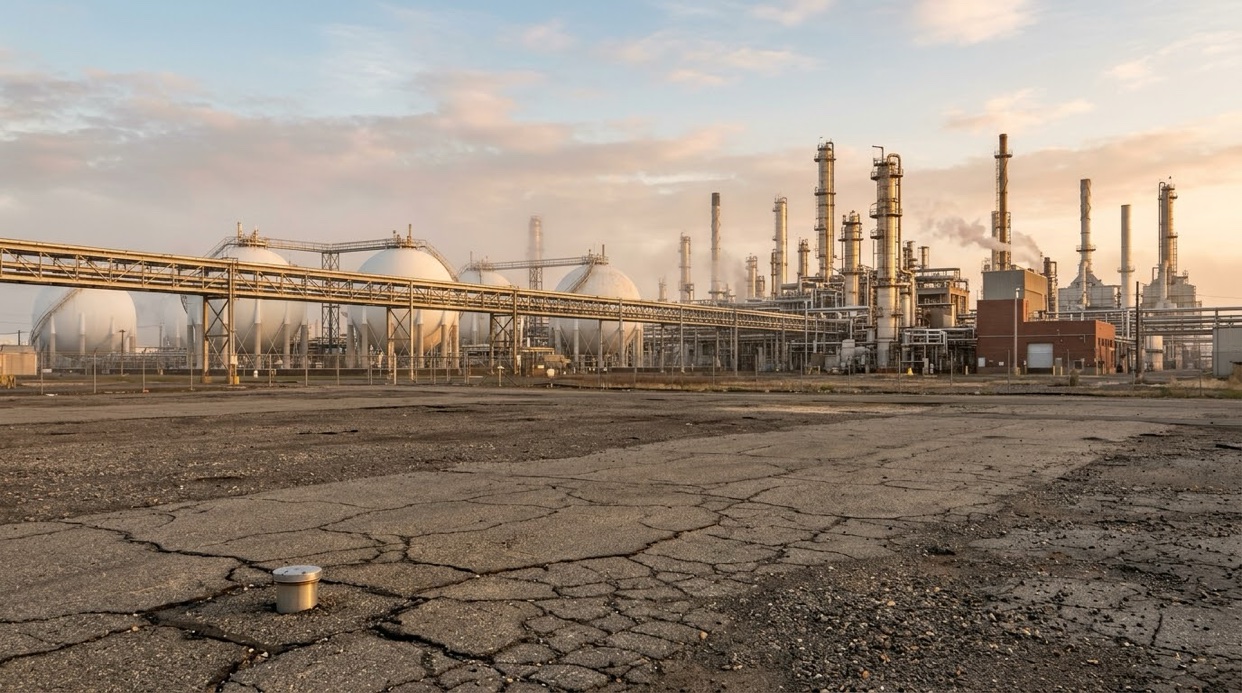
1,2-Dichloroethane—commonly known in the chemical trade as ethylene dichloride—is one of the highest-volume synthetic industrial chemicals produced in the United States. Working in water treatment since 1994, I’ve learned that the chemicals made in the largest volumes are the ones that turn up in the most wells. If you’re reviewing a municipal Consumer Confidence Report or evaluating detailed laboratory water testing for a private well, this volatile organic compound (VOC) is one you should understand. While it doesn’t get as much everyday public name recognition as simple solvents, its massive scale in manufacturing makes it a persistent concern for underground water tables.
How It Gets Into Your Water
1,2-Dichloroethane is manufactured on a massive scale, used overwhelmingly as the primary chemical building block to produce vinyl chloride monomer, which is then processed into polyvinyl chloride (PVC) plastic. Beyond its dominant role in plastics, it historically served as an industrial solvent and chemical intermediate, and for decades was blended into leaded gasoline as an anti-knock additive scavenger.
The EPA’s official listed source for 1,2-dichloroethane in public drinking water supplies is discharge from industrial chemical factories. Over decades of high-volume manufacturing, chemical spills, underground storage tank leaks, and unlined waste disposal at plant sites introduced substantial quantities into the soil. Once in the ground, 1,2-dichloroethane dissolves easily in water, moves readily through soil layers, and persists in underground aquifers without breaking down quickly, forming long-lasting contamination plumes that can reach both municipal supply wells and private residential wells.
What It Can Do to Health
When evaluating VOCs in drinking water, federal health regulators look closely at chronic exposure over a lifetime. The health effect the EPA lists for long-term exposure above the limit is an increased risk of cancer—and that single line is the whole story of this chemical in drinking water.
That table line sits on a formal classification behind it. Separately from the drinking-water table, the EPA’s IRIS program classifies 1,2-dichloroethane as a probable human carcinogen (Group B2), based on several types of tumors induced in rats and mice in laboratory studies. Because the EPA treats it as a carcinogen with no proven safe threshold, federal toxicologists evaluate it under non-threshold risk models—and that is why its health goal, covered in the next section, is zero.
Public systems test for VOCs routinely. If you are on a private well near an industrial chemical plant or an old waste site, testing is up to you—a certified laboratory can run a VOC panel on a sample of your water.
The EPA Drinking-Water Limit
Federal standards for 1,2-dichloroethane are set under the Safe Drinking Water Act:
- Maximum Contaminant Level Goal (MCLG): 0 mg/L (or 0 ppb).
- Maximum Contaminant Level (MCL): 0.005 mg/L (or 5 ppb).
Understanding the gap between these two numbers is critical. The health goal (MCLG) is set at exactly zero because the EPA’s policy for suspected or known carcinogens assumes there is no known threshold level of exposure below which the risk of cancer is proven to be strictly zero. However, the health goal is non-enforceable. The enforceable limit (MCL) is set at 0.005 mg/L (5 ppb)—the lowest concentration that water utilities can reliably measure, monitor, and treat on a municipal scale using Best Available Technology.
Which Home Filtration Actually Removes It
If lab tests confirm 1,2-dichloroethane in your water supply, standard mechanical filters (like sediment cartridges) and conventional water softeners will not touch it. You need treatment technology designed specifically for volatile organic chemicals:
- Activated Carbon Filtration (GAC & Solid Carbon Block): Granular activated carbon (GAC) and solid carbon block filters are your main frontline defense. Activated carbon features a vast porous surface area that physically adsorbs organic chemical molecules like 1,2-dichloroethane as water flows through the bed.
- Reverse Osmosis (RO): A point-of-use reverse osmosis system acts as an effective secondary backstop. RO systems pair carbon pre- and post-filtration with a semi-permeable membrane, giving you multiple barriers of protection against VOC pass-through at the tap.
Understanding Certification Standards
The water treatment industry is filled with vague marketing language like “reduces harsh chemicals.” When dealing with industrial VOCs, you need verified independent proof. Look for filtration equipment certified under these core standards—and read what each seal actually covers:
- NSF/ANSI Standard 53: This is the health-effects standard for drinking water treatment units. In plain English: a unit certified to Standard 53 has been independently tested for the specific health-related contaminant reduction claims named in its certification. Its VOC reduction claim is the one that matters here: a unit certified for VOC reduction has been tested with a surrogate chemical (chloroform) standing in for a defined list of volatile organic chemicals—and 1,2-dichloroethane is on that list.
- NSF/ANSI Standard 58: This is the performance standard for reverse osmosis systems. In plain English: it certifies that an RO system reduces total dissolved solids and the specific contaminants named in its certification—VOC reduction is one of the claims a model may carry, so check the model’s claim list for it.
A certification seal by itself proves only that the unit was tested for the claims on its list—it does not mean the filter removes every chemical. You must examine the manufacturer’s official Performance Data Sheet or look up the unit in an accredited independent certification directory (such as NSF, WQA, or IAPMO) to confirm that 1,2-dichloroethane (or ethylene dichloride) is explicitly listed as a certified reduction claim. If it is not listed by name on the official documentation, do not rely on the filter to remove it.
Facts first, then filter. — Steve
Leave a Reply