
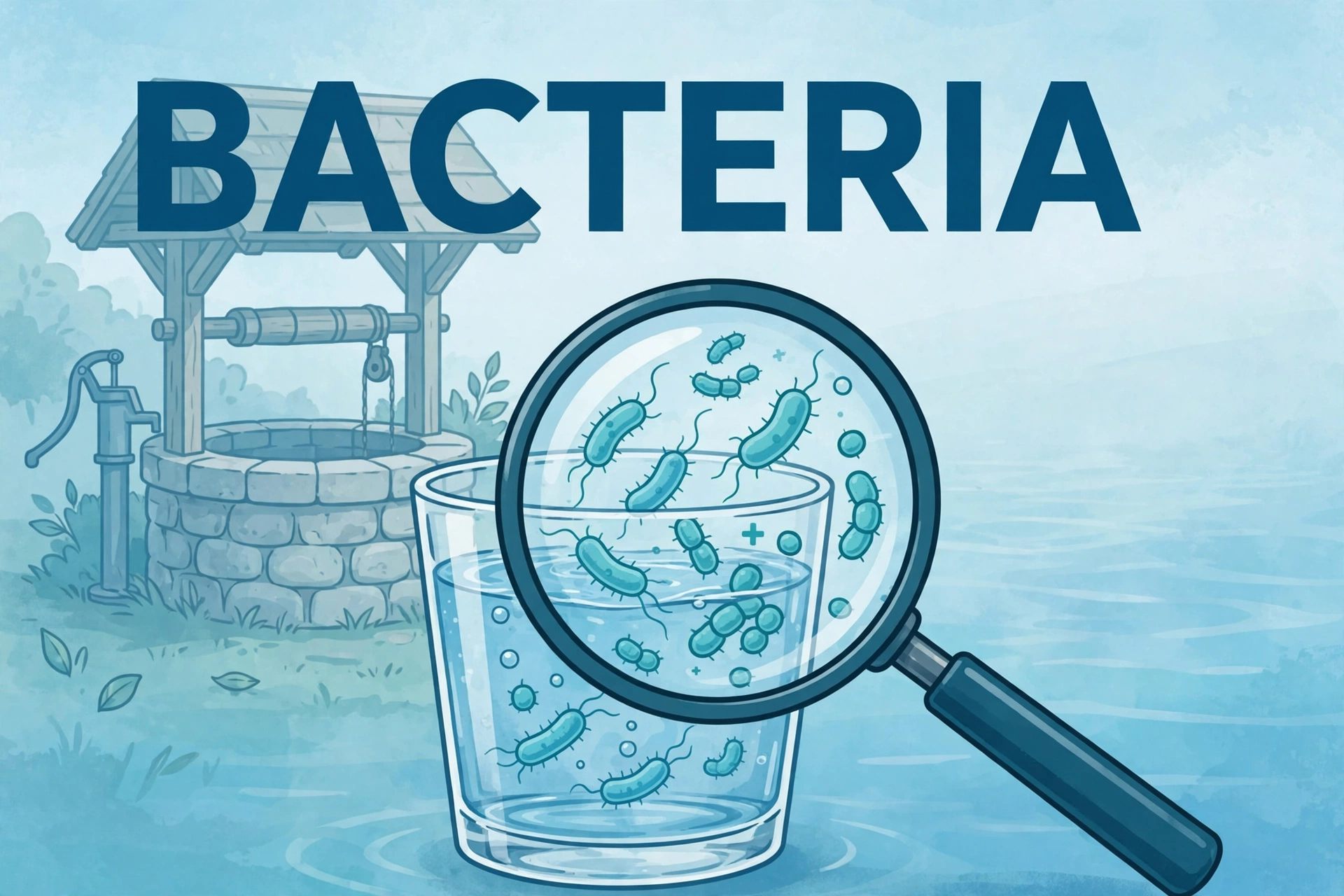
A positive bacteria test is the single most common reason a private well fails its water test. If you’ve ever gotten a lab report back with the word “coliform” on it, here’s what it actually means — and what it doesn’t.
What the test is really telling you
“Total coliform” is a family of bacteria used as an indicator, not a diagnosis. Most coliforms are harmless and live everywhere in soil and vegetation. Their presence in your water says: surface water or soil is getting in somewhere it shouldn’t — a cracked well cap, a failing septic, flooding, a well too close to a barnyard.
E. coli is the more specific one. It’s a type of fecal coliform — its presence means fecal contamination has reached your water, and where feces go, worse pathogens (Giardia, viruses, the dangerous E. coli O157:H7 strain) can follow. Most E. coli strains won’t hurt you. The test isn’t saying you’re drinking poison — it’s saying the door is open.
The honest health picture
A total-coliform positive with no E. coli: investigate and retest, don’t panic. An E. coli positive: stop drinking it until it’s resolved — switch to bottled or boiled water. People with weakened immune systems, infants, and the elderly should be the most cautious. This is straightforward stuff, not a scare story: bacteria in well water is common, well understood, and fixable.
What to do when a test comes back positive
- Retest to confirm — one bad sample can be a sampling error. Use a clean, sterile bottle and follow the lab’s instructions exactly.
- Inspect the wellhead. Cracked cap? Missing screen? Water pooling around the casing? Most bacterial problems start at the top of the well, not deep underground.
- Shock-chlorinate the well — a strong chlorine dose circulated through the whole system, then flushed. This is the standard first response and it works for one-time contamination events.
- Find the source. If positives keep coming back, something structural is wrong — septic too close, surface water intrusion, a compromised casing. Disinfection treats the symptom; the source needs fixing.
What truly disinfects water (and what doesn’t)
- Chlorination — yes, the municipal standard for a century.
- UV light — yes, with a sediment pre-filter. UV can’t disinfect what it can’t see through — cloudy water shields bacteria from the light. This is where filter ratings earn their keep: a 5-micron nominal sediment cartridge ahead of the UV unit keeps the water clear enough for the light to do its job.
- Boiling — yes. A full rolling boil for one minute kills bacteria and viruses. (Note the contrast with nitrates: boiling fixes bacteria and worsens nitrate. Know which problem you have.)
- Distillation — yes.
What doesn’t:
- Standard carbon filters — no. They improve taste and remove chemicals; they don’t disinfect. A carbon filter on bacteria-positive water is decoration.
- Standard water softeners — no.
- A sediment filter alone — no. It protects your UV or RO unit; it doesn’t make water safe by itself.
A word on micron ratings, since they matter here
Bacteria run about 0.2 to 10 microns. An absolute-rated sub-micron membrane can physically block them, but the nominal-rated sediment cartridges in most homes can’t be trusted for that — “nominal” means “most of the time,” and disinfection isn’t a most-of-the-time job. For bacteria, disinfect — don’t just filter.
Bottom line
Test for coliform annually (New Jersey requires it for private wells for good reason). A positive test is a to-do list, not a tragedy: confirm it, inspect, shock, and fix the source. And put disinfection — not just filtration — between your well and your glass.
Wondering what else might be in your water? Start with What’s In Your Water?
Leave a Reply