
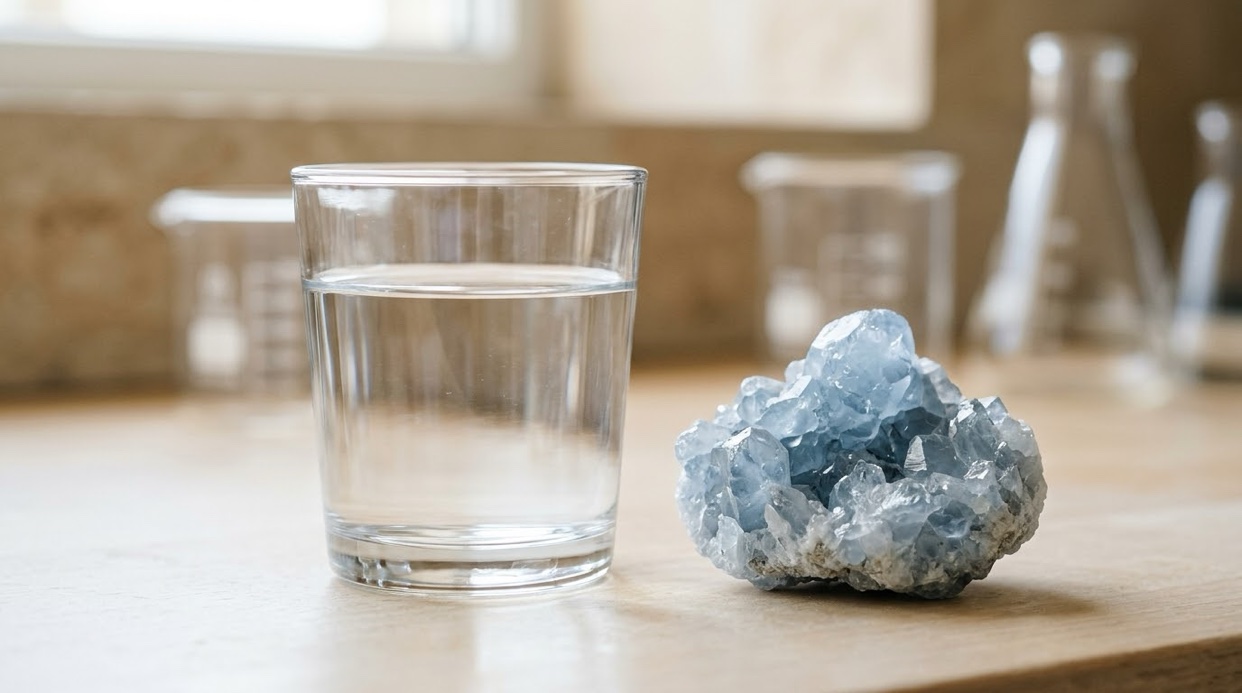
If you take a look at the periodic table, you will spot strontium sitting right at element number 38. It belongs to the alkaline-earth metal family, which makes it a direct chemical cousin to calcium and magnesium—the two minerals responsible for hard water.
Most people recognize strontium for its industrial uses, like giving red fireworks and signal flares their vibrant color, or for its role in glass manufacturing and ceramic magnets. But because it shares so much chemical DNA with calcium, strontium is also a naturally occurring element that regularly turns up in deep groundwater.
As someone who spends every day helping homeowners understand what comes out of their taps, I know that seeing an unfamiliar metal on a water lab report can cause concern. Here is a clear, honest breakdown of what strontium is, how it behaves in drinking water, what it means for your health, and how to address it in your home without any sales hype or scare tactics.
1. What Strontium Is and Where It Comes From
Strontium is a soft, silvery-yellow metal naturally embedded throughout the Earth’s crust, soils, and rock formations—particularly in celestite and strontianite minerals.
In modern manufacturing and technology, strontium is widely utilized for its unique physical properties:
- Pyrotechnics & Flares: Strontium compounds produce a brilliant, vivid crimson-red flame in fireworks, road flares, and emergency signaling devices.
- Glass & Ceramics: It is used in specialty glass (such as cathode-ray tubes and specialized optics) and in producing ferrite ceramic magnets.
- Medical Research: Certain strontium formulations are used in bone density research and sensitive medical imaging.
2. How It Gets Into Drinking Water
Strontium enters drinking water supplies almost exclusively through natural geological processes.
As groundwater flows over and through subterranean limestone, dolomite, and celestite rock formations, strontium minerals dissolve into solution. Because strontium behaves so much like calcium, it travels alongside standard water hardness minerals.
Deep private wells drawing from bedrock aquifers—particularly in areas with limestone geology—are much more likely to contain elevated levels of naturally occurring strontium than shallow wells or surface water rivers.
3. What It Can Do to a Person’s Health
Because the human body processes strontium very similarly to calcium, it absorbs strontium into the bloodstream and deposits it directly into bones and teeth.
- General Exposure: Consuming trace amounts of natural strontium in daily drinking water and food is typical and generally well-tolerated by adults.
- Children and Bone Growth: Developing children represent the genuinely sensitive group when it comes to high strontium exposure. In growing infants and children whose bones are actively forming, excessive strontium intake can interfere with proper bone mineralization and calcium absorption, potentially leading to weakened bone structure or conditions similar to rickets.
4. An Honest Clarification: Stable vs. Radioactive Strontium
When people hear the word “strontium,” they often think of nuclear fallout or historical weapons testing. It is essential to clear up this common point of confusion:
The strontium on a home drinking water test is stable, non-radioactive strontium.
Naturally occurring strontium found in groundwater is completely stable. It is not radioactive strontium-90 (^{90}Sr), which is a synthetic byproduct of nuclear fission and an entirely different story. Natural strontium in your tap water poses no radiation hazard whatsoever.
5. The Federal Picture: Regulations vs. Reference Levels
When evaluating strontium on a water test report, homeowners often look for an enforced federal standard. However, strontium currently has NO EPA Maximum Contaminant Level (MCL).
Here is the regulatory background you should know:
- The EPA Decision: The EPA evaluated strontium under the Safe Drinking Water Act for potential regulation. EPA has never set a drinking water standard for strontium. In 2014 the agency preliminarily determined it should regulate strontium, but in January 2016 it delayed the final decision to consider more data — and as of its January 2025 notice, EPA still had not made a final determination either way.
- The Screening Benchmark: During national monitoring (such as the EPA’s Unregulated Contaminant Monitoring Rule, or UCMR 3), the EPA established a Health Reference Level of 1.5 mg/L (milligrams per liter, or parts per million).
It is crucial to label this correctly: 1.5 mg/L is a health screening reference level used as a research benchmark, NOT an enforceable regulatory limit or standard.
6. How a Homeowner Can Test Their Water
You cannot see, smell, or taste strontium in drinking water, even at elevated concentrations. The only way to know if strontium is present—and at what level—is through lab analysis.
- Skip DIY Home Test Strips: Over-the-counter test strips sold at hardware stores are fine for basic pH or total hardness, but they cannot distinguish between calcium, magnesium, and trace strontium.
- Use a Certified Laboratory: Send a water sample to a state-certified drinking water laboratory. Labs use advanced analytical equipment, such as ICP-OES or ICP-MS (EPA Method 200.7 or 200.8), to deliver an exact measurement of dissolved strontium in milligrams per liter.
7. How to Remove Strontium from Drinking Water
Because strontium is an alkaline-earth metal that behaves almost identically to calcium in water, removing it is remarkably straightforward using standard water treatment equipment.
Effective Removal Technologies
- Cation Exchange (Standard Water Softeners): Because strontium exists in water as a positively charged ion (Sr^{2+}), standard home water softeners remove it easily. The cation-exchange resin trades dissolved strontium and calcium ions for sodium or potassium ions. A water softener installed at the main entry point will effectively reduce strontium throughout the whole home.
- Reverse Osmosis (RO): A point-of-use under-sink Reverse Osmosis system is a highly dependable method for drinking water. RO forces water through a dense semi-permeable membrane that rejects dissolved metal ions like Sr^{2+} while letting pure water molecules pass through.
- Lime Softening: At municipal treatment plants, traditional chemical lime-soda softening raises pH to precipitate out calcium and strontium simultaneously.
The Truth About Carbon Filters
Standard activated carbon block filters are excellent for removing chlorine, taste, and odor, but they do not remove dissolved inorganic minerals like strontium.
Pre-Filtration and Micron Ratings
Physical sediment pre-filters do not catch dissolved strontium ions, but they protect softeners and RO membranes from clogging with sand, silt, and rust.
When selecting pre-filters, pay attention to micron ratings:
- Micron Rating: A micron measures pore size. A 5-micron or 1-micron sediment pre-filter is standard practice ahead of a home filtration system.
- Nominal vs. Absolute Rating:
- Nominal Rating: Traps approximately 60% to 85% of particles at that micron size under standard flow.
- Absolute Rating: Traps 99.9% or more of particles at the specified micron size under strict laboratory test conditions.
Using an absolute-rated pre-filter ensures consistent physical protection for your primary water treatment equipment.
The Bottom Line
Naturally occurring strontium in drinking water is stable, non-radioactive, and closely tied to water hardness and local limestone geology.
Because there is no enforceable federal limit, compare your lab test results against the EPA screening reference level of 1.5 mg/L. If your water test reveals high strontium levels—especially if you have young children in the home—a standard water softener or an under-sink Reverse Osmosis system will easily bring those levels down, leaving you with clean, pure drinking water.
Leave a Reply