
If you take a look at the periodic table, you will spot calcium sitting right at element number 20. It is a soft, silvery-white metal that ranks as the fifth most abundant element in the Earth’s crust—and the single most abundant mineral inside the human body.
When people hear “calcium,” they naturally think of strong bones, milk, and dietary health. But in my line of work as a water treatment professional, calcium is the single biggest player in home plumbing decisions. It is the senior partner in hard water (with magnesium as its junior partner), and managing it is the backbone of residential water quality.
Here is a clear, honest breakdown of what calcium is, how it gets into your tap water, what it does to your body and your plumbing, and how to manage it in your home without any sales pitch or scare tactics.
1. What Calcium Is and Where It Comes From
In nature, calcium is embedded in vast rock formations across the globe—primarily as limestone (calcium carbonate), chalk, and gypsum (calcium sulfate).
Because these calcium minerals dissolve readily when exposed to natural groundwater, calcium ions (Ca^{2+}) wash into deep aquifers and subterranean streams every time it rains.
In human biology, calcium is essential. Roughly 99% of the body’s calcium is stored in bones and teeth, while the remaining 1% plays a vital role in blood clotting, nerve signaling, muscle contraction, and heart function.
2. How It Gets Into Drinking Water (And How It Is Reported)
Groundwater flowing over subterranean limestone and gypsum rock formations is the primary route calcium takes to enter private wells and municipal supplies.
When you look at a water test report or municipal water quality panel, you will see calcium reported as part of Total Hardness.
Because water treatment chemistry developed around limestone, the industry uses a standard reporting convention: hardness is reported as “calcium carbonate equivalent” (CaCO_3).
You will typically see this measured in two ways:
- Milligrams per Liter (mg/L) or Parts per Million (ppm): Standard lab metric where 1 mg/L equals 1 ppm.
- Grains per Gallon (GPG): The practical trade measurement used for sizing home water softeners. One Grain per Gallon equals 17.1 mg/L of calcium carbonate equivalent.
3. What It Does in the Home: The Cost of Limescale
While calcium is a great mineral for human health, it is the number one mineral troublemaker for household plumbing and appliances.
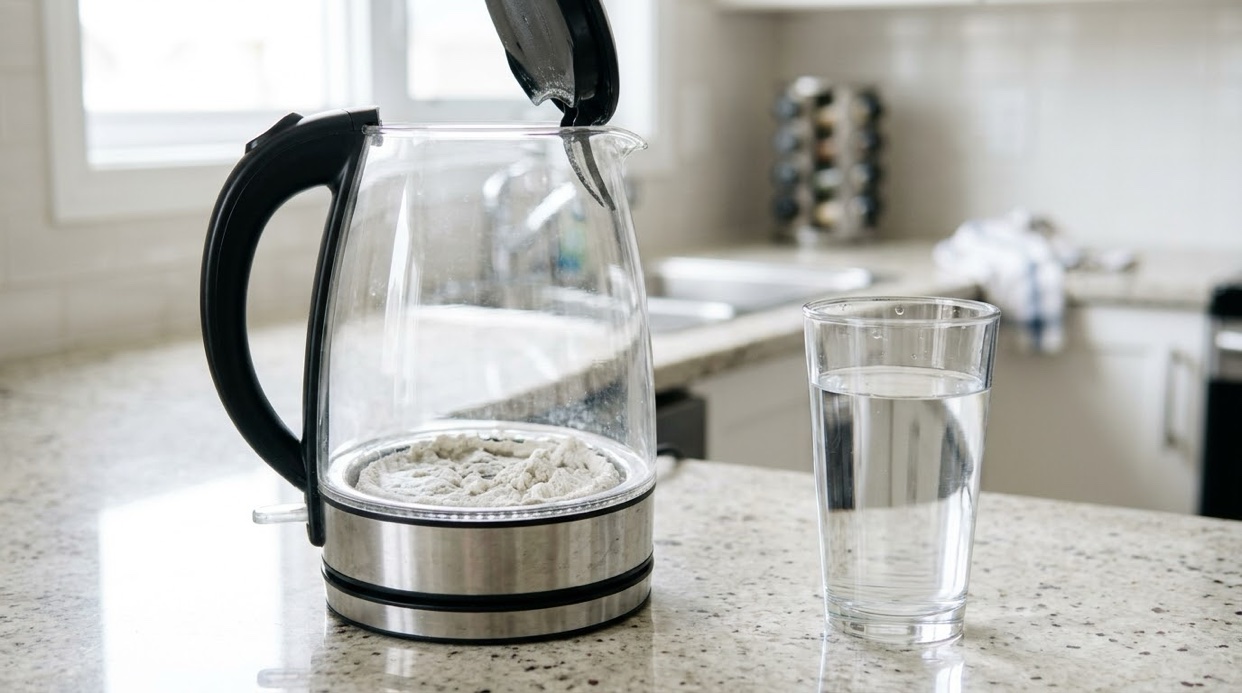
- Water Heater Limescale: When hard, calcium-rich water is heated inside a water heater, boiler, or electric kettle, dissolved calcium drops out of solution and forms hard, rock-like limescale. A layer of calcium scale on a water heater element acts like an insulating blanket, forcing the heater to work significantly harder and consuming extra energy to heat the water. Over time, this shortened lifespan and reduced efficiency cost homeowners real money.
- Soap Curd & Fights with Soap: Calcium reacts directly with soap molecules to form an insoluble, sticky soap curd (the classic bathtub ring). Because calcium “ties up” soap, you need to use significantly more laundry detergent, shampoo, and dish soap to achieve a good lather.
- Spotting & Film: As water droplets evaporate off glass shower doors, dishes, and chrome faucets, calcium leaves behind white, crusty mineral spots and dull haze.
4. What It Can Do to Health: Nutrient vs. Kidney Stone Caution
When evaluating calcium from a health perspective, the picture is overwhelmingly positive, with one important nuance regarding kidney stones.
An Essential Dietary Mineral
Calcium in drinking water is biologically active and absorbed by the body. Drinking hard water rich in calcium provides a modest, helpful boost toward your daily dietary calcium needs. There is no toxicity story or health hazard associated with drinking calcium at tap water levels.
The Honest Truth About Kidney Stones
Because the majority of kidney stones are made of calcium oxalate, people often wonder if drinking calcium-rich hard water causes kidney stones.
To be completely clear and honest: drinking-water calcium is NOT established as a primary driver of kidney stones. Research shows that dietary calcium intake actually binds with oxalates in the digestive tract, reducing overall stone risk. Overall fluid intake (staying properly hydrated) and dietary sodium matter far more than the calcium concentration of your tap water.
However, if you are a known kidney stone former, always follow your own physician’s specific dietary and fluid guidance.
5. The Federal Picture: Unregulated and Beneficial
When reviewing a home water quality report, homeowners often look for a federal safety limit.
Calcium has NO EPA Maximum Contaminant Level (MCL) and NO Secondary standard.
It is completely unregulated at the federal level by the U.S. Environmental Protection Agency. Because calcium is an essential nutrient with no primary toxicity risks, the EPA does not enforce health limits or aesthetic secondary guidelines for calcium in public water supplies.
6. How a Homeowner Can Test Their Water
Testing for calcium is one of the easiest tasks in water quality:
- At-Home Hardness Test Kits: A simple, inexpensive home hardness test kit or test strip (measured in GPG or mg/L) is genuinely useful here. Because calcium makes up the vast majority of hard water, a total hardness test gives you 90% of the practical information you need for home plumbing decisions.
- Certified Laboratory Testing: If you want to know the exact, isolated calcium number separate from magnesium, send a sample to a state-certified drinking water laboratory for an inorganic minerals panel.
7. How to Manage Calcium in Drinking Water
Managing calcium comes down to treating whole-home plumbing versus drinking water at the kitchen tap.
Effective Management Technologies
- Traditional Water Softeners (Ion Exchange): The traditional ion-exchange water softener exists primarily because of calcium. Water softeners pass hard water through a bed of cation resin that swaps dissolved calcium ions (Ca^{2+}) for sodium or potassium ions, protecting your water heater, pipes, and appliances from limescale buildup throughout the entire house.
- Under-Sink Reverse Osmosis (RO): For drinking and cooking water, a point-of-use Reverse Osmosis system typically removes 95% to 98% of dissolved calcium at the kitchen tap, giving you pure, low-mineral water that won’t leave spots in kettles or coffee makers.
- The Neutralizer Twist (Adding Calcium On Purpose): Here is an interesting twist in my trade: if a home has acidic water (low pH below 6.5), we install a calcite neutralizer tank filled with calcium carbonate. As acidic water passes through, it dissolves a small amount of calcium on purpose to raise the pH to a safe, non-corrosive level (around 7.0), protecting copper pipes from pinhole leaks!
Pre-Filtration and Micron Ratings
While physical sediment pre-filters do not remove dissolved calcium ions, they protect water softeners and RO systems from getting clogged with sand, rust, and dirt.
When evaluating pre-filters, pay attention to micron ratings:
- Micron Rating: A micron measures pore size. A 5-micron or 1-micron sediment pre-filter is standard industry practice ahead of a water treatment system.
- Nominal vs. Absolute Rating:
- Nominal Rating: Traps approximately 60% to 85% of particles at that rated micron size under standard flow.
- Absolute Rating: Traps 99.9% or more of particles at the specified micron size under strict lab testing conditions.
Using an absolute-rated pre-filter gives your primary treatment equipment reliable, consistent physical protection over time.
The Bottom Line
Calcium isn’t a pollutant—it is an essential nutrient that happens to be the senior partner in hard water.
Because there is no federal EPA limit, you only need to manage calcium if limescale buildup, soap curd, or spotty glassware is causing headaches in your home. If hard water scale is costing you efficiency or ruining your fixtures, a whole-house water softener will solve the problem, while an under-sink Reverse Osmosis system will give you complete control over the drinking water at your kitchen tap.
Leave a Reply