
Hi, I’m Steve. I’ve been in the water treatment business since 1994. Dichloroacetic acid is one of the most common disinfection byproducts in American tap water — if your city chlorinates, it’s almost certainly in your water at some level. That sentence sounds alarming until you learn how it’s regulated and what the levels actually are. Let’s do this one the way we do all of them: facts first.
What It Is, and How It Forms
Dichloroacetic acid (often shortened to DCA) is one of the five haloacetic acids regulators track together as HAA5. It’s a disinfection byproduct: it isn’t in the source water and it doesn’t come from a pipe or a factory. It’s made during treatment, when chlorine or chloramine reacts with the natural organic matter — decaying leaves, algae, soil compounds — in river, lake, or reservoir water.
Along with trichloroacetic acid, it’s typically one of the two most abundant members of the HAA5 family. Levels rise in warm months (more organic material, higher chlorine doses), and with water age, because the reaction keeps working while water travels the mains — far ends of a system and dead-end streets run higher.
Private wells: untreated groundwater isn’t chlorinated, so the reaction doesn’t happen. No chlorine, no haloacetic acids.
What the Science Says About Health
DCA is not an acute poison — typical city levels won’t make you sick tonight. The file on it is a long-term file:
- In rodent studies, high lifetime doses produced liver tumors in rats and mice. On that evidence, the EPA classifies it as a probable human carcinogen, and IARC lists it as Group 2B — possibly carcinogenic to humans. Note the honest wording: “sufficient evidence in animals, no direct data in humans” is what 2B means.
- The doses in those studies were enormous compared to tap water — the WHO’s risk math starts from mice dosed at levels millions of times higher than your glass.
One fact puts the dose question in perspective better than any multiplier: dichloroacetic acid has also been used as a medicine — given deliberately, at high doses, to treat conditions like lactic acidosis, under medical supervision. That’s not an argument that it’s harmless (at drug doses it can affect nerves, which is exactly why it’s supervised). It’s an argument that dose is the whole conversation — and at parts-per-billion in drinking water, we’re talking about a different universe of exposure than either the rodent studies or the pharmacy.
The Difference That Matters: It Doesn’t Evaporate
If you read our trihalomethane articles, you met byproducts that escape into shower steam. Haloacetic acids are not like that. DCA is non-volatile: it stays dissolved in the water. It does not meaningfully come out in shower steam, bathwater, or a boiling pot.
So the exposure route is simple: drinking and cooking water, full stop. That also means the fix is simple — you do not need whole-house treatment or a shower filter for this family, whatever a salesperson tells you. Anyone selling you a shower filter “for haloacetic acids” is selling you a solution to a route that doesn’t exist.
The Numbers
- Individual legal limit: none. The EPA does not cap dichloroacetic acid alone.
- The legal limit that applies (HAA5 MCL): 60 ppb (0.060 mg/L) — the enforceable ceiling for all five haloacetic acids combined, as an annual average.
- EPA health goal (MCLG): zero — set at zero because of the animal cancer evidence. A goal, not a law: it marks where theoretical risk reaches zero, while the enforceable limit sits where treatment can actually hold it without weakening disinfection.
- WHO guideline: 50 ppb (0.05 mg/L), provisional — and here’s an honest detail most sites skip: WHO’s own math put the health-based value at about 40 ppb, and the guideline was set at 50 and labeled provisional because holding every system under 40 while still disinfecting properly isn’t always technically achievable. That’s regulators saying the quiet part out loud: the limit is a balance, and they show their work.
- EWG health guideline: 0.2 ppb — the one-in-a-million-risk target.
My own utility’s report: dichloroacetic acid at 10.1 ppb, inside an HAA5 total of 19.4 ppb against the 60 ppb limit. Below the legal limit, below the WHO guideline — and fifty times the EWG target, which is where that scary “50x” headline on the report comes from. Same water, three yardsticks. Now you know all three.
How It’s Reduced — the Honest Version
Here’s where this family breaks the pattern, and where a lot of filter marketing falls apart:
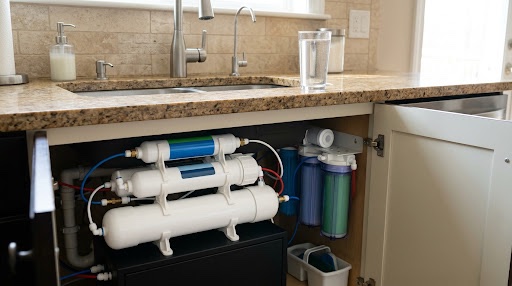
Reverse osmosis is the reliable tool. DCA in water is a charged, dissolved ion, and an RO membrane (0.0001 micron) rejects charged ions. A properly maintained under-sink RO system typically removes 90% or more of haloacetic acids. This is the technology to reach for with the HAA family.
Anion exchange can work — resins that swap ions can capture haloacetic acids the way they capture nitrate. It’s real, but uncommon as a standalone home setup: other minerals compete for the resin, and cost and maintenance are steep for a single-purpose job.
Standard carbon is only modestly effective — and this matters. Carbon is the champion for the THM family because those are uncharged organic molecules that adsorb beautifully. Haloacetic acids are highly soluble, charged ions, and carbon’s grip on them is weak — worse as the cartridge ages. A pitcher or a basic carbon block will take out some, especially when fresh, but it is not the tool I’d stake this family on. If a filter claims HAA5 reduction, the claim to trust is a certified one: NSF/ANSI Standard 53 or 58 with haloacetic acids named on the performance data sheet, certified by NSF International, WQA, or IAPMO. “Reduces chemicals” on a box is not that.
And the standing rule from the THM articles still holds: boiling doesn’t remove it — it concentrates what’s left as water steams off.
How to Find Your Level
Test strips can’t read parts per billion. Two honest routes:
Your Consumer Confidence Report — free, published by July 1 every year. Find the Haloacetic Acids (HAA5) row: that’s the group total against the 60 ppb limit. Utilities don’t break out DCA individually, but since DCA is usually one of the two biggest members of the group, a low HAA5 total means a low DCA number inside it.
A certified lab for the individual figure: ask for a haloacetic acid test — EPA Methods 552.2 or 552.3 are the standard ones. The lab’s sample bottle contains a neutralizer that stops the formation reaction at the moment you fill it, so the result reflects your tap, not the drive to the lab.
The Bottom Line
- Dichloroacetic acid is the HAA family’s most common member; the law caps the family at 60 ppb combined, its own health goal is zero, and WHO’s guideline is 50 ppb provisional.
- It’s non-volatile: drinking and cooking water is the only route that matters. Skip the shower-filter pitch for this one.
- Carbon is the weak tool here; reverse osmosis is the strong one. Match the technology to the chemistry, not to the advertising.
- Check your report’s HAA5 line first — free, two minutes, and it tells you whether you have anything to solve at all.
Facts first, then filter. — Steve
Leave a Reply