Author: iPhilter

  • Fluoride in Drinking Water: When There’s Too Much

    Fluoride in Drinking Water: When There’s Too Much

    Fluoride might be the most argued-about thing in drinking water. One side calls it a public-health triumph that prevents cavities; the other side wants it out of the water completely. Both sides are loud — and if you’re stuck in the middle, it’s hard to know what to believe.

    So let’s clear it up: they’re arguing about different doses. At 0.7 milligrams per liter — the level U.S. health authorities recommend for community water systems — fluoride prevents tooth decay, and that’s well supported. At much higher levels, it does real harm: stained, pitted teeth in kids, and stiff, painful joints over decades. Same substance, different dose. Dose is the whole argument.

    This article is about the high end — too much fluoride — because that’s the end where filtration matters. Nobody needs a filter for 0.7 mg/L.

    What it is

    Fluoride is a naturally occurring mineral — one of the most abundant elements on earth. It gets into water two ways: it dissolves out of rock and soil into groundwater, or a water utility adds it deliberately to prevent tooth decay. About two-thirds of Americans on public water systems drink fluoridated water.

    Where too much comes from

    Mostly geology. In regions with fluoride-rich rock formations — parts of Texas, the Southwest, and scattered pockets elsewhere — private wells can test at 2, 3, even 4+ mg/L straight out of the ground. On public water, utilities target 0.7 mg/L, so excess fluoride is mainly a private-well story.

    The health picture, honestly

    Three numbers matter. At 0.7 mg/L, you’re in the cavity-prevention zone — that’s the target. At 2.0 mg/L — the EPA’s secondary standard — children under nine can develop dental fluorosis: white streaks, brown staining, or pitting of the teeth as they form. It’s cosmetic, but it’s permanent. At 4.0 mg/L — the EPA’s enforceable legal limit — decades of exposure can cause skeletal fluorosis: stiff, painful joints and, in severe cases, weakened bones. That’s the line the law draws, and it’s there for a reason.

    How to test

    If you’re on city water, your utility’s annual water quality report lists the fluoride level — look it up before spending a dime. On a private well, get a lab test; fluoride is cheap to analyze and most state-certified labs run it for a few dollars. Home test strips exist but they’re rough estimates — fine for a first sniff, not for decisions.

    What removes it

    Here’s where I have to be blunt, because this is the trap: your standard pitcher filter does not remove fluoride. Not Brita-style carbon, not fridge filters, not faucet mounts — plain carbon doesn’t catch dissolved fluoride ions, period. What actually works:

    • Reverse osmosis. The proven home answer — removes 80–99% of fluoride along with most everything else dissolved in the water. Under-sink unit, done.
    • Distillation. Boils water and condenses the steam, leaving fluoride behind. Near-total removal, but slow and energy-hungry.
    • Activated alumina. A specialty filter media that grabs fluoride ions. Effective (up to ~90%) but finicky — it wants slightly acidic water and regular media replacement.
    • Bone char carbon. Charred animal bone — sounds odd, works well. Not for everyone, for obvious reasons.

    What does NOT remove it

    Standard carbon pitchers and filters. Water softeners. UV light. Chlorine. And boiling — boiling water down concentrates fluoride as the water evaporates. If your plan was “I’ll just boil it,” that’s backwards.

    What I’d buy

    Treatment type: an under-sink reverse osmosis unit — it’s the straightforward, proven way to take fluoride out of drinking and cooking water without turning it into a science project. Test first so you know your starting number, then retest after install to confirm where you landed.

    The bottom line

    Fluoride is one of those rare topics where both sides have a point: the right amount protects teeth, too much causes real harm. The answer isn’t fear — it’s a number. Get tested, know your level, and act on that instead of guessing.

    Start here: What’s In Your Water? — learn how to read your water report and test your own tap.
  • Trichloroethylene (TCE) in Drinking Water

    Trichloroethylene (TCE) in Drinking Water

    If you grew up anywhere near factories, dry cleaners, or a military base, there’s a decent chance you’ve heard of this one. Trichloroethylene — TCE for short — is an industrial solvent that was used everywhere for decades: degreasing metal parts, dry cleaning, making refrigerants and adhesives. Some of the most famous water contamination cases in American history, like Camp Lejeune, involve TCE. The EPA restricted or banned most uses of it in 2024, but the stuff it spilled decades ago is still sitting in groundwater today. It breaks down slowly, so old messes are still old problems.

    Here’s the thing about TCE: it’s a volatile organic compound. That means it doesn’t just stay in the water — it can evaporate out of it, including into the air inside a home from contaminated groundwater. So people near a plume can get exposed through drinking water, through showering in it, and through vapor getting indoors. Three ways in, not one. That matters when we talk about how to fix it.

    The health picture

    I’ll be straight with you, and I’ll frame this right: the International Agency for Research on Cancer lists TCE in Group 1. IARC groups are hazard classifications — they say whether something can cause cancer, not how much risk a given dose carries. Group 1 doesn’t mean “dangerous at any dose.”

    With that understood: worker studies show higher rates of kidney cancer among people exposed to high levels of TCE over long periods, with some evidence for non-Hodgkin lymphoma and liver cancer too. High exposures can cause dizziness, headaches, nausea, confusion, and damage to the liver and kidneys. Animal studies link it to developmental effects, including fetal heart defects from exposure early in pregnancy. The EPA set the legal limit in public drinking water at 5 parts per billion, and its stated goal for TCE in drinking water is zero — meaning below the legal limit is fine, but less is always better.

    How to test

    TCE is a job for a lab, not a test strip. Ask for a VOC panel (EPA Method 524.2) from a state-certified lab. Who should test? If you’re on a private well anywhere near industrial sites, old factories, dry cleaners, or known cleanup sites, yes. If you’re on city water, your utility tests for it and reports the numbers in your annual water quality report — check what yours says. Private wells near known contamination areas are the real exposure stories with TCE.

    What removes it

    Good news: TCE is one of the contaminants where treatment is proven. Whole-house granular activated carbon filtration is the standard recommendation — state health departments point to carbon filtration first for residential TCE. For well water with significant contamination, aeration (packed tower aeration) is highly effective because TCE is volatile and wants to leave the water; utilities pair it with carbon to catch what’s left. Reverse osmosis also removes it. Whatever system you use, have it installed by a pro, retest after install, and keep up with filter changes — a saturated carbon filter stops doing its job.

    What does NOT remove it

    This is the important part. A water softener does nothing for TCE. UV light does nothing for it. Chlorine does nothing for it. And boiling? Boiling drives it into the air, which can turn a water problem into an air problem. A point-of-use pitcher on the kitchen counter is the wrong scale for a contaminant you can also absorb in the shower — TCE is a whole-house problem, not a drinking-glass problem.

    What I’d buy

    Treatment type: a whole-house granular activated carbon filter from a certified unit (NSF or WQA listed), installed at the point where water enters the home. For a private well with high TCE readings, point-of-entry aeration ahead of carbon is the proven combo. This one’s worth getting professional help for — get the water tested before and after, and retest on a schedule.

    The bottom line

    If you suspect TCE anywhere near your well, don’t guess. Test it, treat the whole house, and verify with retesting. Knowledge first, filter second — that’s always the order.

    Start here: What’s In Your Water? — learn how to read your water report and test your own tap.
  • Radium in Drinking Water: The Radioactive One You’ve Never Thought About

    Radium in Drinking Water: The Radioactive One You’ve Never Thought About

    Radium is the one contaminant in this series that makes a Geiger counter click. Radium-226 and radium-228 are radioactive isotopes — real radiation, right in the glass — and they show up in drinking water more often than most people realize. No taste, no smell, no color. You cannot sense it. Only a lab test finds it.

    So let’s talk about it straight: what it is, where it comes from, and what the risk actually looks like at the levels people drink.

    What it is

    Radium is a naturally occurring radioactive metal. It’s born when uranium and thorium — both present in small amounts in most rocks and soil — undergo radioactive decay. Two of its isotopes matter for drinking water: radium-226 and radium-228.

    Here’s the detail that matters for your body: radium behaves chemically a lot like calcium. When you drink it, your body mistakes it for calcium and deposits it in your bones, where it sits and emits radiation into the surrounding bone tissue. That’s why the health concern is specifically bone cancer — along with other cancers linked to long-term exposure.

    A quick framing note, since this series covers carcinogens: IARC (the International Agency for Research on Cancer) lists both radium-226 and radium-228 as Group 1 — “carcinogenic to humans.” That classification is about hazard: it says radium can cause cancer. It does not say how much risk a given exposure carries. Group 1 does not mean “dangerous at any dose.”

    Where it comes from

    Erosion of natural deposits — it’s geology, not industry. Deep wells pull from rock formations where radium dissolves into the water over time. Surface water and shallow wells typically have lower levels; deep wells have higher ones. Oil and gas extraction activities can also elevate concentrations in some areas.

    This isn’t a rare edge case. USGS research found that in some regions — including the mid-continental U.S. and the North Atlantic coastal region, which includes parts of New Jersey — more than 20 percent of sampled wells had radium above the federal limit. If you’re on a private well in one of those regions, radium is not a hypothetical; it’s a routine test.

    The health picture, honestly

    The EPA’s numbers, plainly: the maximum contaminant level (MCL) for combined radium-226/228 is 5 picocuries per liter (pCi/L), and the health goal (MCLG) is zero — EPA doesn’t consider any level risk-free, just legally acceptable below the limit.

    What does the legal limit mean in real risk? EPA estimates that 1 in every 10,000 people drinking water at the MCL for a lifetime would develop cancer. That’s the honest math: a real, nonzero risk, but not a large one at the legal limit. California, for reference, set its public health goal vastly lower — 0.05 pCi/L for radium-226 and 0.019 pCi/L for radium-228 — levels so low most lab tests can’t even detect them.

    The risk scales with dose and time. A little above the limit for a year is a different story than five times the limit for twenty years. This is a long-term-exposure problem, not an acute-poisoning one.

    How to test

    There is no home strip for radioactivity. Radium is measured in picocuries per liter — a radioactivity measurement, not a chemical one — and it takes a lab. Most people test two ways:

    • Gross alpha screening. Labs often start here: a general screen for radioactive particles. If gross alpha comes back elevated, you follow up with radium-specific analysis.
    • Radium-226/228 analysis. The exact measurement the EPA limit is based on.

    In New Jersey, radium screening is built into the process: the state’s Private Well Testing Act requires a gross alpha test when a property with a private well changes hands, so if you bought a house on well water here, you may already have a number on file. Either way, a certified lab is the only way to know your level. Utilities on public water are required to test for it, and the results are in your annual water quality report — check it before paying for anything.

    What actually removes it

    The good news: radium is one of the more straightforward contaminants to remove, because as an ion it responds to proven methods. Per the WQA fact sheet and EPA guidance:

    • Cation exchange (a whole-house water softener). This is the standout: a standard ion-exchange softener removes radium the same way it removes calcium and magnesium — it’s all the same exchange process. One of the rare cases where “just a water softener” is a legitimate, proven treatment.
    • Reverse osmosis. An under-sink RO unit removes radium from drinking and cooking water at the tap — solid choice if you only want to treat what you drink.
    • Distillation and lime softening. Both effective, though distillation is slow and energy-hungry for household use, and lime softening is a utility-scale method.

    What does NOT remove it

    • Boiling. Does nothing for radium — if anything, boiling water down concentrates it as the water evaporates.
    • Any carbon filter — pitcher, faucet, fridge, whole-house carbon block. Carbon does not remove dissolved radium ions. Zero effect.
    • A sediment filter. Screens particles, not dissolved ions.
    • UV sterilization. Kills microbes; does nothing about radioactivity.
    • Chlorine or chlorination. Disinfects; doesn’t touch radium.

    What I’d buy

    Treatment type: a whole-house cation-exchange water softener — it’s one of the rare cases where the standard softener is the proven answer, treating every tap in the house for radium in one system. If you’d rather treat just your drinking water, an under-sink reverse osmosis unit is the proven point-of-use option. Either way, test first and confirm the treatment brought your combined radium-226/228 under the 5 pCi/L federal limit with a follow-up lab test.

    The bottom line

    Radium is invisible, tasteless, radioactive, and naturally in the ground — and it’s also one of the easier contaminants in this series to beat, because plain ion exchange works. The trap is never testing: the biggest risk isn’t the radium itself, it’s drinking it for decades without knowing. One lab test tells you where you stand. If you’re on a private well in radium country, that’s the single highest-value test you can run.

    Start here: What’s In Your Water? — learn how to read your water report and test your own tap.
  • Hydrogen Sulfide in Drinking Water: Rotten-Egg Smell Causes & Fixes

    Hydrogen Sulfide in Drinking Water: Rotten-Egg Smell Causes & Fixes

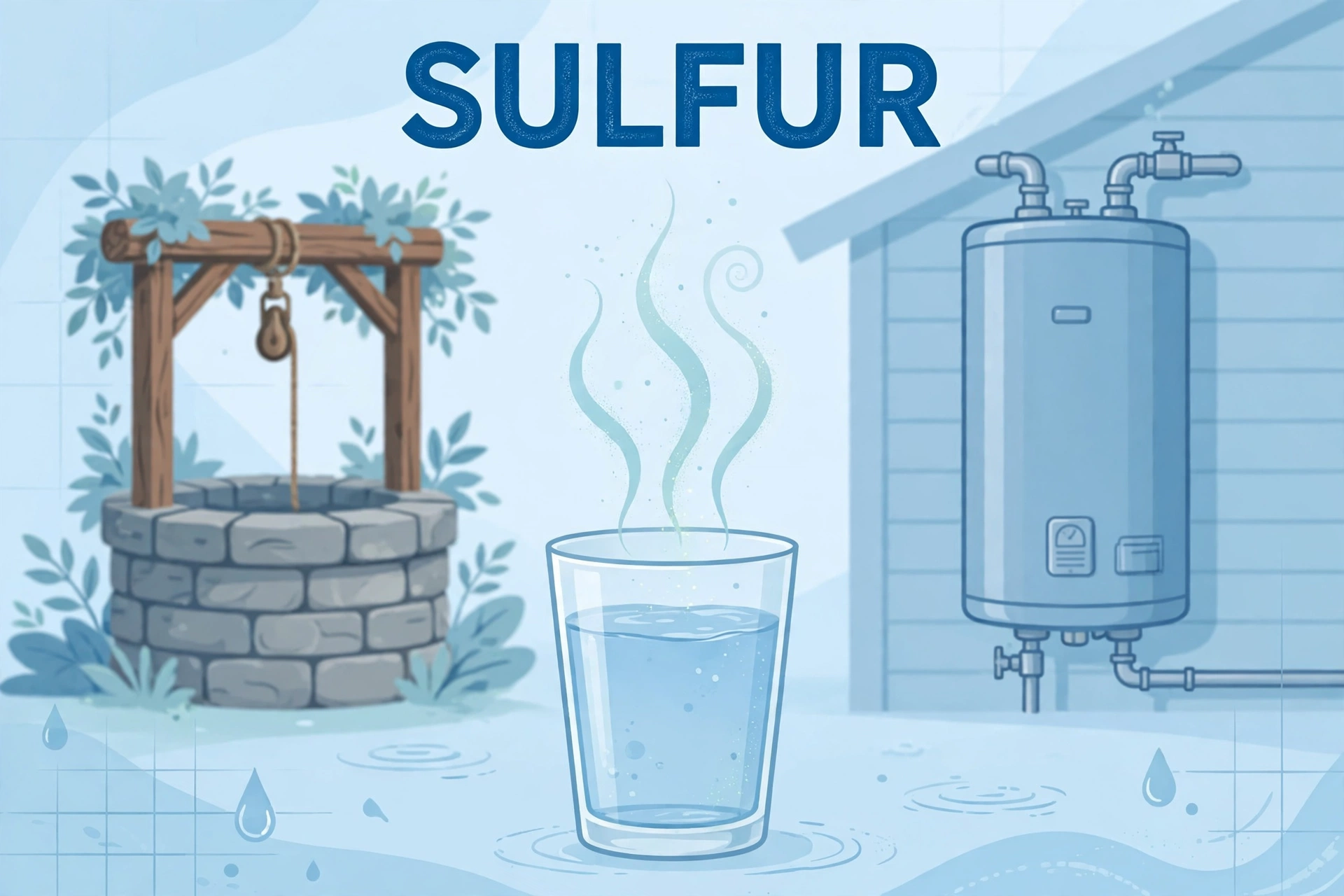
    If your water smells like rotten eggs, you don’t have a mystery — you have hydrogen sulfide. It’s the most complained-about well water problem that isn’t actually dangerous. Here’s how to diagnose it and fix it.

    What it is

    Hydrogen sulfide (H₂S) is a gas dissolved in your water, produced when sulfur-reducing bacteria break down organic matter in low-oxygen environments — deep wells, water heaters, plumbing. Humans can smell it at absurdly low levels (around half a part per billion), which is why a tiny amount smells like a disaster. The smell is the whole problem at household levels: EPA has no primary drinking-water limit for it because typical concentrations aren’t a health threat. (At very high concentrations it’s genuinely toxic — that’s an industrial-safety issue, not a tap-water one.)

    The one test that tells you where it’s coming from

    Run the cold tap. Then run the hot tap. Smell both.

    • Smell only in hot water: the problem is in your water heater, not your well. The magnesium anode rod (the sacrificial rod that keeps the tank from rusting) reacts with naturally occurring sulfate-reducing bacteria, making H₂S inside the tank. Common, fixable, and your well water is fine.
    • Smell in cold water too: it’s coming from the well or the source water itself.

    That thirty-second test saves people from buying whole-house treatment they don’t need. Hot-only smell? Start at the heater.

    The honest health picture

    At the levels found in household water, hydrogen sulfide is a nuisance — smell, taste, and it can tarnish silverware and corrode plumbing fixtures. It is not making you sick. Don’t let anyone sell you a treatment system on fear. Fix it for comfort and to protect your plumbing, not because it’s poisoning anyone.

    What actually removes it

    It depends on where it’s coming from:

    Hot-water-only smell (water heater):

    • Temporarily raise the heater to 160°F for a few hours to kill the bacteria, then flush (careful with scalding — turn it back down after).
    • Chlorinate the heater and flush it.
    • Replace the magnesium anode rod with a zinc-aluminum alloy rod, which produces far less sulfide gas.

    Cold-water smell (well/source):

    • Aeration — spraying or cascading the water through air strips the gas out. Simple, chemical-free, very effective.
    • Oxidation + filtration — chlorine injection, hydrogen peroxide, or ozone converts H₂S to filterable sulfur particles, then a carbon or multimedia filter catches them.
    • Manganese greensand filtration — oxidizes and filters in one unit.

    What doesn’t

    • A standard water softener — no. It swaps hardness minerals; the gas passes through.
    • A plain sediment filter — no. Though here’s the micron-rating footnote: a 5-micron nominal sediment pre-filter is still worth having ahead of oxidation equipment, because sediment fouls treatment media. It protects the fix; it isn’t the fix.
    • A standard carbon pitcher — no. Whole-house GAC after oxidation works; a pitcher doesn’t have the contact time.

    Bottom line

    Rotten-egg smell is hydrogen sulfide, it’s a comfort problem not a health crisis, and the hot-vs.-cold test tells you whether it’s a $30 anode rod or a well treatment system. Diagnose first, buy second.

    Wondering what else might be in your water? Start with What’s In Your Water?

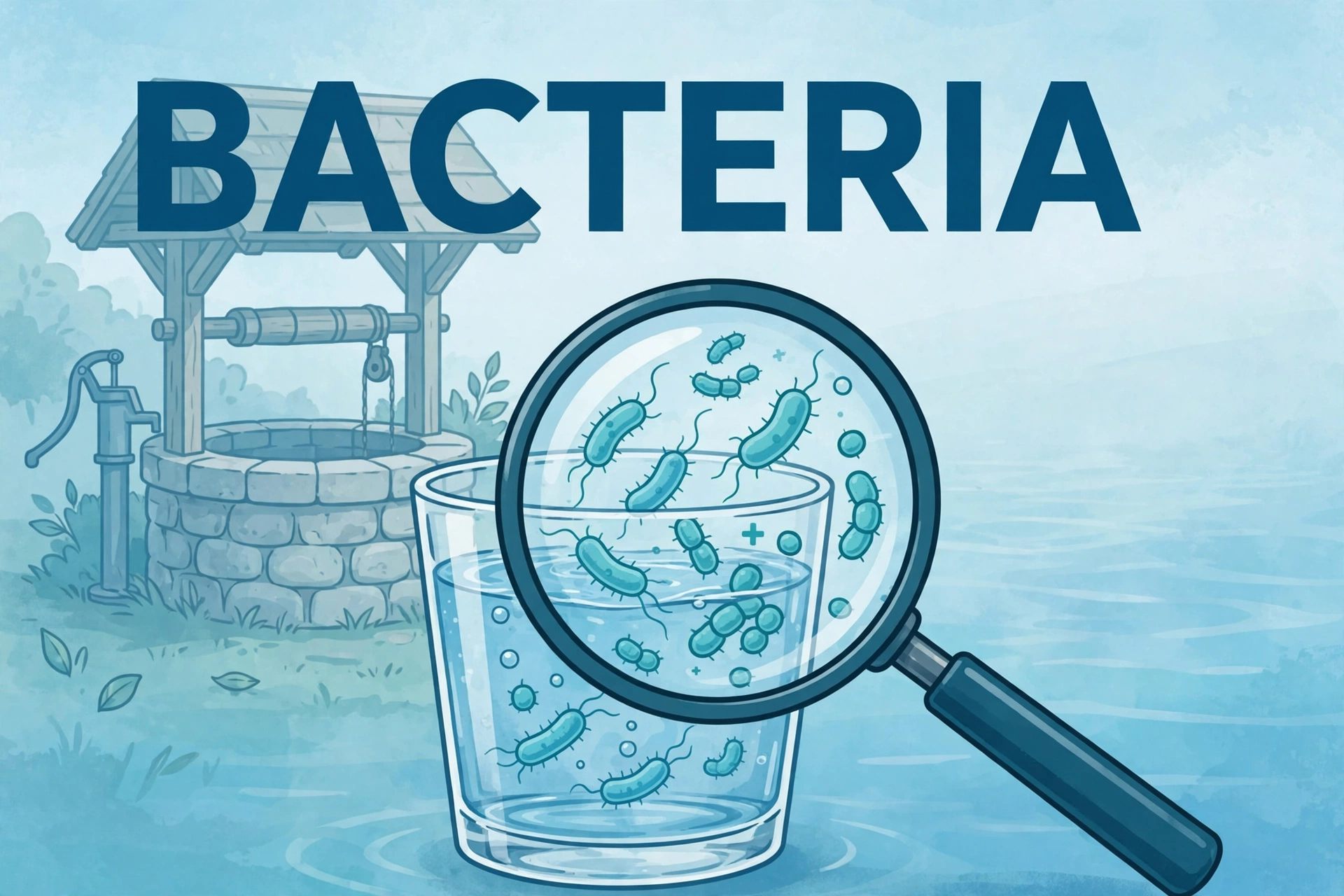
  • E. coli & Coliform in Drinking Water: What a Positive Test Means

    E. coli & Coliform in Drinking Water: What a Positive Test Means

    A positive bacteria test is the single most common reason a private well fails its water test. If you’ve ever gotten a lab report back with the word “coliform” on it, here’s what it actually means — and what it doesn’t.

    What the test is really telling you

    “Total coliform” is a family of bacteria used as an indicator, not a diagnosis. Most coliforms are harmless and live everywhere in soil and vegetation. Their presence in your water says: surface water or soil is getting in somewhere it shouldn’t — a cracked well cap, a failing septic, flooding, a well too close to a barnyard.

    E. coli is the more specific one. It’s a type of fecal coliform — its presence means fecal contamination has reached your water, and where feces go, worse pathogens (Giardia, viruses, the dangerous E. coli O157:H7 strain) can follow. Most E. coli strains won’t hurt you. The test isn’t saying you’re drinking poison — it’s saying the door is open.

    The honest health picture

    A total-coliform positive with no E. coli: investigate and retest, don’t panic. An E. coli positive: stop drinking it until it’s resolved — switch to bottled or boiled water. People with weakened immune systems, infants, and the elderly should be the most cautious. This is straightforward stuff, not a scare story: bacteria in well water is common, well understood, and fixable.

    What to do when a test comes back positive

    • Retest to confirm — one bad sample can be a sampling error. Use a clean, sterile bottle and follow the lab’s instructions exactly.
    • Inspect the wellhead. Cracked cap? Missing screen? Water pooling around the casing? Most bacterial problems start at the top of the well, not deep underground.
    • Shock-chlorinate the well — a strong chlorine dose circulated through the whole system, then flushed. This is the standard first response and it works for one-time contamination events.
    • Find the source. If positives keep coming back, something structural is wrong — septic too close, surface water intrusion, a compromised casing. Disinfection treats the symptom; the source needs fixing.

    What truly disinfects water (and what doesn’t)

    • Chlorination — yes, the municipal standard for a century.
    • UV light — yes, with a sediment pre-filter. UV can’t disinfect what it can’t see through — cloudy water shields bacteria from the light. This is where filter ratings earn their keep: a 5-micron nominal sediment cartridge ahead of the UV unit keeps the water clear enough for the light to do its job.
    • Boiling — yes. A full rolling boil for one minute kills bacteria and viruses. (Note the contrast with nitrates: boiling fixes bacteria and worsens nitrate. Know which problem you have.)
    • Distillation — yes.

    What doesn’t:

    • Standard carbon filters — no. They improve taste and remove chemicals; they don’t disinfect. A carbon filter on bacteria-positive water is decoration.
    • Standard water softeners — no.
    • A sediment filter alone — no. It protects your UV or RO unit; it doesn’t make water safe by itself.

    A word on micron ratings, since they matter here

    Bacteria run about 0.2 to 10 microns. An absolute-rated sub-micron membrane can physically block them, but the nominal-rated sediment cartridges in most homes can’t be trusted for that — “nominal” means “most of the time,” and disinfection isn’t a most-of-the-time job. For bacteria, disinfect — don’t just filter.

    Bottom line

    Test for coliform annually (New Jersey requires it for private wells for good reason). A positive test is a to-do list, not a tragedy: confirm it, inspect, shock, and fix the source. And put disinfection — not just filtration — between your well and your glass.

    Wondering what else might be in your water? Start with What’s In Your Water?

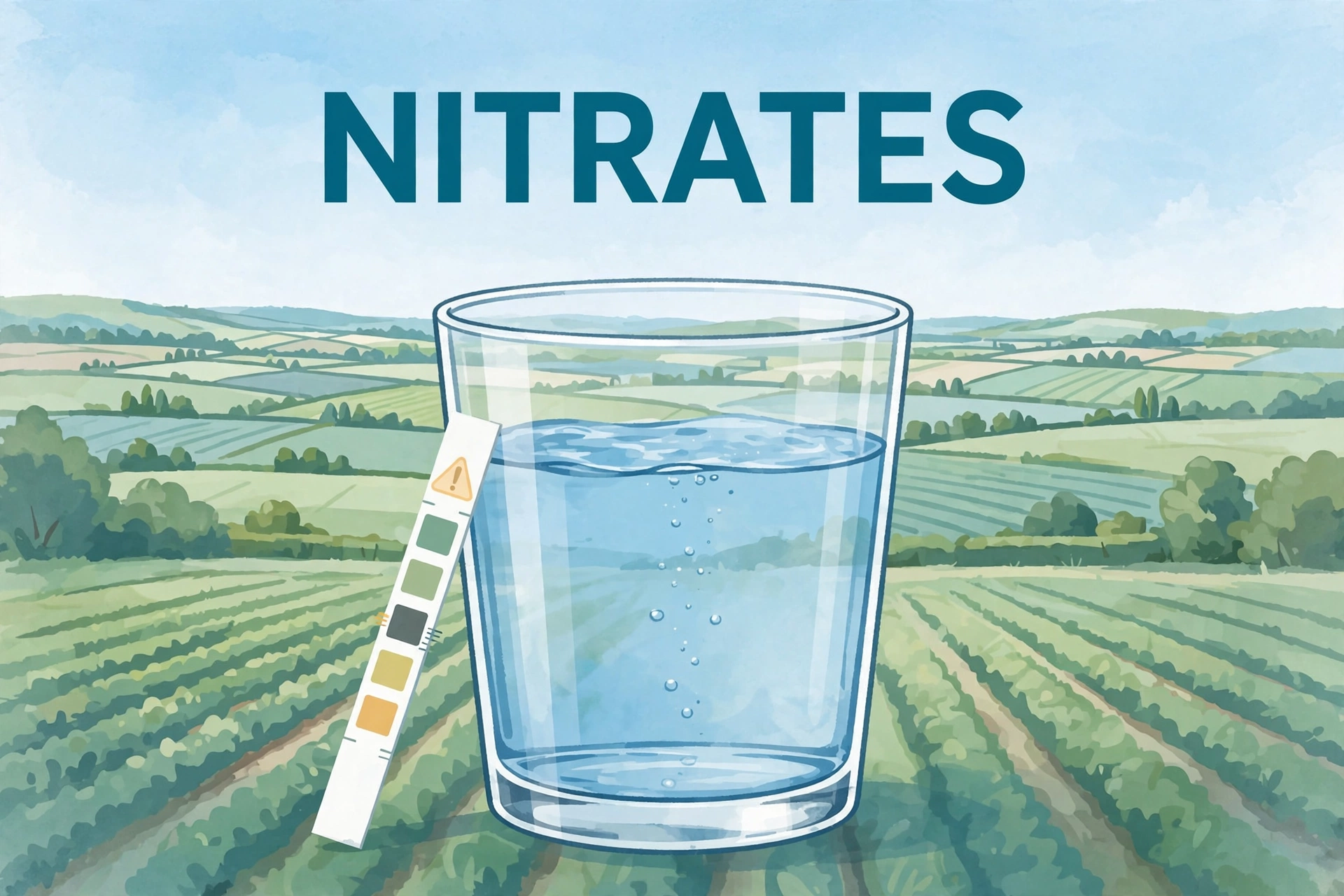
  • Nitrates in Drinking Water: Health Risks, Testing & What Removes Them

    Nitrates in Drinking Water: Health Risks, Testing & What Removes Them

    Nitrate is the most common chemical contaminant in America’s private wells. Not lead, not PFAS — nitrate. If your water comes from a well anywhere near farmland, a septic system, or livestock, this one is worth understanding.

    What it is

    Nitrate (NO₃) and nitrite (NO₂) are nitrogen compounds that dissolve easily in water. The EPA’s legal limit is 10 milligrams per liter measured as nitrogen — you’ll see it written “10 mg/L as N.” That number exists for one clear reason, which I’ll get to below.

    Where it comes from

    Mostly from the surface, working its way down. Synthetic fertilizers and manure spread on fields, septic system drain fields, feedlots, wastewater — rain and irrigation carry the nitrogen down into groundwater. Shallow wells in agricultural areas are the most exposed. This is also why New Jersey’s private-well testing law requires a nitrate test: the state knows it’s the likeliest thing to show up.

    The honest health picture

    The established, no-argument risk is to infants under six months: “blue baby syndrome” (methemoglobinemia). An infant’s digestive system converts nitrate to nitrite more readily, and nitrite interferes with the blood’s ability to carry oxygen. It is serious, and it is preventable — do not mix infant formula with water over the limit.

    For adults, the picture is murkier. You’ll see alarming claims online; here’s the measured version. IARC (the International Agency for Research on Cancer) classifies ingested nitrate and nitrite under conditions that lead to nitrosamine formation in the body as Group 2A — “probably carcinogenic.” A quick framing note, since this series covers classified substances: IARC groups are hazard classifications. They say whether something can cause cancer, not how much risk a given exposure carries. Group 2A does not mean “dangerous at any dose.” The science on adult risk at typical exposures is still debated. What isn’t debated: infants and pregnant women should take the limit seriously.

    How to test

    A lab test for “nitrate as nitrogen,” usually $20–40 from a certified lab. Test once a year if you’re near farms or septic systems, and retest after heavy flooding — runoff spikes levels. If you’ve never tested your well for nitrate, that test is overdue.

    What actually removes it

    • Reverse osmosis — yes, effective.
    • Anion exchange (nitrate-selective resin) — yes, the whole-house option.
    • Distillation — yes.

    What doesn’t — and the dangerous myth

    • Boiling does NOT remove nitrate. It makes it worse. Water evaporates, nitrate stays, concentration goes up. This is the single most important sentence in this article: if your water is high in nitrate, boiling it for your baby’s formula concentrates the very thing you’re worried about.
    • Standard carbon filters — no.
    • Standard water softeners — no (they swap calcium for sodium; nitrate sails through).
    • UV light — no. UV kills bacteria; it doesn’t touch dissolved chemicals.

    Bottom line

    Nitrate is common, testable, and fixable — but only by the right equipment. If you’re on a well, test for it. If it’s over 10 mg/L as N, an RO unit at the kitchen sink handles drinking and cooking water, and that’s the honest, proportionate fix.

    Wondering what else might be in your water? Start with What’s In Your Water?

  • How to Spot an Honest Water Treatment Company (The WQA Code of Ethics, Translated)

    Somebody knocks on your door with a little vial kit, puts a few drops in your tap water, and the water turns brown or full of flakes. Then comes the pitch: your water is dangerous, and their $8,000 system is the only thing standing between you and disaster.

    I’ve watched this show for three decades in water treatment. Sometimes the performance is honest. Often it isn’t. And there is actually a written standard for telling the difference — the Water Quality Association’s Code of Ethics. Every WQA member company pledges to follow it. Most consumers have never heard of it. Let’s fix that.

    I’m not a WQA member and I don’t speak for them. I’m just a guy who’s spent thirty years in this industry and believes you deserve to know what ethical companies have already promised to do. Here’s the code, translated into plain English.

    1. They tell the truth about YOUR water

    The code requires members to accurately represent the source water supply. That means: what’s actually in your water, based on real testing — not theater. Those dramatic precipitation tests? They make almost any water look scary, including perfectly fine water. An honest company tests your water properly and tells you what’s really there, numbers and all.

    2. They tell the truth about what their product does

    Members must accurately represent the performance of their process and the real benefit of their products. “Removes 99% of everything” is a red flag. Honest companies name the contaminant, name the reduction rate, and can point to independent certification — NSF/ANSI or WQA Gold Seal — backing it up.

    3. They recommend only what you need

    This one’s my favorite: the code calls for good judgment in recommending products and respecting the customer — which means selling you what your water actually needs, not the biggest system in the catalog. If your water needs a $300 sediment filter and they’re pitching a $9,000 whole-house system, walk away.

    4. They tell you about maintenance and cost up front

    Ethical companies inform you about maintenance, service requirements, and the related costs before you buy. Filters need changing. Softeners need salt. UV lamps burn out. If nobody mentions upkeep until after the check clears, that’s your answer about their ethics.

    5. They don’t trash-talk your tap water to scare you

    The code’s marketing guidelines exist specifically to stop companies from misleading consumers about the quality of public or private water supplies. Your municipal water is tested and regulated. A salesperson who tells you it’s poison isn’t educating you — they’re setting up a sale.

    6. They stand behind what they install

    Members pledge dependable service and follow-through on every commitment. The company that installed it should still answer the phone a year later. Ask about service before you buy, not after.

    How to use this

    You don’t need to memorize the code. Just keep this one question in your pocket when anyone tries to sell you water treatment:

    “Are you telling me what’s in my water, or are you telling me what to fear?”

    Honest companies do the first. The code says so. And if a company claims to follow the WQA Code of Ethics, you can hold them to it — violations can cost them their membership.

    Want the full document? Here it is, straight from the source: WQA Code of Ethics (PDF)

    Educate. Educate. Educate. The consumer. That’s the whole mission.

  • EPA Drinking Water Standards Decoder: MCL vs. MCLG and What the Legal Limits Actually Mean

    EPA Drinking Water Standards Decoder: MCL vs. MCLG and What the Legal Limits Actually Mean

    You’ve seen it on filter boxes: “meets EPA standards.” Sounds official. Sounds like the government tested this thing and gave it a thumbs-up.

    It doesn’t mean that. The EPA has never tested that filter. The EPA doesn’t test filters at all.

    Here’s the decoder, in plain English — because the EPA runs one system and filter certifications run a completely different one, and the industry is perfectly happy to let you mix them up.

    MCLG — The Health Goal. What Scientists Wish the Number Was.

    MCLG stands for Maximum Contaminant Level Goal. It’s the level of a contaminant in drinking water below which there’s no known or expected health risk — with a margin of safety built in. It’s not a law. Nobody gets fined for exceeding it. It’s the goalpost: where the number should be if health were the only thing that mattered.

    And here’s the number that tells you everything about how this system works: the MCLG for lead is zero. Because there is no safe level of lead exposure — especially for kids and pregnant women. Zero. That’s the health goal.

    MCL — The Legal Limit. What the Law Actually Allows.

    MCL stands for Maximum Contaminant Level. This one is enforceable — it’s the highest level of a contaminant legally allowed in public drinking water. Water systems that exceed it face violations and penalties.

    By law, the EPA must set the MCL “as close to the MCLG as feasible.” Feasible is doing a lot of heavy lifting in that sentence. It means: as close as current treatment technology allows, at a cost the country can actually bear. The gap between the MCLG and the MCL is where science meets economics — and economics usually wins a few rounds.

    So for lead: the health goal is zero, but there’s no MCL for lead at all. Instead the EPA uses an action level of 15 parts per billion under the Lead and Copper Rule — if more than 10% of sampled taps exceed it, the water system has to act. Read that again: the health goal is zero, and the law tolerates up to 15 ppb before it requires action. That gap is exactly why people buy filters.

    The Safe Drinking Water Act, in One Paragraph

    The Safe Drinking Water Act (SDWA), passed in 1974, is the law that gives the EPA authority to set those MCLs and go after water systems that break them. It covers public water systems — roughly, systems serving at least 25 people or 15 connections.

    What it does not cover: your private well. If you’re on well water, the EPA sets no limits for you, tests nothing for you, and sends you no reports. You’re on your own — which is exactly why well owners should read our water testing coverage and test annually.

    Consumer Confidence Reports — Your Water’s Report Card

    If you’re on public water, your utility is required to send you an annual water quality report — the Consumer Confidence Report (CCR) — by July 1st each year. It tells you where your water comes from, which contaminants were detected, how those levels compare to the MCLs, and whether the system had any violations.

    How to read one: skip to the detected-contaminants table, compare each result to its MCL, and pay attention to the footnotes — that’s where violations and explanations hide. Where to get yours: it usually arrives with your water bill or lives on your utility’s website. Lost it? The EPA maintains a CCR search — look up your zip code and read the thing. Most people have never opened theirs. You should be the exception.

    One honest caveat: the CCR tells you what was in the water leaving the treatment plant. It doesn’t tell you what the pipes between the plant and your faucet added — and for lead, those pipes are the whole problem.

    Two Systems, Side by Side — Don’t Mix Them Up

    This is the part that matters most, so let’s make it unmistakable:

    • The EPA regulates your tap water. It sets legal limits (MCLs) for public water systems. It does not test, approve, or certify water filters. Ever.
    • NSF (and other certifiers) test filters. An NSF/ANSI 53 certification means an independent lab verified that a specific filter model actually reduces lead, VOCs, cysts, and the rest. That’s a product claim, proven.

    The EPA writes the speed limit. NSF certifies that your car’s brakes work. You need both ideas in your head at once — and the box that says “meets EPA standards” is hoping you only have one.

    The WQA Gold Seal — The Other Mark You’ll See

    You’ll sometimes see a gold seal instead of the blue NSF mark: the WQA Gold Seal, from the Water Quality Association. Here’s what it is: WQA is the water treatment industry’s trade association, and its Gold Seal program is accredited by ANSI (and Canada’s SCC) to test and certify products to the same NSF/ANSI standards — 42, 53, 58, all of them.

    So a Gold Seal certified to NSF/ANSI 53 means the same thing as an NSF certification to 53: independent testing, same standard, equivalent assurance. Different certifier, same exam.

    One honest footnote, because you deserve it: WQA is the industry’s association certifying the industry’s products. The ANSI accreditation is real and the testing is legitimate — but it’s the industry grading with an accredited proctor in the room, not the government. Read the standard number either way. The number is what matters, not whose logo sits next to it.

    The Weasel Words: “Meets EPA Standards”

    Back to that box. “Meets EPA standards” on a water filter means the manufacturer says their product performs well enough that your water would satisfy EPA limits. The EPA didn’t test it. The EPA didn’t review it. The EPA doesn’t even have a program for that.

    It’s the filter-world cousin of “tested to NSF standards” — a claim graded by the person making it. What you want instead is a certification mark with a standard number: NSF/ANSI 53, or a WQA Gold Seal to NSF/ANSI 53. Certified means somebody independent checked. “Meets EPA standards” means somebody wrote words on a box.

    Don’t Take Anyone’s Word — Including Mine

    Two places to verify everything in this article yourself:

    1. The EPA’s drinking water pages — the actual MCLs, the Lead and Copper Rule, and the CCR search to pull your own water system’s report. Primary source, no middleman.
    2. NSF’s certified-products search at https://listings.nsf.org/certified-products-systems — look up any filter model and see exactly which standards it’s certified to. Two minutes, and it’s the single best defense against fake certification marks.

    The pattern is the same as ever: the people selling you the filter are the last people you should trust about the filter. Check the database. Read your CCR. Know your numbers.

    The Short Version

    You want to know…The answer…
    The level with no health riskMCLG (not enforceable)
    The level that’s actually illegal to exceedMCL (enforceable)
    Why lead’s goal is zero but taps can have 15 ppbMCLG = 0; action level = 15 ppb before systems must act
    Who sets tap water limitsThe EPA, under the Safe Drinking Water Act
    Who certifies that a filter worksNSF or WQA (to NSF/ANSI standards) — not the EPA
    What “meets EPA standards” on a box meansMarketing. The EPA doesn’t certify filters.
    Your water’s annual report cardConsumer Confidence Report, due July 1st

    And whatever the box shouts, read the fine print: “certified” to a numbered standard counts. Everything else is adjectives.

    What I’d buy

    I don’t buy the box — I buy the certification behind the box. The EPA tells me what should be in my water; a numbered certification tells me the filter actually does something about it. Give me NSF/ANSI 53 or a Gold Seal to 53, and show me the database entry. The rest is noise.

    — Steve

  • NSF/ANSI Standards Decoder: What Those Numbers on the Box Actually Mean

    NSF/ANSI Standards Decoder: What Those Numbers on the Box Actually Mean

    You’ve seen the little blue NSF mark on water filter boxes. Maybe you’ve seen numbers next to it — 42, 53, 58 — and wondered if they mean anything.

    They mean everything. Those numbers are the difference between a filter that makes your water taste better and a filter that actually protects your health. And plenty of manufacturers are counting on you not knowing the difference.

    Here’s the decoder, in plain English.

    NSF/ANSI 42 — Taste and Odor. That’s It.

    Standard 42 covers the aesthetic stuff: chlorine taste and smell, particulates, things that make water unpleasant but won’t hurt you. Most pitcher filters and basic faucet mounts carry 42 and nothing else.

    Nothing wrong with 42 — if all you want is better-tasting tap water. But 42 says zero about lead, zero about chemicals, zero about anything that affects your health. A box that shouts “NSF CERTIFIED!” with only 42 behind it is selling you taste, not safety.

    NSF/ANSI 53 — The Health One. This Is the Number That Matters.

    Standard 53 is the heavy hitter. It covers contaminants with actual health effects: lead, mercury, volatile organic compounds (VOCs — the industrial and agricultural chemicals), cysts like giardia and cryptosporidium, and PFAS compounds including PFOA and PFOS.

    If you’ve got a known lead issue, or you’re buying a filter because you’re worried about what’s in your water rather than how it tastes, 53 is the number you need. The CDC itself points to NSF 53-certified filters for lead concerns.

    Here’s the open secret of the industry: 42 is cheap to test for. 53 costs real money and requires real filtration performance. Guess which one most brands stop at — and then put the big blue NSF logo on the box anyway.

    NSF/ANSI 58 — Reverse Osmosis Systems

    Standard 58 covers complete RO systems — tested as a whole unit, membrane plus pre-filters plus post-filters. It covers total dissolved solids and, depending on the specific claims, heavy metals, fluoride, nitrates, and arsenic.

    If you’re buying an RO system, 58 is the certification that says the system works, not just one cartridge in it.

    NSF/ANSI 401 — The New Stuff: Pharmaceuticals and Pesticides

    Standard 401 is the emerging-contaminants standard — trace pharmaceuticals (ibuprofen and the like), herbicides, pesticides, things that aren’t EPA-regulated yet but are showing up in water supplies anyway. If “what else is in there that nobody’s testing for” keeps you up at night, 401 is your number.

    The Supporting Cast

    • NSF/ANSI 44 — water softeners (calcium and magnesium reduction).
    • NSF/ANSI 55 — UV systems for killing microorganisms. Two classes: A handles the dangerous stuff, B handles the merely unpleasant.
    • NSF/ANSI 372 — verifies components are genuinely lead-free.
    • NSF/ANSI 61 — material safety: the filter itself isn’t leaching junk into your water.

    The Weasel Words: “Certified” vs. “Tested To”

    This is the part the marketing departments hope you skip.

    “NSF certified” means an independent lab tested the product and it passed. Real deal.

    “Tested to NSF standards” — or “designed to meet,” “built to exceed” — means the manufacturer ran their own tests and says it would pass. Nobody independent verified a thing. It’s the difference between passing the exam and grading your own paper.

    When you see the weasel words, read the actual standard number. If there isn’t one, there’s a reason.

    Don’t Take Anyone’s Word — Including Mine

    NSF keeps a searchable database of every certified product, by model number and by exactly which contaminants it’s certified to reduce. Before you buy, look the model up yourself. It takes two minutes, and it’s the single best defense against counterfeit marks — which are all over online marketplaces, by the way. A blue NSF logo in a product photo proves nothing. The database entry proves everything.

    Don’t take my word for it — look the product up yourself in NSF’s certified-product search. If it’s not listed there, it isn’t certified, no matter what the box says.

    The Short Version

    You want…Look for…
    Better taste and smellNSF/ANSI 42
    Lead, chemicals, cysts, PFASNSF/ANSI 53
    RO system that actually performsNSF/ANSI 58
    Pharmaceuticals and pesticidesNSF/ANSI 401
    A softener that softensNSF/ANSI 44
    UV that kills the bad stuffNSF/ANSI 55 (Class A)

    And whatever the box shouts, read the fine print: the word is “certified,” or it doesn’t count.

    What I’d buy

    I don’t pick products by the loudest logo — I pick by the standard number behind it. For drinking water at the tap, I want to see 53 on the box at minimum, because taste is nice but health is the point. If a product can’t tell me its standard number, it’s telling me everything I need to know.

    — Steve

  • Arsenic in Drinking Water: The One You Can’t Taste, Smell, or See

    Arsenic in Drinking Water: The One You Can’t Taste, Smell, or See

    Arsenic is the quietest contaminant in this series. It has no taste, no smell, and no color — your senses give you zero warning. The only way to know it’s in your water is a lab test. That’s the first thing to understand, because everything else follows from it.

    This isn’t a factory-spill story. Most arsenic in drinking water is natural — it dissolves out of bedrock into groundwater. If you’re on a private well, that’s the pathway. The hotspots in the U.S. are bedrock wells in New England, the Southwest, the Great Lakes region, and the upper Midwest — and yes, New Jersey has its own piece of this: arsenic is the second most common contaminant to exceed drinking-water standards in NJ private wells, with the Piedmont region carrying the highest risk. (Some arsenic does come from people — old arsenical pesticides, mining and smelting waste — but geology is the main source.)

    The health picture, honestly

    Arsenic is an IARC Group 1 carcinogen. As the series rule goes: Group 1 is a hazard classification — it means arsenic can cause cancer, not that any dose will. The cancer evidence comes from people who drank high-arsenic water for years, mostly in studies from Taiwan, Chile, and Bangladesh.

    Here’s what long-term exposure to elevated inorganic arsenic actually does. The most characteristic effect is a pattern of skin changes: patches of darkened or lightened skin, and thickening — small “corns” or warts — on the palms, soles, and torso. These can show up after years of exposure and can precede non-melanoma skin cancer. The cancer picture from the research: increased risk of skin, lung, and bladder cancer, with liver, kidney, and prostate cancers also implicated. Studies also link chronic exposure to cardiovascular disease, nerve damage (a “pins and needles” numbness in hands and feet), and type 2 diabetes.

    The honest framing: this is about years of drinking water over the limit, not a glass from the tap. EPA’s federal limit is 10 parts per billion (micrograms per liter) — and its health goal is zero, meaning there’s no level considered risk-free. New Jersey doesn’t wait for Washington here: our state standard is 5 ppb, half the federal limit, and it’s held that number since 2006. If your water is at or under 5, you’re in good shape.

    How to test

    No dip strip, no home kit for real answers — arsenic needs a certified lab. If you’re on city water, your utility tests it and reports it on your annual water-quality report. If you’re on a private well, that test is on you: use a state-certified drinking-water lab. Test before you treat, test again after you install anything, and retest yearly. Arsenic levels in a well can shift, and filters wear out.

    One more NJ note: if you’ve bought or sold a house here, arsenic is part of the Private Well Testing Act — it gets tested at real estate transactions. Check the paperwork.

    What actually removes it

    Several proven methods — but with one catch that matters, so read this section twice. Arsenic comes in two forms: As(III) and As(V). Some treatment only handles one of them.

    • Reverse osmosis. The workhorse. An under-sink RO handles both arsenic forms, and EPA’s own testing program found RO knocking out roughly 99% of total arsenic. This is the default recommendation for drinking and cooking water.
    • Anion exchange. Effective — but only against As(V). If your well water has a big share of As(III), the water needs an oxidation pre-treatment step to convert it to As(V) first. This is why you need a full lab analysis before buying a system, not just a number.
    • Adsorptive media (activated alumina and iron-based). Solid whole-house options — iron-oxide media in particular can handle As(III) too, which makes it a good fit for some well chemistries.
    • Distillation. Works — boils the water, leaves the arsenic behind. Slow and energy-hungry for whole-house use, but legitimate.

    Whatever you choose, look for NSF/ANSI certification with arsenic listed on it. Uncertified claims are just marketing.

    What does NOT remove it:

    • Carbon filters — your pitcher, faucet, or fridge filter. Carbon-based pitcher filters do not remove arsenic, period. (A rare few pitchers are NSF-certified for arsenic — unless the box says exactly that, assume it isn’t.)
    • A water softener. It swaps hardness minerals; arsenic sails through.
    • Boiling. Makes it worse — water evaporates, arsenic stays, concentration goes up.
    • UV, chlorine, and sediment/particle filters. They disinfect or clarify; arsenic is neither.

    One thing you can relax about: arsenic is barely absorbed through skin. Showering, bathing, washing clothes — fine. Protect the water you drink and cook with, and you’ve handled the exposure.

    What I’d buy

    Treatment type: an under-sink reverse osmosis system, NSF/ANSI 58 certified, with arsenic on the certification sheet — it handles both arsenic forms, no pre-treatment chemistry to fuss over, and it knocks out plenty of other things in the same pass. For a well with mostly As(III) and a whole-house approach, an iron-oxide adsorptive media system, sized to your water test, is the other legitimate play. Either way: test first, install second, retest after.

    The bottom line

    Arsenic is the argument for testing your well even when everything seems fine — because with this one, fine is exactly what dangerous looks like. New Jersey’s 5 ppb bar is stricter than the federal one, so check your number against that. If you’re over, the fix is real and proven: RO for the kitchen, adsorptive media for the whole house, nothing else sold as a shortcut.

    Start here: What’s In Your Water? — learn how to read your water report and test your own tap.