Author: iPhilter

  • Pharmaceuticals in Drinking Water

    Pharmaceuticals in Drinking Water

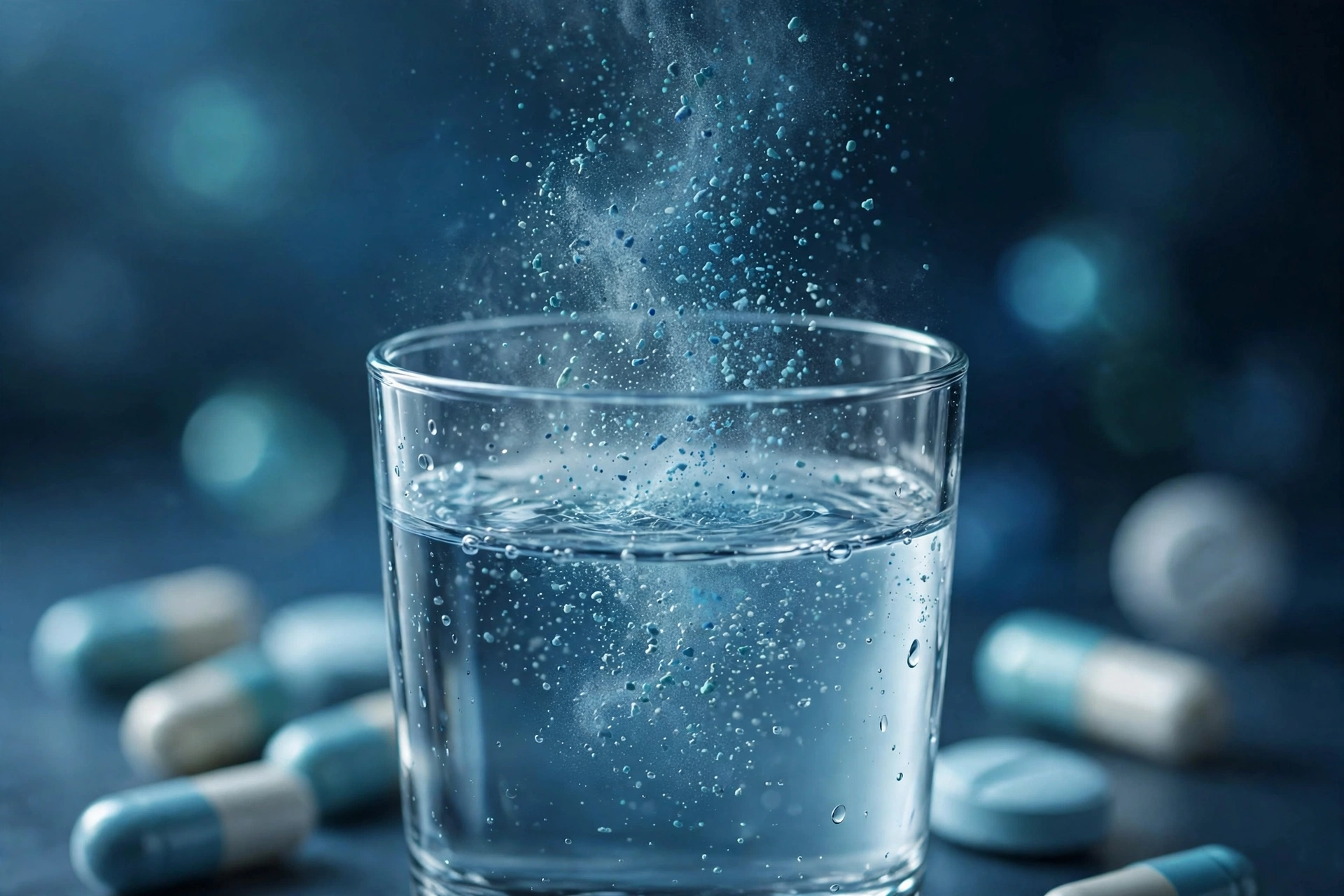
    Trace amounts of prescription drugs — antibiotics, hormones, mood stabilizers, painkillers — have been detected in tap water across the country. The amounts are tiny. The question everyone asks is whether tiny matters.

    What they are

    Pharmaceuticals and personal care products (PPCPs): the residues of medicines people take, excreted or washed down drains, passing through wastewater treatment that was never designed to remove them. An AP investigation found dozens of pharmaceuticals in tap water supplies serving tens of millions of Americans. Concentrations are typically measured in parts per trillion — far below a medical dose.

    Where they come from

    Us — flushed toilets, shower drains, and the biggest avoidable source: unused medications flushed or poured down the drain. Wastewater plants remove some fraction, and the rest rides into rivers that become someone else’s drinking water downstream.

    The health picture, honestly

    There’s no federal MCL for pharmaceuticals in drinking water, and at detected levels, no study has shown direct human health harm from tap-water exposure. But “no proven harm at trace levels” isn’t the same as “proven safe” — especially for hormones and endocrine disruptors, where tiny doses can have outsized effects, and for the mixture of dozens of compounds nobody’s tested in combination. The honest position: levels are very low, the science is incomplete, and reducing exposure is reasonable.

    How to test

    Specialized lab analysis — not a home test-kit item, and expensive. For most people, the practical assumption is that trace PPCPs are present in any surface-water-derived supply, and the response is filtration, not testing.

    What removes them

    Reverse osmosis — the most effective home treatment, removing 90–99%+ of pharmaceutical molecules. Activated carbon (especially GAC) adsorbs many pharmaceutical compounds effectively. Ozonation and advanced oxidation destroy them. A four-year utility study ranked RO first, with ozone, advanced oxidation, nanofiltration, and activated carbon all “superior.” Conventional chlorination removes roughly half — better than nothing, not the answer.

    What does NOT remove them

    Standard pitcher filters, boiling, water softeners, UV at disinfection doses, basic sediment filtration.

    What I’d buy: an under-sink reverse osmosis unit, NSF listed — the most effective home answer for pharmaceuticals, hormones, and the personal-care chemicals riding with them. Pair it with carbon pre-filtration for the broadest coverage. And do your part upstream: never flush unused meds — use a drug take-back program.

    Pharmaceuticals in water are a “low dose, open question” contaminant — not a crisis, not nothing. RO filtration handles them along with nearly everything else on this list. And the cheapest contribution anyone can make is a take-back envelope instead of a toilet.

    Curious what’s in your tap? Start with What’s In Your Water?

  • Microplastics in Drinking Water: Health Concerns & How to Remove Them

    Microplastics in Drinking Water: Health Concerns & How to Remove Them

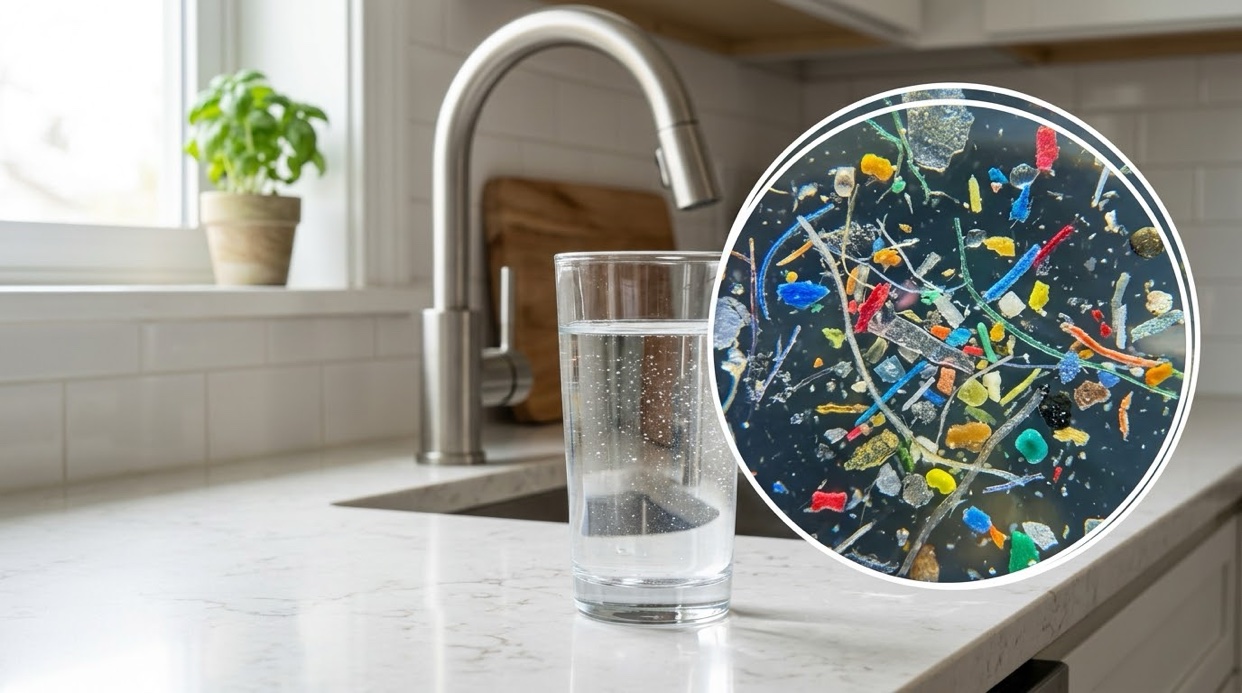
    Microplastics have transitioned from a niche topic in marine biology to a primary concern for homeowners evaluating their tap water quality. As testing techniques grow more sensitive, scientists are detecting microscopic plastic particles in tap water, bottled water, rivers, and even inside the human body.

    While headlines can sound alarming, the scientific understanding of human health risks is still evolving. This article provides a clear, factual breakdown of what microplastics are, where they originate, what research shows about their presence in drinking water, and how water filtration systems perform against them.

    1. What Are Microplastics and Nanoplastics?

    Plastic does not readily biodegrade; instead, environmental exposure to sunlight, wind, and wave action breaks it down into progressively smaller fragments. Plastic contaminants in water are generally classified into two primary size categories:

    • Microplastics: synthetic solid plastic particles ranging from 1 micrometer (µm) up to 5 millimeters (mm) in size (about the size of a pencil eraser).
    • Nanoplastics: plastic particles smaller than 1 micrometer (under 1,000 nanometers). Because of their sub-micron scale, nanoplastics are invisible under standard optical microscopes and require advanced chemical imaging technology to detect.

    Primary Sources of Contamination

    Microplastics enter the water supply through several everyday human activities and industrial processes:

    • Synthetic Clothing Fibers: Washing synthetic garments (such as polyester, nylon, or acrylic fleece) sheds thousands of microfibers per laundry load. Wastewater treatment facilities capture many, but not all, of these fibers before effluent is discharged into waterways.
    • Tire Wear and Road Runoff: Friction between vehicle tires (made of synthetic rubber compounds) and road surfaces generates tiny rubber-plastic particles. Rain washes this debris into storm drains and local surface waters.
    • Degraded Plastic Waste: Single-use plastic packaging, bags, and bottles left in landfills or rivers slowly break down into fragments and microfibers over time.
    • Cosmetics Microbeads: Historically added as exfoliants in facial scrubs and toothpaste, polyethylene microbeads washed down household drains. Although federal law banned intentionally added microbeads in wash-off cosmetics via the Microbead-Free Waters Act of 2015, older residues persist in environmental sediments.

    2. What Studies Have Found in Drinking Water

    As scientific instrumentation has advanced, researchers have shifted from studying ocean waters to testing tap and bottled water directly.

    • Tap Water Contamination (Kosuth et al., 2018): In a global study published in PLOS ONE, researchers tested 159 tap water samples from around the world. The study found that 81% of tap water samples contained anthropogenic particles — nearly all of them fibers — with an average concentration of 5.45 particles per liter.
    • Bottled Water Microplastics (Mason et al., 2018): A groundbreaking study by researchers at the State University of New York at Fredonia analyzed 259 individual bottles of water across 11 global brands (published in Frontiers in Chemistry). The team detected plastic particles in 93% of the tested bottles, averaging 325 particles per liter (including particles down to 6.5 µm). Polypropylene, the polymer frequently used to manufacture bottle caps, accounted for 54% of the identified particles, suggesting the packaging process itself contributes contamination.
    • Bottled Water Nanoplastics (Qian et al., 2024): Utilizing single-particle Stimulated Raman Scattering (SRS) microscopy, researchers from Columbia and Rutgers Universities published a landmark study in PNAS. They found that bottled water contained an average of ~240,000 plastic particles per liter — roughly 90% of which were nanoplastics under 1 micrometer in size, which earlier analytical methods were unable to count. (That headline count has since drawn a published critique over laboratory blank methods, which the authors have answered; the exact number is debated, but the finding that bottled water carries far more plastic particles than tap water is not.)

    3. Potential Health Effects: What Science Knows (and Does Not Know)

    Understanding how microplastics affect human health requires distinguishing between detection and toxicity. Scientists have confirmed where particles go, but long-term health consequences remain an active field of study.

    Where Particles Have Been Detected in the Body

    Peer-reviewed studies have detected microplastics and nanoplastics in human blood, lung tissue, placenta tissue, and stool samples. Recent autopsy studies have also detected particles in cardiovascular tissue and human brain tissue samples.

    The Current Scientific Consensus

    • Biological Absorption: Larger microplastics (above roughly 150 micrometers) are generally not absorbed by the human gastrointestinal tract and pass through the body. However, smaller particles — particularly sub-micron nanoplastics — possess the theoretical capability to cross biological membranes, such as the gut lining or blood-brain barrier.
    • Toxicity Concerns: Researchers are actively investigating two main areas of concern: cellular toxicity caused by physical particle irritation, and chemical exposure from plastic additives (such as phthalates or bisphenols) leaching into tissues.
    • Current Status: In its public health evaluations, the World Health Organization (WHO) concluded that while routine monitoring is sensible, the current scientific evidence does not show a clear, quantified health risk from consuming microplastics at current levels in drinking water. Health institutions emphasize that more standardized research is required before firm conclusions can be drawn.

    4. Regulatory Status: EPA Standards and Regulations

    To evaluate your drinking water accurately, it is essential to understand federal and state regulatory frameworks.

    Is there an EPA Maximum Contaminant Level (MCL) for microplastics?
    No. There is currently no enforceable EPA drinking water standard or Maximum Contaminant Level (MCL) for microplastics or nanoplastics under the Safe Drinking Water Act. Public water utilities are not legally required to test for or report microplastic concentrations.

    Regulatory Outlook:
    The EPA has included microplastics on its draft Contaminant Candidate List 6 (CCL 6), published in April 2026. The CCL is a watchlist of unregulated contaminants known or anticipated to occur in public water systems. Inclusion on this list prioritizes federal research into standardized testing methodologies, occurrence, and toxicology, which represents the initial administrative step toward potential future regulation. Microplastics are often discussed alongside PFAS — the forever chemicals — as the two emerging contaminant stories in drinking water; you can read our full breakdown in PFAS in Drinking Water.

    5. Particle Sizes vs. Filter Micron Ratings

    Selecting the right water filter requires comparing particle dimensions against filter pore sizes. Particle dimensions are measured in micrometers (µm), commonly called microns (1 micron = 0.001 millimeters).

    Size Reference Scale

    • Human Hair Diameter: ~70 µm
    • Fine Beach Sand: ~100 µm
    • Microplastics: 1 µm to 5,000 µm (5 mm)
    • Nanoplastics: under 1 µm (under 1,000 nanometers)

    Absolute vs. Nominal Micron Ratings

    When shopping for water treatment filters, understanding the difference between rating types is critical:

    • Nominal Micron Rating: Per the Water Quality Association (WQA), a nominal rating means the filter traps about 85% of particles at the specified size. A 1-micron nominal filter still lets roughly 15% of 1-micron particles pass through.
    • Absolute Micron Rating: Represents a verified physical barrier where the filter rejects 99.9% or more of particles at or above that specified micron size under laboratory test conditions.

    6. What Removes Microplastics: Filter Types and Pore Sizes

    Water treatment technologies vary in their ability to capture microplastics based on physical pore size and filtration mechanics.

    Sediment Filters

    Typical Pore Size / Rating: 1 µm to 50 µm

    Microplastic Removal Capability: Moderate to High (traps larger fragments and synthetic fibers)

    Nanoplastic Removal Capability: None (nanoplastics pass straight through)

    Carbon Block Filters

    Typical Pore Size / Rating: 0.5 µm to 10 µm

    Microplastic Removal Capability: High (captures most microplastics 0.5 µm and larger via physical straining and adsorption)

    Nanoplastic Removal Capability: Low to None (sub-micron particles bypass carbon pores)

    Reverse Osmosis (RO)

    Typical Pore Size / Rating: ~0.0001 µm

    Microplastic Removal Capability: Very High (~99%+ physical rejection)

    Nanoplastic Removal Capability: High (rejects sub-micron particles down to ionic levels)

    Important Note on Certifications

    There is no standalone standard written only for microplastics — but that does not mean no certification exists. Microplastics Reduction is a certified claim under NSF/ANSI 401, the standard for emerging compounds, and real products carry it today, certified by NSF and by IAPMO R and T. When you shop, that claim — Microplastics Reduction under NSF/ANSI 401 — is the one to look for, and you can confirm any product listing in the certifier own directory before you buy.

    The size-based claim still matters too: Particulate Reduction, Class I, under NSF/ANSI 42 covers particles of 0.5 to 1 µm (at least 85% reduction) — rust-and-sediment territory originally, but the same physical size range as larger microplastics. Be wary of any brand advertising a special microplastic certified logo outside these standards; check the claim against the NSF/ANSI 401 listing instead.

    7. Regional Findings: Microplastics in New Jersey Waterways

    Local research in New Jersey highlights how microplastics move through state water infrastructure and natural surface waters.

    • NJ DEP Wastewater and Surface Water Analysis (2026): A May 2026 study published by the New Jersey Department of Environmental Protection (NJ DEP) Division of Science and Research, with Rutgers University researchers, evaluated microplastic concentrations across four municipal Wastewater Treatment Plants (WWTPs) and receiving water bodies.
    • Findings: The study identified particles ranging in size from 140 µm to 5,000 µm in wastewater. Influent entering the plants averaged 33 microplastic particles per liter, and the plants removed 84–93% of microplastics by the end of treatment, with treated effluent averaging about 1.4 particles per liter. Nearby surface waters averaged between 1.0 (upstream) and 1.5 (downstream) microplastic particles per liter, showing that treated discharge and stormwater runoff continually introduce synthetic polymers into New Jersey rivers and watershed systems; the most common polymers identified in the wastewater itself were polypropylene (35%) and polyester (23%).

    Summary and Practical Takeaways

    1. Tap water contains significantly fewer microplastic particles than bottled water. Bottled water packaging sheds substantial quantities of micro- and nanoplastics into the liquid.
    2. Reverse Osmosis (RO) and sub-micron Carbon Block filters (0.5 µm absolute) are the most effective home filtration methods for capturing microscopic plastic debris.
    3. A microplastics certification does exist — look for a Microplastics Reduction claim under NSF/ANSI 401, verified in the certifier directory, or a certified Class I particulate reduction (0.5–1 µm) under NSF/ANSI 42, or an RO system, for the strongest documented performance.
  • Giardia & Cryptosporidium in Drinking Water: How to Remove Them

    Giardia & Cryptosporidium in Drinking Water: How to Remove Them

    Crypto’s in the news this week — 14 people got sick from a hotel pool in Washington, and the pool was clean, well-maintained, no violations on record. That’s the thing about Cryptosporidium: chlorine doesn’t stop it. These are the same parasites behind every “boil water” notice you’ve ever seen. Giardia and Cryptosporidium — “Crypto” — are microscopic parasites that cause intestinal illness, and Crypto has one nasty trick: its protective shell shrugs off the chlorine your utility uses to disinfect the water.

    What they are

    Single-celled parasites spread through human and animal waste. When conditions turn bad, they form hard-shelled cysts (Giardia) and oocysts (Crypto) that survive in cold water for months. It takes as few as one to ten organisms to cause infection. Symptoms: diarrhea, nausea, vomiting, fever — miserable for a healthy adult, dangerous for the immunocompromised.

    Where they come from

    Surface water — lakes, rivers, reservoirs — contaminated by wildlife, livestock, or sewage overflows. Wells under the influence of surface water can carry them too. After heavy rain or flooding, the risk spikes. This is why utilities drawing from surface water must filter and disinfect to strict federal standards.

    The health picture, honestly

    For healthy people, giardiasis and cryptosporidiosis are usually self-limiting — a week or two of misery. For infants, the elderly, and anyone immunocompromised, Crypto can be life-threatening. There’s no MCL for either — the EPA regulates them through treatment requirements instead: utilities must achieve 99.9% removal or inactivation of Giardia and 99% of Crypto.

    How to test

    Specialized lab testing exists but isn’t routine for homeowners. Practically: if your utility issues a boil-water advisory, assume the worst. Well owners after floods or with surface-water influence should test for total coliform as a screening indicator and talk to their health department.

    What removes them

    Three proven answers: boiling (a rolling boil for 1 minute kills both — the CDC’s gold standard), absolute 1-micron filtration, and UV disinfection (very effective against both, including chlorine-resistant Crypto). Reverse osmosis removes them easily. Note the word absolute: a filter labeled “absolute 1 micron” is tested to block everything above that size. A filter labeled “nominal 1 micron” or just “1 micron” is not — the CDC specifically warns that nominal filters may NOT remove Crypto. NSF Standard 53 or 58 certification for cyst reduction is what you look for on the box.

    What does NOT remove them

    Chlorine and chloramine at normal municipal levels — Crypto is virtually unaffected. Standard carbon pitchers, water softeners, and sediment filters with loose micron ratings. “Effective against Giardia” on a label doesn’t mean effective against Crypto.

    If a boil-water advisory hits your town

    Don’t use your drinking water system during the advisory. Put whole-home filters in bypass mode — bacteria can linger in the filter media and in POE tanks. It might not cause trouble right away, but they’re susceptible to harboring it. After the advisory lifts, flush through the spigot — not the shower head — before putting anything back in service. If a shower head filter was used during the advisory, replace it just like the other filters. And if your RO was used, assume the prefilters and membrane are fouled — replace them and disinfect the tank as a precaution.

    What I’d buy: a point-of-use filter certified to NSF 53 or 58 for cyst reduction with an ABSOLUTE (not nominal) 1-micron rating — or an under-sink reverse osmosis unit, which handles cysts plus everything dissolved. For whole-house protection on a private well, a properly sized UV system validated for Crypto inactivation.

    This is the article where the micron rating lesson matters most: absolute versus nominal is the difference between protected and exposed. Read the label. If it doesn’t say “absolute,” it doesn’t count.

    Curious what’s in your tap? Start with What’s In Your Water?

  • What Your Water Is Doing to Your Water Heater

    What Your Water Is Doing to Your Water Heater

    Here’s a stat that stopped me this week: about 18% of your home’s energy use goes to heating water. (That one’s from the Water Quality Association.) Your water heater is the second-hardest-working appliance in the house, right behind your heating and cooling system — and most people never think about it until the shower runs cold.

    But here’s the part nobody talks about: it’s not just an energy story. It’s a water story. What’s in your water is quietly beating up your water heater from the inside, every single day. And there’s plenty you can do about both sides of it.

    Sediment: the slow killer

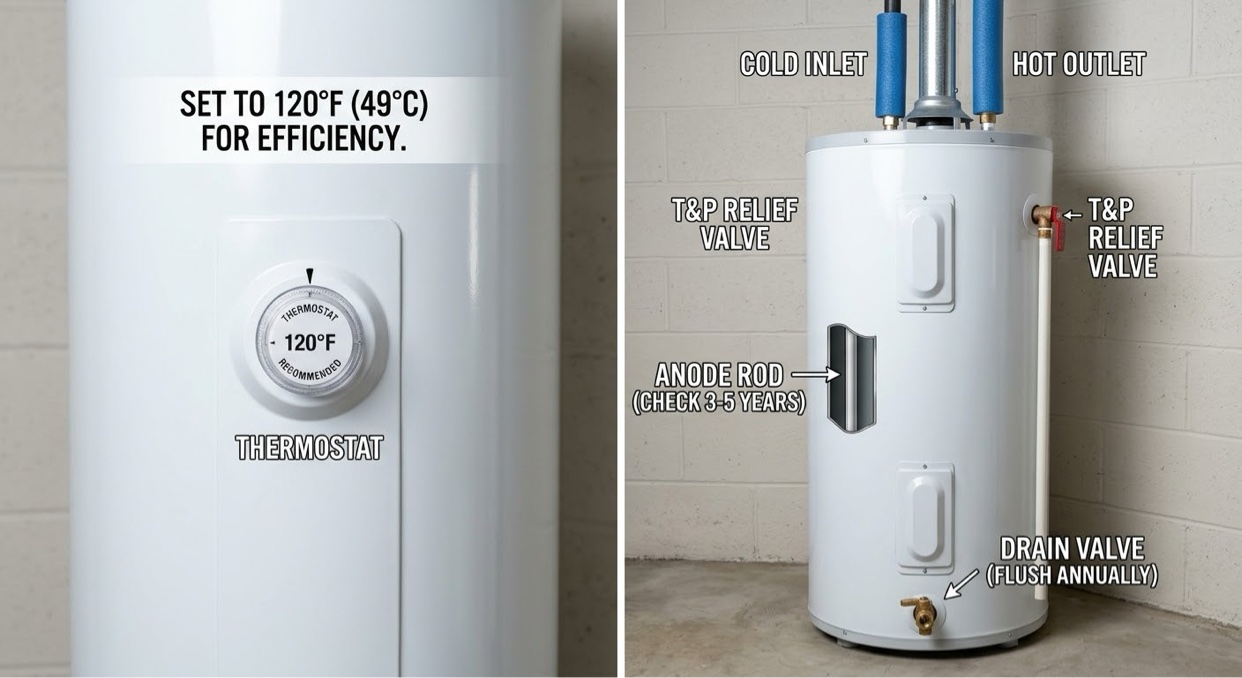
    If you have a tank water heater, everything dissolved in your water — calcium, magnesium, minerals — settles to the bottom of that tank over time. That layer of sediment sits between the burner (or heating element) and your water like a blanket. The heater has to work longer and burn hotter to push heat through it. That’s wasted energy and a shorter-lived tank.

    You can hear it happening. That rumbling or popping sound from the tank? That’s water trapped under the sediment layer, boiling and bubbling up through it. A quiet tank is a happy tank.

    The fix is simple: drain a few gallons from the drain valve once or twice a year. It takes ten minutes and flushes the loose sediment out before it compacts into something permanent.

    The anode rod: the part that dies so your tank doesn’t

    Inside every tank water heater there’s a metal rod — usually magnesium or aluminum — called the anode rod. Its whole job is to corrode. It attracts the corrosive elements in your water so they eat the rod instead of eating through your steel tank.

    It’s sacrificial by design. And when it’s gone, the tank is next.

    Checking it every 3 to 5 years and replacing it when it’s worn down (it’s a $20 to $50 part) can add years to your tank’s life. Most people have never heard of it. Now you have.

    Hard water hits heaters hardest

    If you’re on hard water, everything above happens faster. More minerals in, more scale on the heating elements, more sediment on the tank floor, faster anode rod consumption. A water softener doesn’t just protect your fixtures and your skin — it protects the second-most-expensive appliance to run in your home.

    The 120-degree rule

    Most water heaters ship set to 140°F. Turning it down to 120°F saves energy — roughly 3 to 5% for every 10 degrees you drop — slows mineral buildup inside the tank, and drops the scalding risk. There’s no good reason to keep it at 140 unless your owner’s manual says otherwise.

    Going away for a few days? Drop it to the lowest setting or hit “vacation mode” on gas models. No point heating water for an empty house.

    Stop losing heat you already paid for

    A lot of the energy your heater uses never makes it to your shower — it radiates straight off the tank and the pipes. If your tank feels warm to the touch, or it sits in an unheated garage or basement, an insulating blanket wrapped around it can cut standby heat loss substantially. Same story with the pipes: wrapping foam insulation around the first several feet of the hot and cold lines near the tank keeps heat where it belongs.

    Use less hot water in the first place

    This is the easy half nobody thinks about:

    • Low-flow showerheads. A good high-efficiency showerhead can cut your hot water use dramatically without you feeling the difference in pressure. The shower is where most of your hot water goes — this is the single biggest lever.
    • Wash in cold. The vast majority of the energy your washing machine uses goes to heating the water, not running the machine. Modern detergents are built to work in cold water. Unless you’re dealing with something genuinely filthy, cold gets it done.
    • Fix the drip. A hot water faucet with a slow drip can waste hundreds of gallons of heated water in a month. That’s water you paid to heat, going straight down the drain.

    Your annual checklist

    • Drain a few gallons from the drain valve to flush sediment.
    • Lift the lever on the T&P relief valve briefly to make sure it releases water — that’s the safety valve that prevents pressure buildup.
    • Check the anode rod every few years.
    • Keep the thermostat at 120°F.
    • Walk the house once for dripping hot water faucets.

    None of this requires a plumber. All of it adds up.

    Your water heater doesn’t ask for much. But what you don’t know about your water is costing you money every month — and one day it’ll cost you a Saturday with a flooded basement. A little attention now beats a replacement later.

  • Friday Fact: In Watercolor, Water Does the Painting

    Friday Fact: In Watercolor, Water Does the Painting

    You look at a watercolor and see the paint. Wrong. The water runs the show.

    Pigment is just dry color dust sitting on paper. Add water and it wakes up. Water pulls the color along, mixes it, blooms it outward, and settles it where it pleases. The artist guides it. The water makes the final call.

    That is because water is a carrier by nature. It grabs things and moves them — color across a page, minerals through your pipes, spots onto your glasses. Same job everywhere. It just looks prettier on art paper.

    Try this tonight. Let a clean glass air-dry upside down. See that cloudy film? That is your water signing its work — the same minerals that stiffen your laundry and scale up your water heater. A cheap test strip tells you exactly what is riding along in yours.

    Water never just sits there. It is always carrying something. iSee, iPour, iDrink.

    Inspired by the Water Quality Association’s Friday Fact

  • pH in Drinking Water: The 0–14 Scale, Explained

    pH in Drinking Water: The 0–14 Scale, Explained

    pH in Drinking Water: The 0–14 Scale, Explained

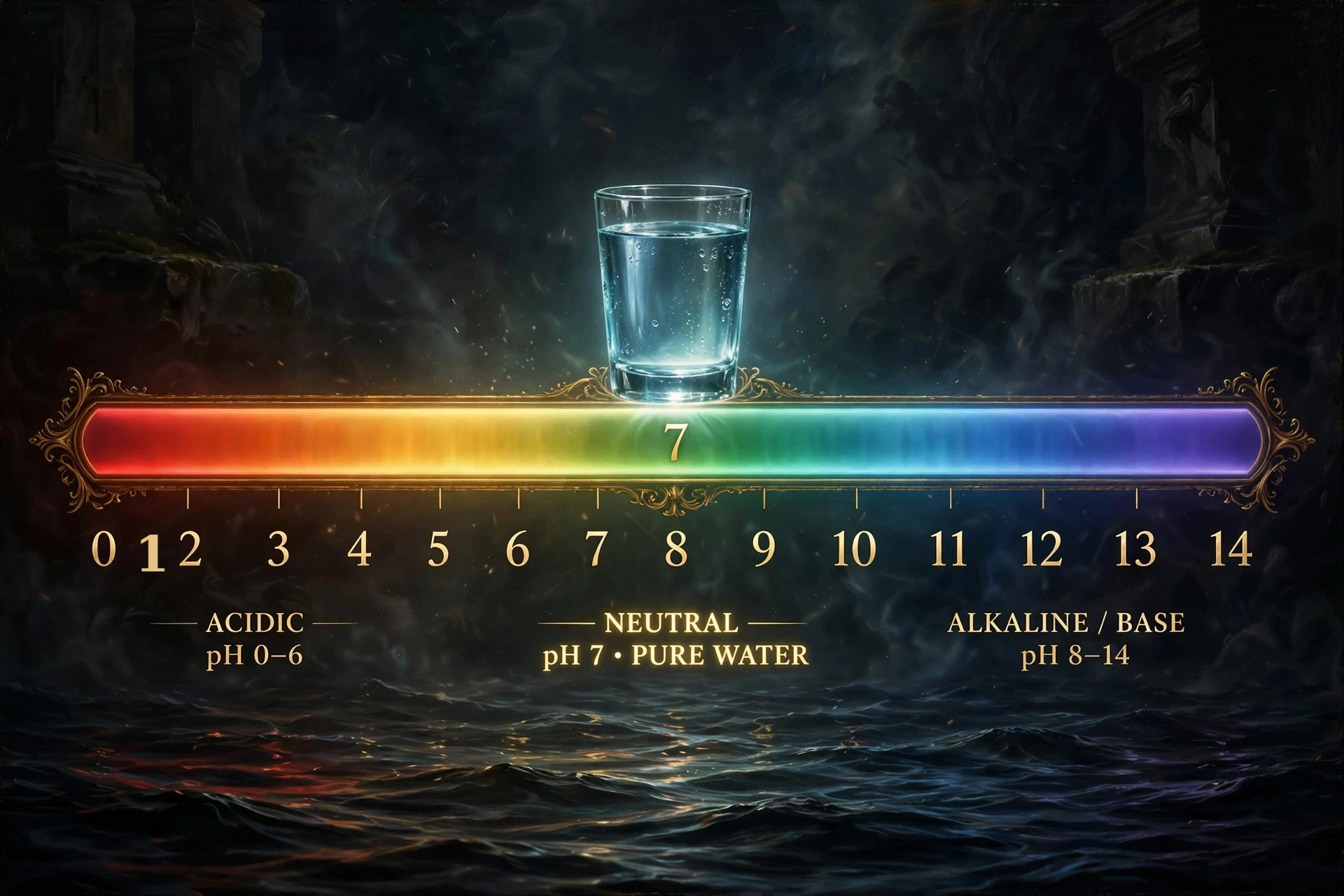
    “Check the pH, then filter.” It’s the first half of how I work — and the part most people skip. pH is just a number from 0 to 14 that tells you how acidic or alkaline your water is. 7 is neutral. Below 7 is acidic. Above 7 is alkaline. That’s the whole scale.

    What the letters mean. pH stands for “potential of hydrogen.” It’s a straight measure of hydrogen ions in the water — more of them, lower the number, more acidic; fewer of them, higher the number, more alkaline.

    Here’s what lives on it:

    The scale, with real examples.

    • 0: Sulfuric acid (battery acid), concentrated hydrochloric acid, aqua regia (nitric + hydrochloric acid — dissolves gold)
    • 1: Hydrochloric acid (stomach acid)
    • 2: Lemon juice (citric acid), lime juice, vinegar (acetic acid), cola (phosphoric acid)
    • 3: Orange juice, grapefruit juice, sports drinks, energy drinks, pickles
    • 4: Tomato juice, beer, wine
    • 5: Black coffee, plain rainwater, bananas
    • 6: Milk (lactic acid), saliva
    • 7: Pure water — neutral; human blood (7.4); heavy water (deuterium oxide — also neutral, its neutral point is 7.4)
    • 8: Seawater, baking soda solution (sodium bicarbonate), eggs
    • 9: Toothpaste, hand soap
    • 10: Milk of magnesia (magnesium hydroxide)
    • 11: Household ammonia (ammonium hydroxide)
    • 12: Bleach (sodium hypochlorite)
    • 13: Oven cleaner (sodium hydroxide)
    • 14: Drain cleaner (lye — concentrated sodium hydroxide)

    Notice how much of everyday life sits between 2 and 9. Your morning coffee is a 5. Your tap water should be near 7 or 8. Anything at the extremes — near 0 or near 14 — will burn you, and that’s the point of the scale: distance from 7 is intensity.

    What it means for YOUR water. The EPA wants drinking water between 6.5 and 8.5. That’s not a health limit — it’s about your pipes and your taste buds. Below 6.5, water turns corrosive: it eats at copper pipes and can pull lead out of old solder and fixtures. That’s the real danger of acidic water — not the pH itself, but what it drags along with it. Above 8.5, you get bitter taste, scale buildup, and chlorine doesn’t disinfect as well.

    How to test. pH test strips are cheap and fine for a rough number. A liquid drop kit is better. A digital pH meter is the best value if you test often. Or just read your utility’s annual water quality report — pH is always on it.

    How to fix it. Acidic water (below 6.5): a calcite neutralizer filter — water flows through crushed limestone that dissolves just enough to bring the pH up. Simple, no electricity, no chemicals to refill. Very acidic well water may need soda ash injection instead. After reverse osmosis: RO strips the minerals out and usually drops the pH, so most under-sink RO systems finish with an alkaline post-filter — a cartridge of calcite, oyster shell media, or a calcite/Corosex blend that puts minerals back in and brings the pH up before the water hits your glass. Alkaline water (above 8.5): most people don’t treat it for drinking, but acid-injection systems exist for extreme cases.

    What I’d buy

    Treatment type: a calcite neutralizer tank for acidic well water, sized for your flow rate and installed at the point of entry. Test pH before and after — the number tells you when the media needs replacing.

    pH won’t hurt you directly. But it decides what your water does to your pipes — and that decides what ends up in your glass. Check the pH, then filter. That’s the order.

    Curious what’s in your tap? Start with What’s In Your Water?

  • Chloramine in Drinking Water

    Chloramine in Drinking Water

    Chloramine in Drinking Water

    If your tap water smells a little like a swimming pool but your utility says they don’t use chlorine — they’re probably using chloramine. It’s the disinfectant of choice for a growing number of water systems, and it’s a tougher customer than chlorine when it comes to filtration.

    What it is. Chloramine (usually monochloramine) is made by combining chlorine with ammonia. Utilities have used it since the 1930s, and its use has grown because it lasts longer in the distribution system and forms fewer disinfection byproducts (like TTHMs and HAA5) than free chlorine. Over 68 million Americans drank chloraminated water as of the last big survey, and the number has only grown.

    Where it comes from. Your utility, on purpose. If your annual water quality report lists a disinfectant residual and mentions chloramine — or your utility sent a notice about switching disinfectants — that’s your answer. This is a city-water topic.

    The health picture, honestly. The EPA caps chloramine at 4.0 mg/L (measured as chlorine), and water meeting that standard is considered safe to drink, cook with, and bathe in. Above that level, eye and nose irritation, stomach discomfort, and anemia are the reported effects. Two groups must remove it completely: kidney dialysis patients (it must never enter the bloodstream) and aquarium owners (it’s lethal to fish). Everyone else — it’s a taste, smell, and peace-of-mind issue more than a health emergency.

    How to test. Your utility’s report tells you whether they use chloramine and at what residual. Home test kits for total chlorine will pick it up. If your water smells like a pool but tests low for free chlorine, suspect chloramine.

    What removes it. Here’s the key point: standard carbon is slow and incomplete against chloramine — you need catalytic carbon. Catalytic carbon breaks the chlorine-ammonia bond far more effectively than regular GAC. A whole-house catalytic carbon system is the standard answer. Reverse osmosis also removes it effectively at the drinking-water tap. UV is an established technology for chloramine removal in dialysis and pharmaceutical settings.

    What does NOT remove it. Standard pitcher filters and fridge filters — they’re built for chlorine, not chloramine, and contact time is too short. Boiling doesn’t reliably remove it. Letting water sit out, which works for chlorine, barely dents chloramine — that’s exactly why utilities switched to it.

    What I’d buy

    Treatment type: a whole-house catalytic carbon system, NSF or WQA listed, at the point of entry. Not standard carbon — catalytic. That’s the difference between actually removing chloramine and just hoping. For drinking water only, an under-sink RO works.

    Chloramine isn’t the villain some corners of the internet make it out to be — it’s a legitimate disinfectant with real benefits. But if you want it out of your water, you need the right carbon for the job. Regular carbon won’t cut it.

    Curious what’s in your tap? Start with What’s In Your Water?

  • Benzene in Drinking Water

    Benzene in Drinking Water

    Benzene in Drinking Water

    If there’s a gas station, an old factory, or a leaking underground fuel tank anywhere near your well, keep reading. Benzene is the one that shows up when petroleum gets into groundwater — and it’s the nastiest of the bunch.

    What it is. Benzene is a volatile organic compound — a building block of gasoline and a feedstock for plastics, resins, and synthetic fibers. It’s a known human carcinogen. Not a “maybe,” not “suggestive” — the occupational evidence settled that decades ago, and the cancer it causes is leukemia. That “known carcinogen” label is a hazard classification — it says benzene can cause cancer, not how much risk any given dose carries.

    Where it comes from. Gasoline, mostly. Leaking underground storage tanks at gas stations are the classic source: a slow drip of fuel into the soil becomes a plume in the groundwater. Petroleum refineries, chemical plants, and hazardous waste sites round out the list. If your well sits downhill from any of those, test.

    The health picture, honestly. Long-term exposure above the legal limit is linked to leukemia and other blood cancers, plus anemia and immune system damage. At high doses it causes dizziness and headaches first — and because it’s volatile, it gets into you through the air in your home too, not just the glass. The EPA’s legal limit is 5 parts per billion, with a health goal of zero. Some states go further — California and Florida hold it to 1 ppb.

    How to test. A lab test for VOCs (EPA Method 524.2) from a state-certified lab. On city water, check your annual water quality report first. On a well near gas stations, industrial sites, or known spill areas — test, don’t guess.

    What removes it. Granular activated carbon (GAC) plus aeration — that’s the EPA-approved combo. A whole-house carbon system at the point where water enters the home, sized for your flow rate and maintained on schedule. For serious contamination, packed tower aeration strips it out before carbon polishes what’s left.

    What does NOT remove it. Here’s the one that surprises people: reverse osmosis does NOT reliably remove benzene — the solvent can dissolve into the RO membrane and migrate through to the treated water. Standard pitcher filters are the wrong scale for this. Boiling just drives it into the air. Water softeners, UV, chlorine — nothing.

    What I’d buy

    Treatment type: a whole-house granular activated carbon system, NSF or WQA listed, sized for your home and installed at the point of entry. Carbon works — but only until it’s exhausted, so replace it on schedule and retest to prove it.

    Benzene is the real deal as contaminants go. But it’s also very treatable — carbon and aeration have been doing this job for decades. Test, treat the whole house, verify. That’s the order.

    Curious what’s in your tap? Start with What’s In Your Water?

  • The Only Thing That Actually Softens Shower Water

    The Only Thing That Actually Softens Shower Water

    Hard water in the shower is one of the most common complaints I hear: dry skin, dull hair, chalky buildup on the glass. And the market’s answer is a wall of “shower filters” promising soft, silky water. So let’s clear this up once, plainly, because almost nobody selling these will.

    A shower filter and a shower softener are not the same thing, and the industry is happy to blur them.

    A shower filter — carbon, KDF, vitamin C, whatever’s in the cartridge — can reduce chlorine and improve the smell. It cannot soften water. Softening means removing calcium and magnesium, and the only residential way to do that is ion exchange: resin beads that grab the hardness minerals and get recharged with salt. No salt, no softening. That’s chemistry, not marketing.

    What actually softens a shower

    Option one: a shower-head softener like the ShowerStick (~$280). A real ion-exchange unit that hangs on the shower arm. It works — briefly. The resin bed is tiny, so you’re regenerating with table salt constantly, and you’re showering through a flimsy handheld. Tedious is the kind word.

    Option two: a portable tank softener (On The Go and its clones). The same ion-exchange chemistry in a bigger tank — 8,000 to 16,000 grains — regenerated with table salt in about 30 minutes. A more serious tool, and a cumbersome one: hauling the tank, hooking up hoses, finding somewhere to plumb it inline. No portable on the market carries NSF/ANSI 44 or WQA product certification. “NSF certified media” on the label means the resin is safe — it doesn’t mean anyone verified the softening. And most apartment renters can’t plumb a tank inline anyway, which makes this mostly an RV, marine, and spot-use answer.

    How to check any of them yourself

    A $15 hardness test kit. Test before, test after. If the number doesn’t drop, the softener isn’t softening — no badge or brand name overrides that.

    The bottom line: if it doesn’t use salt, it doesn’t soften. Everything else is a filter wearing a softener’s costume.

    Start here: What’s In Your Water? — learn how to read your water report and test your own tap.

  • Carbon Filtration, Explained Honestly: Types, Uses, and the Hills and Valleys Nobody Talks About

    Carbon Filtration, Explained Honestly: Types, Uses, and the Hills and Valleys Nobody Talks About

    If you’ve shopped for a water filter, you’ve seen the word “carbon” everywhere. Carbon filter. Carbon block. Catalytic carbon. Coconut carbon. Silver-impregnated carbon. The marketing makes them all sound the same. They’re not.

    I’ve spent three decades in water treatment, and carbon is the hardest-working media in the business — and the most misunderstood. So let’s do this the way it should be done: educate, educate, educate the consumer. Here’s what carbon actually is, the real differences between the types, and the one thing about carbon’s surface that changes how you should set up your whole system.

    What activated carbon actually does

    Activated carbon doesn’t work like a strainer. It works by adsorption — with a D, not a B. Contaminants stick to the carbon’s surface rather than passing through it. One gram of activated carbon can have over 3,000 square meters of surface area. That’s the whole game: enormous surface, tiny spaces, contaminants get grabbed and held.

    What it’s genuinely great at: chlorine taste and odor, many volatile organic compounds (VOCs), pesticides and herbicides, trihalomethanes (THMs), and improving overall taste and smell. What it does poorly or not at all: dissolved metals like lead and arsenic, nitrates, fluoride, hardness minerals, and dissolved salts. Anyone who tells you a carbon filter “removes everything” is selling you something. I won’t.

    The types of carbon — and why the source material matters

    Coconut shell carbon. The premium choice for drinking water, and it’s not close for taste, odor, and chlorine work. Coconut shell produces a hard, dense carbon dominated by micropores — the smallest pores — which are exactly the right size to grab small molecules like chlorine and the compounds behind bad taste and odor. It also has a high iodine number, the industry’s rough measure of micropore activity. When someone asks me what carbon to put in a drinking-water filter, coconut shell is my answer.

    Bituminous coal carbon. The workhorse of whole-house and municipal systems. Harder than wood-based carbon, with a mix of micropores and mid-size pores, so it handles a broader range of contaminants. Tough, durable, and it backwashes well in tank systems. Most of the big backwashing carbon tanks you’ve seen — including the Fleck-valve units — run on coal-based carbon.

    Wood-based carbon. Softer, with larger macropores. Better at grabbing bigger molecules — it’s the decolorization specialist — but it doesn’t hold up as well physically and isn’t the first pick for drinking water.

    Lignite carbon. Similar story to wood: larger pores, softer structure, niche uses.

    Catalytic carbon. This is surface-modified carbon — the surface chemistry is changed to speed up reactions. Its claim to fame is chloramine. Standard carbon removes chloramine slowly and poorly; catalytic carbon handles it far better. It also does strong work on hydrogen sulfide (rotten-egg smell). If you’re on city water treated with chloramine instead of chlorine — and more cities are switching every year — catalytic carbon is what you want in the tank, not standard GAC.

    Silver-impregnated carbon. Here’s where I need you to hear me clearly: silver-impregnated carbon is bacteriostatic. That word matters. It means the silver inhibits the growth and multiplication of bacteria within the filter bed itself. It does not disinfect your water. It does not make non-potable water safe. What it does is keep the carbon bed from becoming a bacteria farm between filter changes — carbon removes the chlorine that was keeping microbes in check, so the bed is a comfortable place for them. The silver keeps the media hygienic longer. Bacteriostatic. Not bactericidal. Anyone who blurs that line is misleading you.

    GAC vs. carbon block — and micron ratings, honestly explained

    Granular activated carbon (GAC) is loose granules in a cartridge or tank. Water flows around and through the granules. Good contact time in a properly sized tank; in a small cartridge, contact time is short and performance drops off.

    Carbon block is carbon powder fused into a solid block. Water is forced through the block, so contact is more thorough — and the block itself acts as a particulate filter with a real micron rating.

    And here’s where I teach you something the industry hopes you never learn: micron ratings come in two kinds, and only one of them means what you think.

    • Absolute rating means the filter is tested to remove a stated percentage (typically 98–99%+) of particles at or above that size. A 1-micron absolute filter stops essentially everything 1 micron and up.
    • Nominal rating means the filter removes some percentage — often around 85% — of particles at that size. A “5-micron nominal” filter lets a meaningful share of 5-micron particles straight through.

    Same number on the label, completely different filter. When you compare carbon blocks, find out whether the rating is absolute or nominal. If the manufacturer won’t say, assume nominal — and assume the worst.

    The hills and valleys — the thing nobody tells you about carbon

    Now the part that matters most, and the reason I wrote this article.

    Carbon’s surface is not smooth. Under magnification, it’s a landscape — hills and valleys, peaks and pores, an irregular terrain at the microscopic level. That’s what gives it all that surface area. But those valleys are also traps.

    When fine particulate — oxidized iron, sulfur, sediment — reaches a carbon bed, it doesn’t just sit on top. It works down into the valleys and lodges there. And here’s the part the brochures skip: backwashing doesn’t properly remove it. Backwash lifts and fluffs the bed, and it carries off what’s loose. But particulate wedged into the hills and valleys stays wedged. Over time the bed fouls. Capacity drops. Water starts channeling through the paths of least resistance instead of contacting the carbon evenly. Your expensive carbon tank quietly stops doing its job, and nothing on the outside tells you.

    This isn’t theory. I’ve opened fouled carbon beds. I’ve seen what backwash leaves behind.

    After chlorination: Filter-Ag before carbon, every time

    This is where the hills and valleys turn into a system-design rule.

    Chlorination oxidizes dissolved iron and sulfur — turns them from invisible dissolved contaminants into visible particulate (that fragile iron floc). That’s the point of chlorinating: make the iron filterable. But if that freshly oxidized particulate goes straight into your carbon bed, it packs into the valleys and never fully comes out, no matter how faithfully you backwash.

    So the rule, consistently applied: after chlorination, run a Filter-Ag filter before the carbon.

    Filter-Ag is a lightweight silica filter media — fractured edges, irregular surface — that pulls suspended solids down into the 20–40 micron range, and field experience has shown its rough surface is excellent at entrapping exactly that fragile oxidized iron floc. It takes the beating so the carbon doesn’t have to. The carbon then does what carbon does best: taste, odor, chlorine and chemical polish on water that’s already been cleared of particulate.

    The sequence matters: chlorinate → Filter-Ag → carbon. Skip the middle step and you’re feeding your carbon bed a steady diet of valley-fouling particulate. Put it in and your carbon lasts longer, performs better, and actually gets to do its job.

    What I’d buy

    Treatment type: a backwashing carbon tank with a Fleck 5600SXT valve for whole-house chlorine, taste, and odor work on city water — and if you’re on chloramine, make it catalytic carbon in that tank. Dealing with well water, iron, or sulfur ahead of the carbon? That’s exactly the system where a Filter-Ag stage ahead of the carbon earns its keep. Both picks live in the Carbon Filtration section of the buyer’s guide, along with the full Fleck vs. Clack vs. Autotrol breakdown.

    The bottom line

    Carbon is the hardest-working media in water treatment — but only when it’s the right carbon, in the right form, with the right water reaching it. Know your carbon type. Know your micron rating — absolute or nominal. Respect the hills and valleys. And after chlorination, always Filter-Ag before carbon.

    Start here: What’s In Your Water? — learn how to read your water report and test your own tap.