
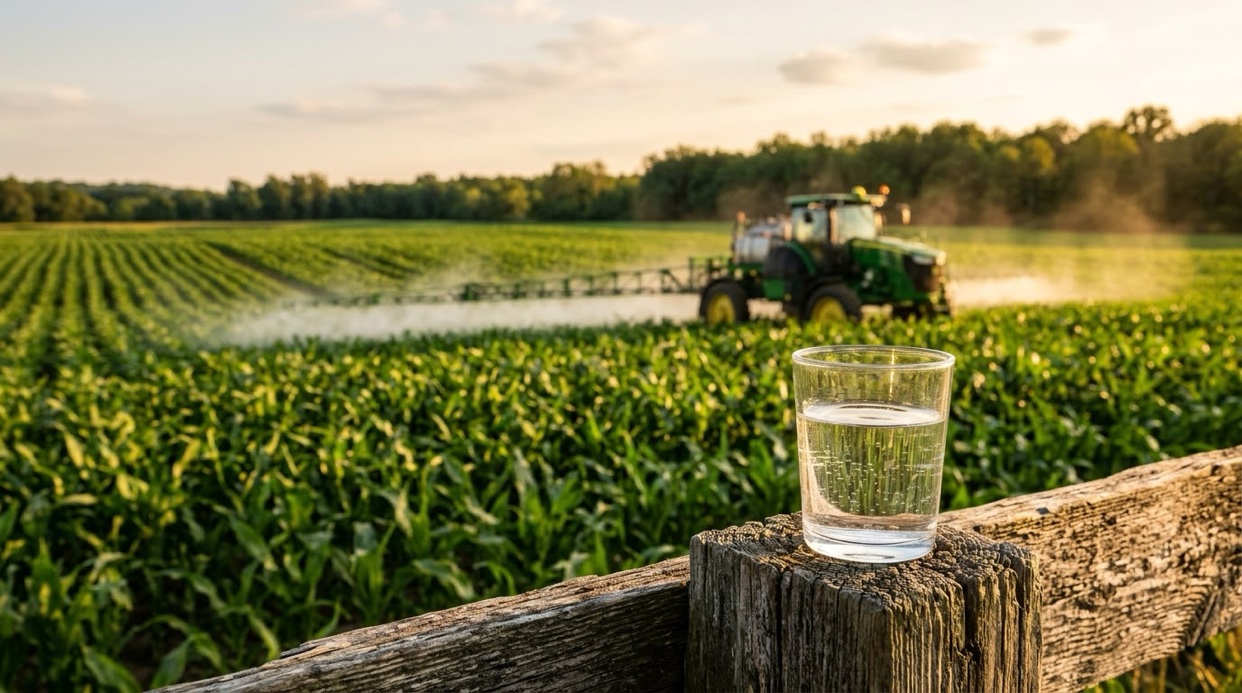
Chlorpyrifos was once the most widely used household insecticide in America. If you had your home treated for termites or roaches any time in the last century, there’s a good chance this is the chemical that did the work — sold under names like Dursban and Lorsban. It’s been banned from homes for over twenty years now, it’s still sprayed on a short list of farm crops, and it has been fought over in federal court for a decade. And here’s the part that matters for your tap: there is no federal drinking-water limit for it. Not a legal limit, not even an official health goal. What exists instead is a set of advisory numbers — and understanding the difference between an advisory and a law is the whole ballgame with this one.
1. What It Is
Chlorpyrifos is a broad-spectrum organophosphate insecticide. Broad-spectrum means it doesn’t target one bug — it kills a wide range of insects, which is exactly why it got used everywhere. Organophosphate is the family it belongs to: a class of insecticides that work by attacking the insect’s nervous system. You’ll see it sold under product names like Lorsban, Dursban, and Empire.
For years it was the go-to chemical for household termite and roach work, and it was used heavily in agriculture as well. Today the household uses are gone — those were cancelled in 2000 — but a limited set of farm uses remains, on crops including apples, cherries, citrus, cotton, soybeans, and wheat. So this is not a chemical from a history book. It’s a chemical whose home life ended and whose farm life got narrowed down to a short list, and the argument over what’s left of it is still going on in court.
2. Where It Comes From
Chlorpyrifos gets into the environment the way farm and pest-control chemicals generally do: it’s sprayed where the bugs are, and some of it moves. It was applied in and around homes for decades, and it’s still applied to fields and orchards today. Chemicals put down across that much ground don’t stay politely in place — they wash, they drift, and they work their way toward the same water everybody downstream drinks.
The regulatory story tells you how seriously this one is taken. Residential uses were cancelled in 2000. In 2021, EPA revoked all of its food tolerances — the legal limits for how much residue can remain on food — effective in 2022, a move that would have ended its use on food crops. In 2023, the Eighth Circuit Court of Appeals vacated that revocation, so limited agricultural registrations came back to life while EPA pursues narrower tolerance revocations aimed at specific uses. California banned virtually all agricultural sales of chlorpyrifos in 2020, and California, New York, Hawaii, and the European Union have all banned it outright. When that many governments move against one chemical while the federal fight is still in court, you’re looking at a substance whose safety argument has been lost in most rooms — just not finished in the last one.
3. The Numbers
Here’s where you have to read carefully, because chlorpyrifos has no MCL and no MCLG, and those two absences matter.
The MCL — Maximum Contaminant Level — is the enforceable legal limit. It’s the number a public water system can actually be penalized for exceeding. The MCLG — Maximum Contaminant Level Goal — is the non-enforceable health goal: the level EPA’s scientists say carries no known or expected risk, set on health alone, without asking what it costs to achieve. For regulated chemicals, you get both numbers. For chlorpyrifos, you get neither, because it has never been given a federal drinking-water regulation.
What EPA has published instead is a Health Advisory. A Health Advisory is guidance, not law. It’s EPA telling water systems and the public, “here is the level our health science points to” — but no system can be fined for going over it, because it isn’t a standard. Chlorpyrifos’s advisories, from EPA’s 2018 Drinking Water Standards and Health Advisories tables, are these: a Lifetime Health Advisory of 0.002 mg/L — that’s 2 parts per billion, or 2 ppb — and a 10-day Health Advisory for a child of 0.03 mg/L, or 30 ppb, with the 1-day advisory also at 0.03 mg/L. To feel how small 2 ppb is: one part per billion is roughly one drop of water in an Olympic-size swimming pool. The lifetime advisory says that a lifetime of drinking water at 2 ppb is the level EPA’s health review is comfortable with — offered as advice, not enforced as law.
The states don’t add a backstop here. California has no MCL, no Notification Level, and no Public Health Goal for chlorpyrifos, and New Jersey has no MCL for it either. California does list chlorpyrifos under Proposition 65 as a developmental toxicant — that listing dates to December 15, 2017 — but Proposition 65 is a warning law, not a drinking-water limit. So the full picture is: no enforceable number anywhere, and one set of federal advisory numbers to measure against.
4. What EPA Says About Health
Chlorpyrifos works on nerves — that’s how it kills insects, and it’s why the health questions around it are nerve questions. It inhibits acetylcholinesterase, an enzyme your nervous system uses to switch nerve signals off. Block that enzyme, and the signals don’t switch off the way they should. EPA’s human health risk assessments describe acute neurotoxicity from it — nausea, dizziness, and confusion, and at high exposures, respiratory paralysis.
The concern that drove the bans and the court fights is different, and slower: neurodevelopmental deficits in children exposed before birth or in early infancy. That’s the exposure window EPA’s risk assessments raised the flag on, and it’s why California lists the chemical for developmental toxicity and why so many governments decided the argument was over.
On cancer, EPA’s drinking-water tables classify chlorpyrifos as Group D — not classifiable as to human carcinogenicity, meaning the evidence isn’t there to call it either way. IARC has no classification for it. So the documented fight over this chemical has never really been about cancer. It’s been about developing brains and a nerve enzyme, and on those two points, the concern is on the record.
5. What Removes It
Start with the honest part: because chlorpyrifos is unregulated in drinking water, EPA has designated no Best Available Technology for it. There is no official “use this” stamp. What we have is the chemistry, and the chemistry points to two working home answers: activated carbon and reverse osmosis.
First, understand what you’re trying to catch. Chlorpyrifos in water is a dissolved chemical — it’s not a particle floating in the water, it’s part of the water, the way sugar is part of sweet tea. A sediment filter or a micron rating cannot catch it. A micron rating is a measurement of holes; it tells you the size of particle a filter can strain out. Trying to stop a dissolved chemical with a particle rating is like trying to catch wind in a chain-link fence. The holes aren’t the problem. The wind isn’t a thing the fence was ever built to hold.
Carbon works on a completely different principle: adsorption — the chemical sticks to the carbon’s surface instead of passing through. Chlorpyrifos is strongly hydrophobic, with a log Kow of about 4.96, which in plain English means it strongly prefers not to be dissolved in water and will grab onto carbon when it gets the chance. Granular activated carbon gives it an enormous surface to grab, and GAC removes chlorpyrifos at high efficiency — over 95 percent. Reverse osmosis works the other way: it pushes water through a membrane tight enough to exclude molecules of chlorpyrifos’s size. It weighs in around 351 daltons, which is big for a dissolved chemical, and RO also removes it at over 95 percent. So if this chemical is on your list of concerns, the answers are a good carbon system, an RO system, or both in line — not a finer sediment filter.
6. The Bottom Line
Chlorpyrifos is the chemical America used to spray in its kitchens, banned from homes in 2000, and is still arguing about in court. It has no drinking-water limit and no health goal — only EPA advisory numbers: 2 ppb for a lifetime, 30 ppb for a child’s short-term exposure, offered as guidance rather than law. The health concern on record is nerves and developing brains, not cancer. And if it ever shows up in your water, carbon and reverse osmosis are the tools that take it out — because what catches a dissolved chemical is chemistry, not a smaller hole.
Facts first, then filter. — Steve
Leave a Reply