
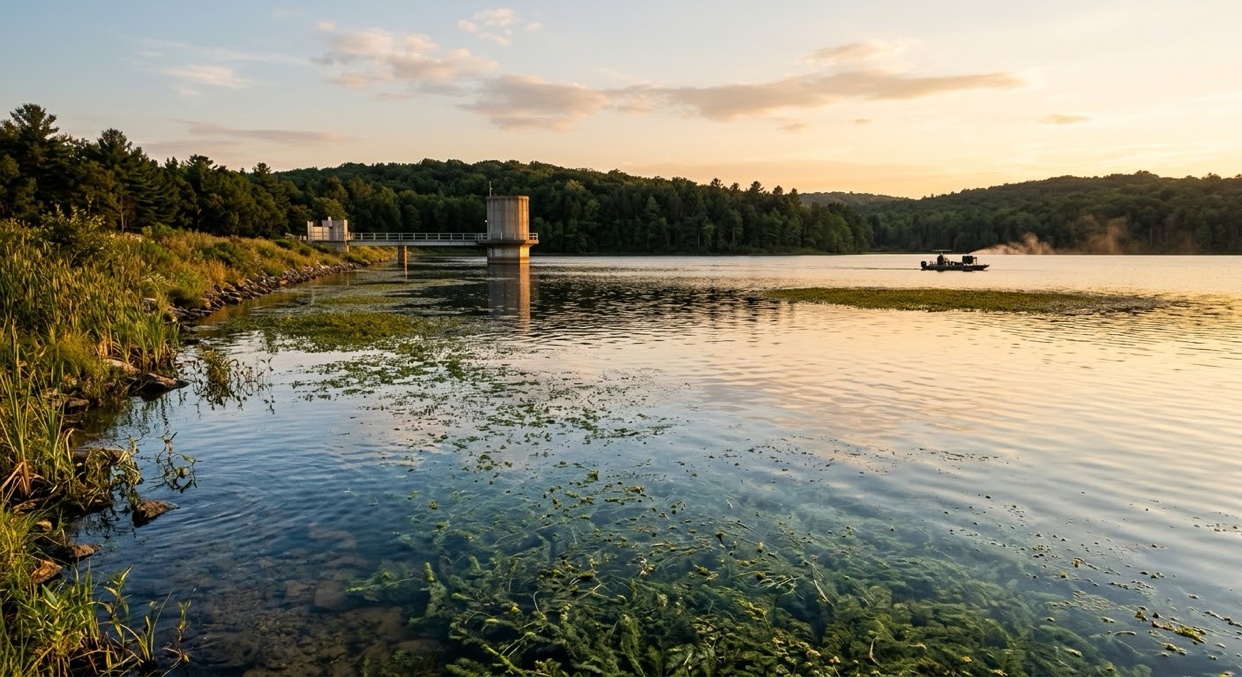
If your annual municipal water report or a certified lab panel turns up a detection of endothall, you are looking at a chemical that entered the water cycle very differently than most agricultural pollutants. Endothall is not usually a chemical that leaked accidentally from a container or leached out of an abandoned waste site; in most cases, it was added directly to a body of water on purpose to manage aquatic plants and algae.
Understanding what endothall is, how its short environmental lifespan dictates its presence, and how residential treatment equipment captures it helps you evaluate your drinking water with clarity and confidence.
What Is Endothall?
Endothall is a selective contact herbicide and algaecide. In surface water management, it is widely marketed under trade names like Aquathol to clear choked waterways. Unlike systemic herbicides that take weeks to move through a plant’s roots and stems, endothall works quickly on contact to destroy cellular membranes, causing target plants and algae to break down rapidly.
It serves two primary operational roles:
- Aquatic Weed and Algae Control: Applied directly to lakes, ponds, reservoirs, and drainage canals to eliminate submerged aquatic vegetation (such as hydrilla, coontail, and pondweeds) and filamentous algae that block water flow or ruin recreational waters.
- Agricultural Harvest Aid: Applied to select land crops as a desiccant or defoliant to dry out foliage prior to harvest — as a vine killer on potatoes, a desiccant on alfalfa and clover, and a defoliant on cotton.
Because applicators put endothall directly into lakes, reservoirs, and feeder canals — sometimes the same waters that feed drinking-water intakes — it is a standard line item on drinking-water laboratory screening panels.
How It Gets Into Drinking Water: A Story of Timing and Distance
Most synthetic organic chemicals contaminate drinking water through accidental spills, agricultural field runoff, or deep underground leaching. Endothall is different because applicators introduce it directly into surface water bodies.
Because of this direct application, keeping endothall out of tap water comes down to two critical factors: timing and distance. The sequence runs like this: applicators put the herbicide in, label restrictions hold certain water uses back, microbes break the chemical down, and water that reaches an intake should be back under the legal limit.
Water Use Restrictions: The federal label controls drinking water by distance and by concentration. Applicators may not treat within 600 feet of a functioning drinking-water intake, and treated water may only be consumed once the endothall level has fallen below the EPA limit of 0.1 parts per million — in rivers and canals, intakes must stay closed while water above that limit is passing by. Separately, the label sets waiting periods of 7, 14, or 25 days, depending on how much was applied, before treated water may be used for livestock, irrigation, or household purposes.
Proximity to Intakes: If an application occurs too close to a municipal drinking water intake, or if a public utility reopens an intake before the specified waiting period has elapsed, trace amounts of the chemical can enter the treatment facility’s raw water supply.
The Short-Life Twist: A Short-Window Contaminant
Many legacy pesticides are notorious for sitting in underground aquifers for decades without changing form. Endothall features a distinct environmental twist: it breaks down quickly in water.
Unlike long-lasting synthetic compounds, endothall is readily biodegradable. Naturally occurring aquatic microorganisms use endothall as a carbon source — certain bacteria can live on it alone — breaking it down first into glutamic acid, an ordinary amino acid, and ultimately into carbon dioxide and water. Under typical environmental conditions, half of it is gone in about 4 to 10 days, and breakdown is essentially complete within 30 to 60 days.
This rapid breakdown means endothall is a short-window contaminant. It is not a permanent, decades-long resident of deep groundwater. When it shows up in drinking water, it indicates a recent upstream application or an intake timing issue rather than a permanent aquifer contamination problem.
Understanding the EPA Limits: MCL vs. MCLG
Under the authority of the Safe Drinking Water Act, the U.S. Environmental Protection Agency (EPA) sets strict national standards for chemical levels in public water supplies. For endothall, the regulatory limits are set as follows:
Maximum Contaminant Level (MCL): 0.1 mg/L — 100 parts per billion (ppb)
Maximum Contaminant Level Goal (MCLG): 0.1 mg/L — 100 parts per billion (ppb)
To understand how these numbers apply to your household, it helps to break down the regulatory terminology:
- Maximum Contaminant Level Goal (MCLG): This is the level of a contaminant in drinking water below which there is no known or expected risk to human health. It is a health-based goal that includes a built-in safety margin. It does not consider financial costs or the technical limitations of water treatment.
- Maximum Contaminant Level (MCL): This is the highest level of a contaminant legally allowed in public drinking water. MCLs are enforceable federal standards. Regulators set the MCL as close to the MCLG as feasible, taking into account available treatment technologies and laboratory detection limits.
For endothall, the EPA established both the health goal (MCLG) and the legally enforceable limit (MCL) at the exact same value: 0.1 mg/L (100 ppb).
What Health Effects Regulators Documented
When federal health agencies evaluated endothall to set safety thresholds, toxicity assessments focused primarily on the direct physical effects of chronic, long-term exposure above the 0.1 mg/L limit.
The primary health risk documented by regulators for long-term exposure to endothall above the MCL is:
- Gastrointestinal Effects: In EPA’s own summary, people who drink water containing endothall above the MCL over many years could experience stomach and intestinal problems — irritation of the stomach and intestinal tract.
Regulatory exposure limits are calculated specifically to ensure that long-term daily consumption remains far below levels that could cause stomach or intestinal distress.
How to Find Out If Endothall Is in Your Water
Endothall is odorless, colorless, and tasteless at the parts-per-billion levels regulated by health authorities.
Over-the-counter home test strips or store-bought liquid drop kits cannot detect endothall. Basic dip strips are designed strictly for general water parameters—such as hardness, pH, total dissolved solids, or high-level chlorine—and lack the analytical capability to identify specific organic chemical molecules.
To determine if endothall is present in your water supply:
- Order a Certified Laboratory Test: Submit a water sample to an EPA-certified drinking water laboratory and request a Synthetic Organic Chemical (SOC) panel or a broad-spectrum pesticide screen.
- Verify Testing Instrumentation: Certified labs measure endothall by EPA Method 548.1 — the sample is concentrated on an ion-exchange cartridge, the endothall is chemically converted into a form a gas chromatograph can handle, and a mass spectrometer reads it, accurately down to roughly 2 parts per billion.
- Check Your Annual Utility Report: If you receive water from a public utility, review your local Consumer Confidence Report (CCR). Public utilities using surface water sources are required to monitor for SOCs like endothall and report any detections to the public.
How Water Treatment Systems Remove Endothall
If laboratory testing reveals endothall in your water above actionable levels, home filtration equipment can effectively remove it. The EPA designates Granular Activated Carbon (GAC) as the Best Available Technology (BAT) for endothall reduction, while Reverse Osmosis (RO) serves as a robust physical barrier.
Activated Carbon (Adsorption)
Granular Activated Carbon (GAC) whole-house tanks and point-of-use carbon block cartridges remove dissolved synthetic chemicals like endothall through a chemical process called adsorption.
- How Adsorption Works: Adsorption is a surface-attraction mechanism, not a mechanical filter screen. High-temperature activation creates millions of microscopic pores inside the carbon, generating a massive internal surface area (roughly 1,000 square meters in a single gram).
- Chemical Attraction: As water flows across the carbon matrix, dissolved endothall molecules are attracted to the carbon’s internal surface and chemically lock onto its pores, allowing purified water to flow out.
- Capacity Limits: Carbon media has a finite capacity. Once every available bonding site is occupied, the bed becomes saturated and “breakthrough” occurs. Regular media replacement or filter cartridge changes are necessary to ensure uninterrupted protection.
Reverse Osmosis (Membrane Separation)
Point-of-use Reverse Osmosis (RO) drinking water systems force water under pressure against a dense semi-permeable membrane. An RO membrane is not a sieve full of simple holes — it separates dissolved material by molecular size and electrical charge, and it blocks charged molecules most strongly of all. At normal drinking-water pH, endothall carries a negative charge (it is built from a two-ended acid), and at 186 daltons it sits well above the size these membranes reliably reject, so the membrane turns it back and sends it out through the drain stream.
Mechanical Straining vs. Chemical Adsorption
Homeowners must understand the fundamental difference between mechanical straining and chemical adsorption. Picture it this way: a sediment filter works like a kitchen strainer — water flows through, and sand, rust, and silt are caught because they are solid particles too big to pass. A carbon filter works more like a magnet for molecules — there are no particles to catch; instead, dissolved molecules drifting past are pulled onto the carbon’s surface and held there.
A physical sediment filter—regardless of how small its micron rating is—cannot catch endothall. Endothall is fully dissolved in the water at a molecular level, much like salt in ocean water. Capturing it requires media designed for molecular surface attraction (activated carbon) or a membrane engineered for molecular separation (reverse osmosis).
Translating Equipment Certifications
When shopping for residential treatment systems to address organic chemicals, you will frequently see independent performance standards listed on product labels. Whenever an equipment manufacturer claims an NSF standard, it is vital to translate what that standard actually measures:
- NSF/ANSI Standard 53 (Drinking Water Treatment Units – Health Effects): When a carbon filter is certified under Standard 53 for organic chemical or VOC reduction, it means an accredited independent lab has evaluated and verified that the system reliably reduces the specific health-related contaminants named in its certification, below EPA safety limits. Certification is claim-by-claim — the contaminant you care about has to appear on that product’s list.
- NSF/ANSI Standard 58 (Reverse Osmosis Drinking Water Treatment Systems): This standard verifies that a point-of-use reverse osmosis system’s materials are safe for contact with drinking water, that the system is structurally sound, that it reduces total dissolved solids by a tested amount, and that it reduces any additional specific contaminants named in its listing.
Ignore unverified marketing phrases like “chemical-grade” or “total purification.” Look for explicit certification to Standard 53 or Standard 58 specifically covering organic chemical reduction.
The Honest Bottom Line
Endothall is a working aquatic chemical applied directly to surface waters to clear choked lakes and canals.
Because it breaks down rapidly in the environment, the risk of endothall appearing in drinking water is primarily about treatment timing and intake location near treated water bodies. If your water comes from a lake or reservoir with active weed management, endothall is a compound worth knowing on your lab panel—and standard, properly maintained activated carbon or reverse osmosis equipment gives your home a reliable barrier.
Facts first, then filter. — Steve
Leave a Reply