
The Family
When you spend decades in the water treatment trade — crawling under crawlspaces, pulling old submersible pumps, sitting at kitchen tables talking to folks about what’s coming out of their taps — you learn very quickly that the world of water chemistry is vast and largely invisible. We talk endlessly about lead, arsenic, and nitrates. Those are the heavy hitters, the contaminants that grab headlines and trigger mandatory public notices. But beneath the surface lies another cohort entirely: thirteen specific chemical compounds that form an administrative blind spot in modern sanitation.
This family consists of thirteen distinct names — twelve built on a single carbon atom dressed in chlorine, bromine, iodine, or fluorine, plus one close two-carbon cousin (chloroethane) — including four famous refrigerants. All thirteen are extremely volatile: gases or near-gases that escape water at the first chance. And here is the headline fact, stated plainly: not one of the thirteen has a federal drinking-water limit — no MCL, no MCLG — and none has an entry in the federal treatment-technology table. They sit entirely outside routine regulatory oversight.
Group One: The Freons
Chlorodifluoromethane. This is HCFC-22, or R-22 — for generations the primary air-conditioning refrigerant in homes and commercial buildings across the country. It was phased out of new equipment in 2010, and the overall HCFC phaseout completes in 2030.
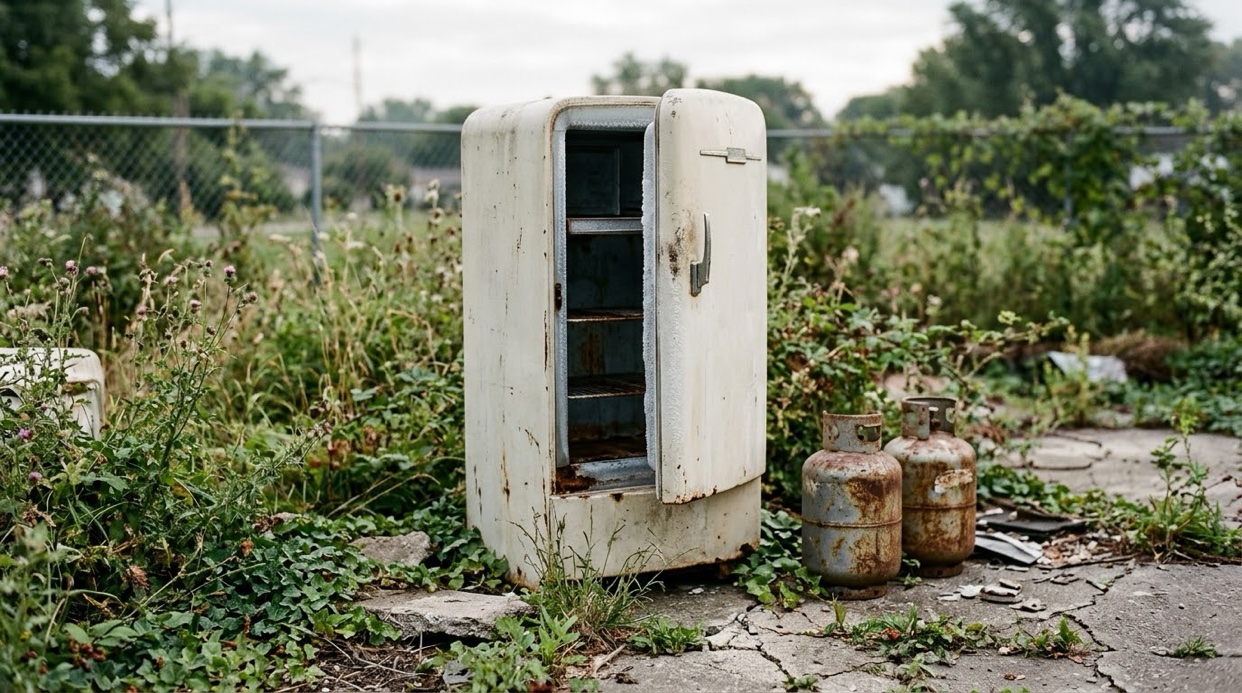
Dichlorodifluoromethane. This is CFC-12, Freon 12 — the classic refrigerant of household refrigerators and car air-conditioning systems. Its chemical stability made it an excellent cooling fluid, and that same stability means releases from discarded appliances and legacy equipment can persist in soils and shallow groundwater for decades.
Trichlorofluoromethane. This is CFC-11, Freon 11. It was used as the refrigerant in large commercial chillers, and it also served as a foam-blowing agent in the manufacture of rigid insulation — leaving industrial footprints in soil and groundwater around the places that made and used it.
Trichlorotrifluoroethane. The full name is 1,1,2-trichloro-1,2,2-trifluoroethane — CFC-113, Freon 113. This one was a precision-cleaning solvent, used heavily for degreasing delicate electronics, circuit boards, aerospace hardware, and metal parts, which is why it turns up so often in industrial groundwater plumes.
United States CFC production and import ended in 1996 under the Montreal Protocol; in water today these are legacy and industrial traces.
Group Two: The Two Fumigants That Came and Went
Bromomethane. Methyl bromide — a soil and structural fumigant gas, used on a massive scale against pests in fields, buildings, and quarantined goods. Its U.S. use was phased out in 2005 under the Montreal Protocol, though critical-use and quarantine exemptions remain. And worth knowing: the EPA looked at this one for drinking water and formally decided not to regulate it. No federal limit was ever set.
Iodomethane. Methyl iodide — sold as the MIDAS soil fumigant, and its whole American career fits in five years: registered in 2007, sales suspended in March 2012, and all U.S. agricultural use ended December 31, 2012. A fumigant that arrived with fanfare and was gone before most water systems ever thought to look for it.
Group Three: The Everyday Methanes
Chloromethane. Methyl chloride — the odd one on this list because most of it isn’t ours. The oceans, rotting wood, fungi, and biomass burning produce the bulk of it naturally. Industry manufactures it too, mainly for silicones, and it was once used as a refrigerant and an anesthetic.
Chloroethane. Ethyl chloride — the family’s two-carbon cousin. Its largest past use was making tetraethyl lead for leaded gasoline. Today it’s used for ethyl cellulose, dyes, and pharmaceuticals, as a solvent, and as a topical refrigerant anesthetic spray — the cold spray that numbs skin.
Dibromomethane. Methylene bromide — a solvent, a gauge fluid, and a synthesis reagent in chemical manufacturing. Marine algae also produce it naturally, so a trace near the coast doesn’t automatically point at a factory.
Group Four: The Fire Fluid
Bromochloromethane. Halon 1011 — a fire-extinguishing fluid from the era when halons were the gold standard of fire suppression. The NFPA banned it from extinguishers in 1969, and its production was banned January 1, 2002. When it shows up on a water report today, it’s a leftover from old fire-suppression sites and industrial handling. Bromochloromethane is not a disinfection byproduct.
Group Five: The Two Your Treatment Plant Can Make, and the Odd One Out
Dichloroiodomethane. An iodinated trihalomethane — which means your own disinfection can create it. When source water carries natural iodide and gets chlorinated or chloraminated, this is one of the byproducts that forms; in that setting, the iodinated byproducts like this one are among the most abundant.
Bromochloroiodomethane. Same family, same origin: an iodinated trihalomethane formed when iodide-bearing source water is chlorinated or chloraminated, and likewise among the most abundant iodinated byproducts where it occurs. Not something a factory sold you — something treatment itself can make.
Diiodomethane. Methylene iodide — the odd one out. It is a laboratory heavy liquid, roughly three and a third times as dense as water, used for mineral separation and gemstone testing, and as a reagent in organic chemistry. Diiodomethane is not a trihalomethane and not a disinfection byproduct.
The Only Numbers in the Set
Thirteen chemicals, and the only drinking-water numbers attached to any of them belong to one state and three freons. First, the units: µg/L means micrograms per liter, the same as parts per billion. An MCL is an enforceable legal limit. A notification level is an advisory — health guidance, NOT an enforceable limit.
California’s limit for Freon 11 (trichlorofluoromethane) is an MCL of 0.15 mg/L — 150 µg/L.
California’s limit for Freon 113 (1,1,2-trichloro-1,2,2-trifluoroethane) is an MCL of 1.2 mg/L — 1,200 µg/L.
For Freon 12 (dichlorodifluoromethane), California sets a notification level of 1 mg/L and a response level of 10 mg/L. That advisory rests on a noncancer endpoint — reduced body weight in rats.
No New Jersey drinking-water limit was found for any of the thirteen, and the other ten names have no California number of any kind.
Health Framing
Four of the thirteen appear on California’s Proposition 65 list: chloromethane (methyl chloride), for developmental and male reproductive toxicity; bromomethane (methyl bromide, as a structural fumigant), for developmental toxicity; chloroethane, for cancer; and iodomethane (methyl iodide), for cancer.
Five of the thirteen — bromomethane, chloromethane, iodomethane, chloroethane, and chlorodifluoromethane — are IARC Group 3, which means “not classifiable”: the evidence does not allow a determination.
Group 3 does not mean proven safe, and no IARC classification was found for the other eight.
Bromomethane is known primarily as an occupational lung and nervous-system hazard, and the EPA’s cancer assessment for chloroethane is provisional.
What Removes Them
These are dissolved gases, not particles, so a micron rating won’t help you here — no filter pore catches a gas. The physical answers for this family are aeration (air stripping), which shakes them out of the water into air, and granular activated carbon, which adsorbs them. Carbon performance varies by compound, and there are no per-chemical removal guarantees.
The Bottom Line
Here is the whole shelf in one look: refrigerants the world banned to save the ozone layer, two fumigants that came and went, a fire fluid outlawed twice over, and two byproducts your own disinfection can create — still printed on twenty-first-century water reports, with no federal number beside a single one of them. Finding one on your report isn’t a verdict of danger, and the blank space beside it isn’t a verdict of safety. It’s a gap in the rulebook — and now you know how to read it.
Facts first, then filter. — Steve
Leave a Reply