
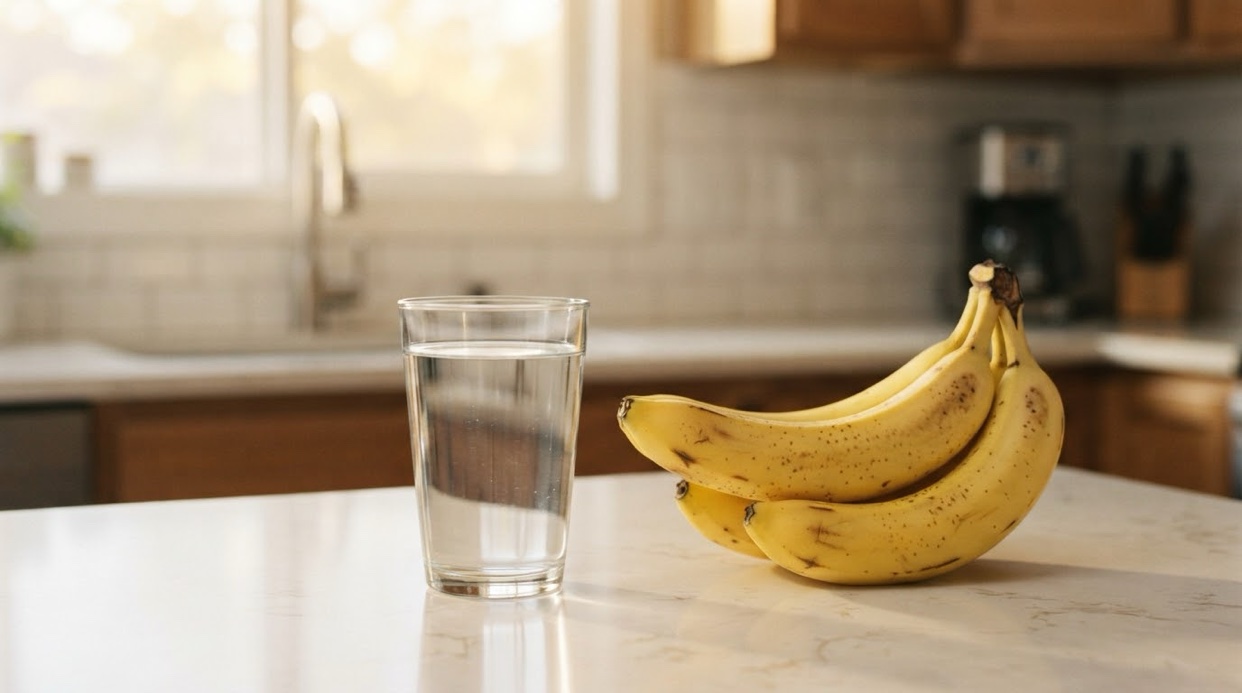
If you walked into your kitchen with a radiation detector, the most radioactive thing in the room would not be the granite countertop, the tap water, or the bunch of bananas on the counter. It would be you.
Every living cell relies on potassium to function, and a tiny, fixed fraction of all potassium on Earth is radioactive. When potassium-40 turns up in a water quality report or a discussion about radioactivity, it is easy to assume it belongs in the same category as industrial fallout or underground contaminants. It does not. Potassium-40 is a natural baseline of life on Earth—and when it comes to your drinking water, it is the one radioactive entry where there is simply nothing to fix.
What it is
Potassium-40 is a naturally occurring, primordial radioactive isotope of potassium. “Primordial” means it has been present since before the Earth formed and cooled, rather than being created by modern human activity or decaying from heavier elements like uranium.
It decays very slowly, with a half-life of 1.25 billion years, emitting both beta particles and gamma rays as it breaks down. Because it has stuck around for billions of years, geologists actually use its slow, predictable decay in potassium-argon dating to determine the age of ancient rocks.
Across the entire planet, potassium-40 makes up about 0.0117% of all natural potassium. You cannot separate that tiny radioactive fraction from ordinary potassium in nature. Wherever potassium goes, potassium-40 goes with it. It is in rocks, soils, agricultural fertilizers, natural groundwaters and surface waters, everyday foods like potatoes and bananas, and the tissues of every plant and animal.
The rulebook
Because potassium-40 is an unavoidable part of the natural environment rather than a pollutant, federal and state regulators treat it very differently from man-made radiation.
There is no federal Maximum Contaminant Level (MCL), no Maximum Contaminant Level Goal (MCLG), and no EPA health advisory for potassium-40 specifically. While the EPA does enforce a drinking-water limit of 4 millirems per year (4 mrem/yr) for beta particle and photon radioactivity—with a non-enforceable goal of zero—that standard applies strictly to man-made radionuclides. Because potassium-40 is natural, it is not what that limit governs.
State regulations follow the same logic. California mirrors the federal approach, applying the 4 mrem/yr standard to man-made beta and photon emitters without setting a standalone limit for potassium-40. (California’s Proposition 65 does not list potassium-40 by name either, though it has broadly listed “Radionuclides” as a category known to cause cancer since July 1, 1989.) New Jersey likewise sets no standalone limit for potassium-40, following the federal radionuclide standards.
Instead of restricting potassium-40, water regulators account for it by subtraction. When public water systems screen water for gross beta radioactivity, they compare the result against a screening level of 50 picocuries per liter (50 pCi/L). If a sample triggers that screen, water systems are allowed to measure the water’s total potassium in milligrams per liter (mg/L), multiply that number by 0.82 to calculate the potassium-40 share, and subtract it from the gross beta total. In plain terms, regulators measure potassium-40 mainly so they can take its natural background out of the equation and see if any man-made contamination is actually present.
The potassium-40 in you
Because every human body requires a steady supply of potassium to keep nerves firing and muscles contracting, potassium-40 is the largest source of natural radioactivity inside you. In an average adult, potassium-40 accounts for roughly 4,400 radioactive disintegrations per second—measured as 4,400 becquerels (Bq).
Crucially, you cannot alter that number through what you eat or drink. The human body tightly regulates its total potassium balance through homeostasis, automatically excreting excess potassium through the kidneys. Because your body keeps its total potassium level essentially constant, your internal level of potassium-40 remains constant as well. You cannot raise your radioactivity by eating bananas, and you cannot lower it by drinking potassium-free water or avoiding potassium-rich foods.
When evaluating health risks, regulatory agencies look at ionizing radiation broadly rather than singling out potassium-40. As a general category, ionizing radiation is classified as carcinogenic: the International Agency for Research on Cancer (IARC) places ionizing radiation and internally deposited beta-emitting radionuclides in Group 1, and the EPA classifies all radionuclides as Group A known human carcinogens. However, potassium-40 is not individually named by IARC, and its presence in the body is simply an inseparable condition of human biology.
What removes it
If someone wanted to strip potassium-40 out of tap water anyway, standard water-treatment chemistry applies. Because potassium-40 is chemically identical to non-radioactive potassium, any process that removes dissolved potassium ions will remove potassium-40 along with them.
Reverse osmosis systems and cation exchange units (standard water softeners) both effectively remove dissolved potassium ions from water. Conversely, granular activated carbon filters and air stripping systems do not remove dissolved potassium ions at all.
Because potassium-40 is not regulated as a drinking-water contaminant, the EPA does not list a “best available technology” for removing it. While a reverse osmosis unit or a water softener will lower the potassium content of your tap water, doing so will not change the amount of potassium-40 in your body—your metabolism will simply balance its potassium levels from the food you eat instead.
The honest bottom line
Radioactivity in a water report naturally invites scrutiny, and for man-made isotopes or elevated radium and uranium, treatment makes sense. Potassium-40 is different. It is the natural background radiation of the Earth itself, present in every ocean, every river, every harvest, and every human cell since life began. Filtering it out of your tap water will not make you less radioactive, because your body deliberately holds onto the potassium it needs to keep you alive. When you see potassium-40 factored into a water analysis, there is nothing broken and nothing to fix.
Facts first, then filter. — Steve
Leave a Reply