
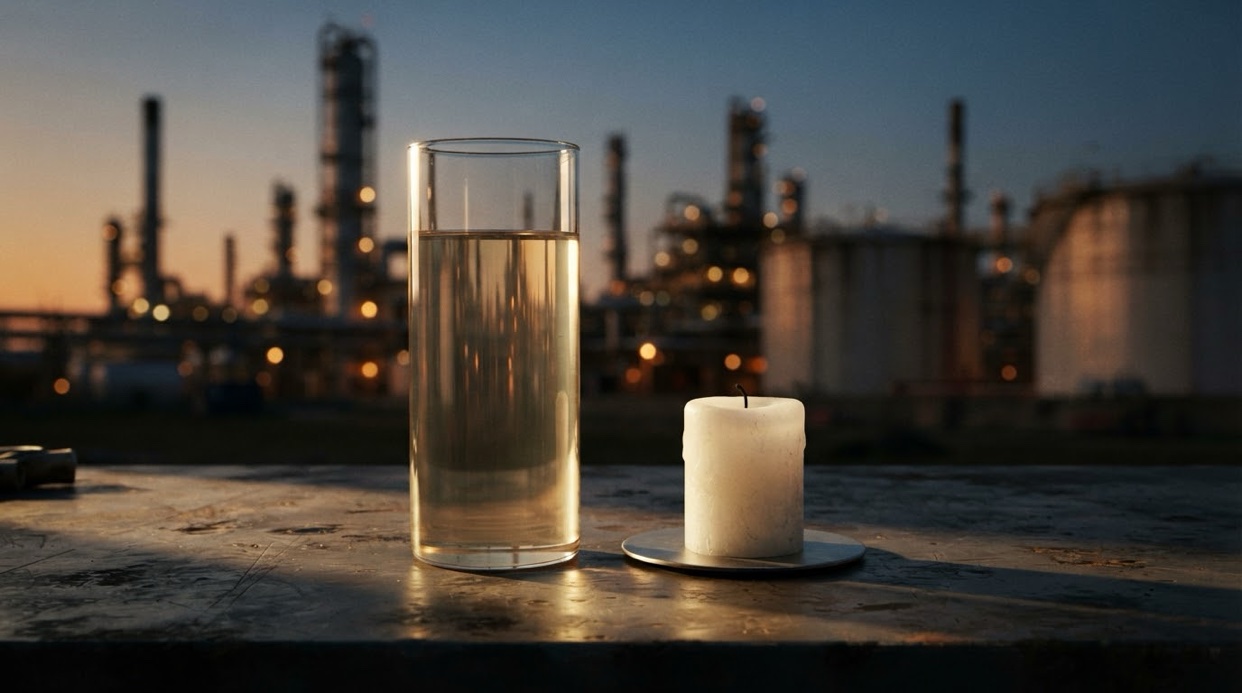
When homeowners spread a full-spectrum laboratory water test across the kitchen table and read down into the obscure tail of the chemical list, they occasionally run into six names that sound like Greek mythology mixed with heavy industry: decane, dodecane, tetradecane, pentadecane, heneicosane, and docosane. Most folks see a cluster of unfamiliar “-ane” words, assume they are dealing with half a dozen exotic industrial poisons, and start worrying about what is coming out of their faucet. After a lifetime in professional water treatment, I can tell you that these six names are much simpler than they look—they are straight chains of petroleum, stretching from diesel fuel all the way to ordinary candle wax, and their real job on a water test is acting as a detective’s fingerprint.
The Family
If the light gasoline hydrocarbons are the short skeleton of gasoline, these six compounds sit at the far end of the exact same refinery barrel: long, straight chains made of carbon and hydrogen, and nothing else.
Once you know the secret, the names stop sounding intimidating because they are simply counting words. Decane has 10 carbons, dodecane has 12, tetradecane has 14, pentadecane has 15, heneicosane has 21, and docosane has 22. Chains in that 10-to-16 carbon range form the backbone of kerosene and diesel fuel. Once you step past about 20 carbons, you are no longer talking about liquid fuel at all—you are talking about paraffin wax, the exact stuff used to make candles. It is the exact same chemical family from top to bottom, just cut into a longer piece of rope.
The One Physical Fact That Rules This Entry
Before you even look at a number next to these six names, there is one physical rule you have to understand: they essentially do not dissolve in water. Decane, which is the lightest and most soluble of the six, dissolves at only about 0.05 milligrams per liter, and solubility collapses even further with every single carbon atom added to the chain. By the time you reach the two longest molecules on the list, heneicosane and docosane, you are looking at waxy solids at room temperature.
That creates an honest puzzle for a homeowner reading a lab sheet: if these compounds do not dissolve in water, how did the laboratory find them in a water sample? The answer is straightforward. When a lab reports one of these names, it is not measuring a chemical dissolved in water like sugar stirred into hot tea. Instead, the instrument is catching microscopic traces carried on suspended particles and tiny bits of petroleum residue. That is the exact reason laboratories include these names in petroleum fingerprint testing. A hit on one of these rows is a source clue telling you where the water has been, not a dissolved chemical dose.
The Names
Taken one by one, each of these six straight chains marks a specific step down the length of the refinery barrel:
- Decane: A 10-carbon chain; the lightest of the six and a core component of diesel and kerosene.
- Dodecane: A 12-carbon chain; a classic diesel-range hydrocarbon that is also used as a laboratory solvent.
- Tetradecane: A 14-carbon chain sitting squarely in the mid-diesel range.
- Pentadecane: A 15-carbon chain sitting in the upper diesel range.
- Heneicosane: A 21-carbon chain that crosses the line from liquid fuel into wax, serving as a paraffin component.
- Docosane: A 22-carbon chain; a waxy solid at room temperature and a standard component of paraffin wax.
The Numbers
If you look across the regulatory columns beside these six names, you will find zero legal standards. Not one of the six has a federal drinking-water limit—no Maximum Contaminant Level (MCL) and no Maximum Contaminant Level Goal (MCLG)—and no Environmental Working Group health guideline exists for any of them either.
In national tap-water testing, detections of these long chains are rare and tiny in footprint. Decane has been detected in public water systems serving about 15,000 people in a single state, and docosane has been found in systems serving about 19,000 people in a single state. Even more telling is the pattern in the data: these names tend to print together, as a cluster, on the exact same Texas utility reports—one Texas system, for example, shows docosane, dodecane, pentadecane, and tetradecane all printed on a single report. That is the petroleum fingerprint behavior in action: where one long chain prints, its brothers print right alongside it.
Health Framing
There is no federal drinking-water health assessment for any of these six compounds, and basic chemistry explains why nobody has rushed to write one: a substance that essentially cannot dissolve in water cannot deliver a meaningful dissolved dose from a glass of tap water. The industrial safety files that do exist for these compounds concern workers handling the pure liquids themselves—specifically skin contact and, above all, the danger of inhaling liquid hydrocarbon directly into the lungs—rather than drinking trace residues in tap water.
What Removes Them
Because these six compounds do not dissolve, you handle them physically. They ride through water attached to tiny particles and oily residue, which means sediment filtration and granular activated carbon address the physical material they travel with. More importantly, any visible fuel contamination in a well is a source problem that needs to be fixed at the source, not simply covered up with a filter. Keep in mind that no federal best-available-technology listing and no removal guarantees exist for any of the six.
The Bottom Line
After decades of reading laboratory water reports, my verdict on these six names is plain: they sound intimidating on paper, yet they are mostly a laboratory’s technical way of saying “petroleum was here.” Read them as a chemical fingerprint pointing back toward a fuel or wax source rather than six poisons sitting in your water glass.
Facts first, then filter. — Steve
Leave a Reply