
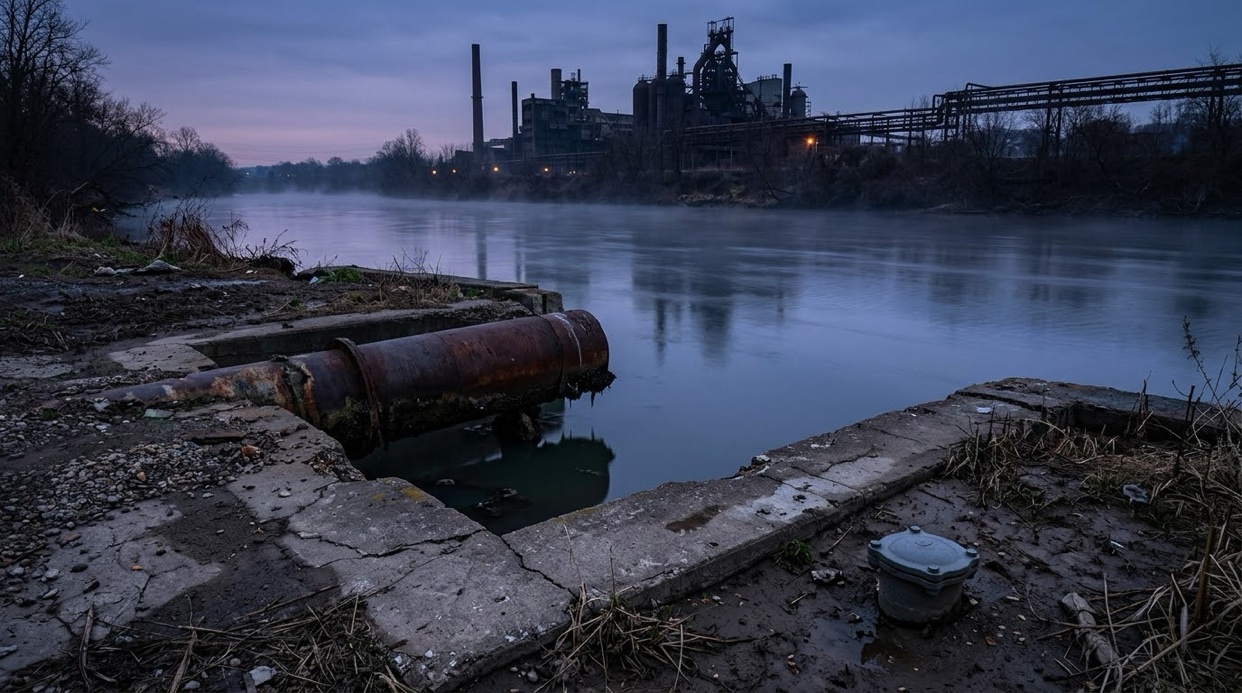
1,1-Dichloroethylene—known in industrial chemistry as vinylidene chloride—is a synthetic volatile organic compound (VOC) that sits on the federal list of regulated drinking water contaminants. Working in water treatment since 1994, I’ve watched chemicals like this one outlive the factories that made them. If you’re reading through your municipal water quality report or reviewing certified lab testing for a private well, this is a chemical you want to pay attention to. While it isn’t something you’d buy off a retail shelf, decades of industrial manufacturing and disposal have left it as a lingering legacy contaminant in groundwaters across the country.
How It Gets Into Your Water
1,1-Dichloroethylene is primarily manufactured as a core chemical building block used to produce plastics, synthetic polymers, and latex copolymers. Its most common application is in creating polyvinylidene chloride (PVDC) films and coatings—the barrier coatings widely used in food packaging to keep moisture out, as well as in flame-retardant coatings for fabrics and carpets.
Because it is synthesized and processed at large-scale industrial chemical plants, environmental contamination typically traces back to manufacturing facilities. The EPA’s listed source for 1,1-dichloroethylene in drinking water is discharge from industrial chemical factories. Industrial wastewater discharges, chemical spills during transport or handling, and unlined or leaking hazardous waste sites are the primary entry points allowing the chemical to reach soil and water tables.
1,1-Dichloroethylene is highly volatile. If it enters open surface waters like streams, rivers, or lakes, a significant portion of it escapes into the air through evaporation. However, when spills or leaks seep down into the soil, the chemical travels downward into aquifers. Once trapped underground in an aquifer—shielded from air exposure and sunlight—it loses that pathway for evaporation. In that oxygen-deprived environment, it persists for long periods, forming stable contamination plumes that can migrate toward private and municipal wells.
What It Can Do to Health
The U.S. Environmental Protection Agency evaluates volatile organic chemicals in public water supplies primarily through the lens of long-term, chronic exposure. The health effect the EPA lists for long-term exposure above the limit is liver problems—plain as that. The liver is this chemical’s target, and that’s what the federal standard is built around. Because it is a synthetic industrial compound with no beneficial presence in the human body, federal safety thresholds are enforced to restrict human ingestion.
Public systems test for VOCs routinely. If you are on a private well near an old industrial chemical site, testing is up to you—a certified laboratory can run a VOC panel on a sample of your water.
The EPA Drinking-Water Limit
Federal safety limits for 1,1-dichloroethylene are established under the Safe Drinking Water Act:
- Maximum Contaminant Level Goal (MCLG): 0.007 mg/L (or 7 ppb). This non-enforceable health benchmark represents the level in drinking water below which there is no known or expected risk to health, allowing for a margin of safety.
- Maximum Contaminant Level (MCL): 0.007 mg/L (or 7 ppb). This is the legally enforceable federal standard that public water utilities must not exceed.
Because the health goal and the enforceable limit are set at the exact same number, any public water system detecting 1,1-dichloroethylene above 7 parts per billion is in direct violation of federal standards and must take immediate corrective action or issue public notifications.
Which Home Filtration Actually Removes It
Standard mechanical filters (like sediment screens) and conventional water softeners do nothing to remove dissolved volatile organic chemicals like 1,1-dichloroethylene. Stripping synthetic solvents out of tap water requires media specifically designed to capture small organic molecules:
- Activated Carbon Filtration (GAC & Solid Carbon Block): Granular activated carbon (GAC) and solid carbon block filters are your primary frontline defense. Organic chemical molecules stick to the vast internal pore structure of activated carbon through a physical process called adsorption as water flows through the bed.
- Reverse Osmosis (RO): Point-of-use reverse osmosis systems serve as an effective backstop. RO units combine high-density carbon pre- and post-filtration with a semi-permeable membrane barrier, giving you multi-stage protection against VOC pass-through at the tap.
Understanding Certification Standards
The water treatment market is filled with broad, non-specific claims like “reduces chemical taste” or “tested to NSF standards.” You shouldn’t rely on general marketing when dealing with industrial solvents. Look for third-party testing and validation under these exact standards—and read what each seal actually covers:
- NSF/ANSI Standard 53: This is the health-effects standard for drinking water treatment units. In plain English: a unit certified to Standard 53 has been independently tested for the specific health-related contaminant reduction claims named in its certification. Its VOC reduction claim is the one that matters here: a unit certified for VOC reduction has been tested with a surrogate chemical (chloroform) standing in for a defined list of volatile organic chemicals—and 1,1-dichloroethylene is on that list.
- NSF/ANSI Standard 58: This is the performance standard for reverse osmosis systems. In plain English: it certifies that an RO system reduces total dissolved solids and the specific contaminants named in its certification—VOC reduction is one of the claims a model may carry, so check the model’s claim list for it.
A certification seal by itself proves only that the unit was tested for the claims on its list—it does not mean it removes every chemical. You must check the manufacturer’s official Performance Data Sheet or verify the unit in an independent directory (such as NSF, WQA, or IAPMO) to confirm that 1,1-dichloroethylene (or vinylidene chloride) is explicitly named as a certified reduction claim. If it is not listed by name on the official paperwork, do not assume the filter will remove it.
Facts first, then filter. — Steve
Leave a Reply