
Water itself does not expire. Chemically speaking, H₂O doesn’t rot, spoil, or break down over time.
When stored water goes bad, it happens for four specific reasons: microbial growth, chemicals migrating out of an unsuitable container, contamination introduced through openings or dirty equipment, and the loss of disinfectant residual over time.
Understanding how to control these four factors determines whether your stored water stays clean or turns into a hazard.
Storage Containers: Getting the Foundation Right
Your water is only as safe as the vessel holding it.
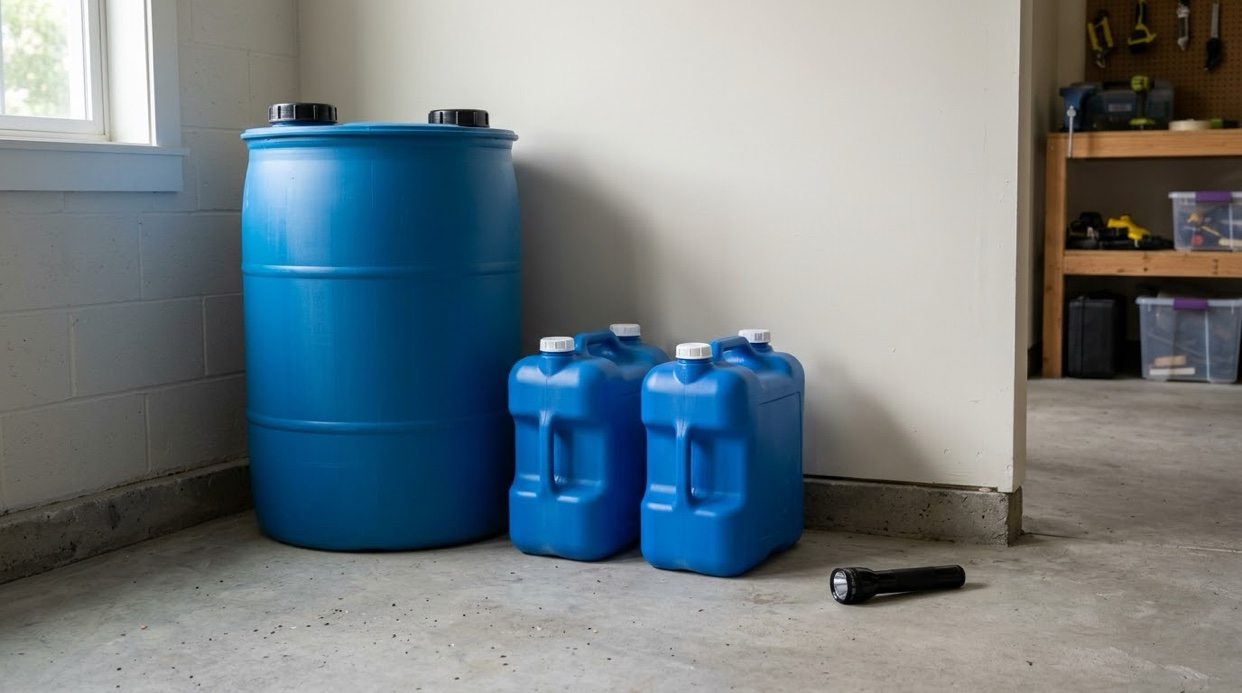
- Food-Grade Verification: Use food-grade containers confirmed food-grade by the manufacturer. A recycling #2 stamp alone does not prove food-grade status, though HDPE #2 is the standard drum resin.
- Light and Opacity: Keep stored water out of direct sunlight. Using opaque containers helps prevent light from fueling microbial issues.
- Prohibited Containers: Never use a container that held detergent, pesticides, petroleum, or other toxic chemicals. Never use a used barrel or IBC tote unless you know exactly what was in it.
- Design and Sanitation: Choose containers featuring a tight-fitting lid and a narrow opening. Always clean and sanitize the container before filling it.
- Environment: Store your containers cool — ideally 50 to 70 degrees F — and away from any toxic substances stored nearby.
Water Rotation Schedules
The CDC recommends replacing self-filled stored water every 6 months. That is a freshness and reliability standard designed to ensure your supply remains safe and clear of contamination.
The 6-month rotation timeframe is a recommendation, not a sudden cliff where water turns dangerous on day 181. For commercially bottled water, simply follow its labeled expiration or use-by date.
Emergency Disinfection Standards
If you must treat questionable water in an emergency, use regular, unscented liquid household chlorine bleach — no added cleaners or fragrances — and follow the EPA/CDC instructions for the particular product.
- Clear Water Dosage: Add 8 drops of 6% sodium hypochlorite bleach per gallon of clear water. If using 8.25% bleach, add 6 drops per gallon.
- Strengths Vary: Bleach is not one strength. Older bottles are 5.25%, most regular bleach today is 6%, and concentrated bleach runs 7.5% to 8.25%. The doses above are the EPA’s published points for 6% and 8.25% — whatever percentage your bottle’s label states is the one that governs.
- Pool Chlorine: Pool chlorine is stronger — liquid runs 10% to 12.5% — but it is not the bottle for this job; it isn’t labeled for drinking water.
- Since People Ask — the Stipulations: Liquid pool chlorine is the same chemical as bleach at roughly double strength, but (1) only a jug of plain sodium hypochlorite with no additives — no algaecides, clarifiers, or copper compounds — is even a candidate; (2) no agency publishes a dose for it, so any dose is proportion guesswork, and a mistake at double strength is a doubled mistake; and (3) an opened jug loses strength fast, so the label’s percentage may no longer be true. That is why the official word is household bleach, and pool chlorine stays an improvisation, not a method. Pool shock is calcium hypochlorite — a different chemical and procedure altogether.
- Process: Stir the mixture thoroughly and let it stand for 30 minutes.
- Verification: Check for a slight chlorine odor. If you do not smell chlorine, repeat the dosage and wait another 15 minutes.
- Important Note: This disinfection process is an emergency treatment for questionable water, not a routine step required for clean city water.
- Bleach Degradation: Keep in mind that household bleach loses its potency over months once opened, so always dose with fresh bleach.
Hydrogen Peroxide Is Not a Water Disinfectant
Neither the EPA nor the CDC recommends household 3% hydrogen peroxide for disinfecting drinking water at any drop dose. It does not provide reliable long-term residual protection.
Commercial Water Preservers
Commercial water preservers are stabilized sodium hypochlorite formulations EPA-registered for 5-year stored-water use. They are neither magic nor a scam. When evaluating them against standard bleach, compare their active ingredient, EPA registration, specific directions, and overall cost per gallon over time. And read the label: an EPA registration is not a guarantee that every product performs identically, and a five-year claim holds only under the product’s labeled storage conditions.
The Look-and-Smell Test Does Not Exist
Disease-causing microorganisms generally cannot be detected by sight, smell, or taste. Water can look perfectly clear and have no unusual odor while still containing harmful pathogens.
An anecdote about someone drinking old stored water without becoming ill is not evidence of safety. You cannot establish microbiological safety by looking at, smelling, or tasting water.
Understanding Legionella
Legionella bacteria grow in warm, stagnant water, particularly around 77 to 113 degrees F. They are commonly associated with showers, hot tubs, cooling towers, and plumbing systems.
People primarily become infected by inhaling contaminated water droplets. Aspiration of contaminated water is another possible route, but simply drinking water is not the typical transmission pathway.
The storage lesson is straightforward: keep stored water cool, sealed, and properly maintained.
Fixing Flat Taste
Stored water often tastes flat because it has lost dissolved air.
- Aeration: Pour the water back and forth between two clean containers and let it stand. Aeration improves taste only; it is not a treatment method.
- Boiled Water: If water was boiled, a pinch of salt per quart improves the flavor. A taste tip only — it does nothing for safety.
How Much Water to Store
- Baseline: Store at least 1 gallon per person per day.
- Duration: The CDC floor is a 3-day supply, but aim for 2 weeks if space allows.
- Adjustments: Store more for extreme heat, illness, pregnancy, pets, and basic hygiene needs.
Facts first, then filter. — Steve
Leave a Reply