
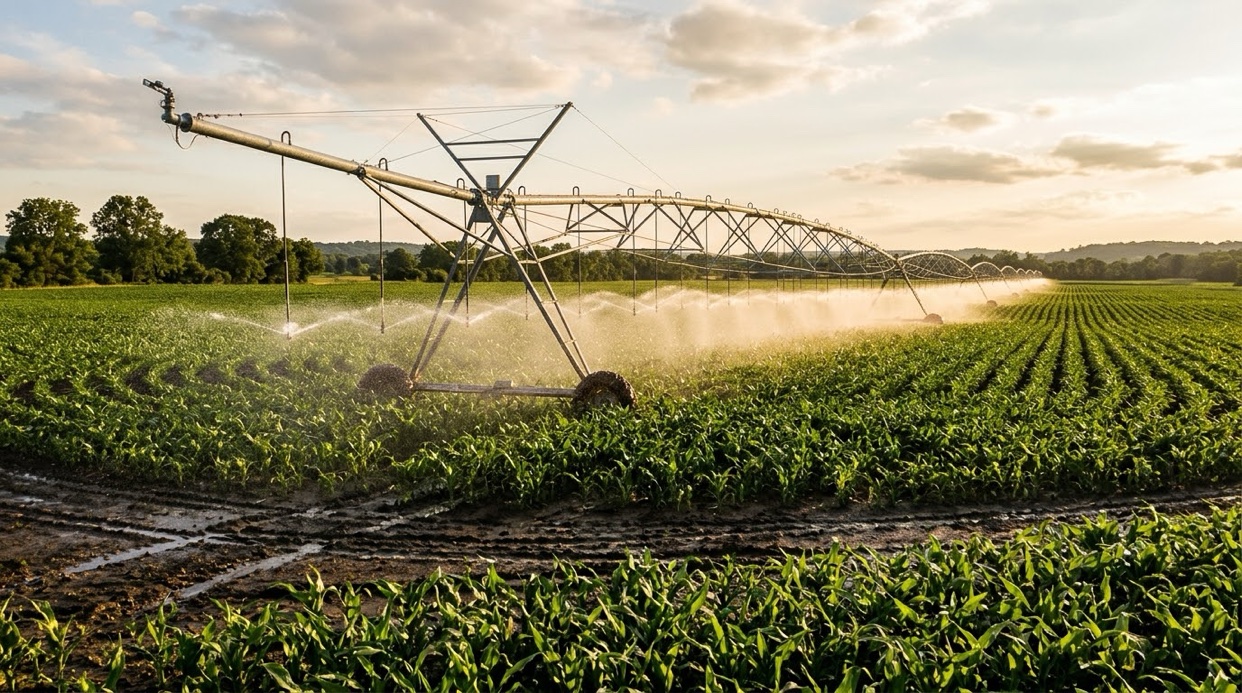
Drive through corn and soybean country in the spring and you are driving through metolachlor country. This herbicide is consistently one of the top three highest-volume herbicides applied in American agriculture, spread over millions of acres before the weeds even come up. It has no federal drinking-water limit. What it does have is a well-documented habit of showing up — along with the chemicals it breaks down into — in Midwestern streams and shallow wells. If your water comes from a well anywhere near farm fields, this one is worth your ten minutes.
1. What It Is
Metolachlor is a pre-emergence herbicide in the chloroacetanilide family. “Pre-emergence” describes how it is used: it goes on the field before the weeds sprout, and it stops annual grasses and small-seeded broadleaf weeds as they try to germinate. The crops it protects are the backbone of American farming — corn, soybeans, sorghum, peanuts, and cotton.
You will see it on product labels as Dual, Bicep, and Pennant. In today’s commerce, the original chemical has largely been replaced by its enriched active isomer, S-metolachlor, sold as Dual II Magnum — a refined version that delivers the active form more efficiently. Both remain actively registered with EPA, and the chemical family continues under the agency’s Registration Review. This is not a banned relic. It is a current, high-volume farm chemical, applied every planting season.
The volume matters, so let me put it plainly. Plenty of chemicals on contaminant lists are rare — old industrial leftovers, or products a handful of facilities ever used. Metolachlor is the opposite. When a chemical ranks among the top three herbicides by volume in the entire country, year after year, the question for nearby groundwater is not really whether traces of it and its breakdown products will be found. At that scale of use, finding them is the expected outcome, and the monitoring record in Midwestern streams and shallow wells bears exactly that out. Scale of use is the first thing I look at with any farm chemical, and this one’s scale is about as large as it gets.
2. Where It Comes From
Metolachlor is applied to soil, and soil is where its water story begins. Rain and irrigation move residues off fields and into drainage, streams, and the ground above shallow aquifers. But the parent chemical is only half the story, and honestly it is the smaller half.
As metolachlor breaks down in soil, it produces two degradates — metolachlor ESA (the sulfonic acid form) and metolachlor OA (the oxanilic acid form). These breakdown products are water-soluble, mobile, and persistent, and they are routinely found in Midwestern streams and shallow wells. That is the pattern to understand: the herbicide goes on the field, the parent compound largely stays near the soil or degrades, and its chemical children travel with the water. For a farm-country well owner, the degradates are often the part of this story that actually reaches the tap — and, as the removal section explains, they are also the part that is harder to treat.
3. The Numbers
Metolachlor has no federal drinking-water standard. There is no MCL and no MCLG for it.
In plain English: the MCLG — Maximum Contaminant Level Goal — is the level EPA’s scientists consider safe; it is a goal, not a law. The MCL — Maximum Contaminant Level — is the enforceable legal limit a water system must meet. Metolachlor has neither, so no public water system is federally required to test for it or hold it under any set number, and no federal rule governs it in a private well at all.
What EPA publishes instead are Health Advisories — guidance, not law. They are the agency’s scientific advice on safe levels, with no enforceable standard behind them. For metolachlor, the Lifetime Health Advisory is 0.7 mg/L (700 ppb): the concentration EPA considers acceptable to drink every day over a lifetime. The short-term advisories for a child are higher, as short-term values usually are: both the 1-day and the 10-day Health Advisory are 2 mg/L (2,000 ppb).
The states do not add a layer here. California has no MCL, no Notification Level, and no Public Health Goal for metolachlor. New Jersey has no MCL for it. Metolachlor is not listed under California’s Proposition 65. So the federal advisory figures are the whole yardstick — and it is worth repeating that they are guidance a homeowner or a water system may use, not a limit anyone is enforcing.
4. What EPA Says About Health
EPA’s health advisory document for metolachlor rests mainly on chronic animal studies. In laboratory rats exposed at high doses over long periods, metolachlor caused liver toxicity — the findings included increased liver weight, eosinophilic foci (small clusters of altered liver cells), and proliferative liver lesions — along with reduced body weight. That liver record is the center of the health picture: the doses that produced those effects are the doses EPA worked from in setting its advisory levels.
The cancer classification has two chapters, and you deserve both. In EPA’s 2018 Drinking Water Standards and Health Advisories, metolachlor is classified Group C — “possible human carcinogen” — reflecting those liver findings in rats. In later assessments from EPA’s pesticide program, the classification was revisited: metolachlor was judged “not likely to be carcinogenic to humans” at doses that do not damage the liver. In other words, the agency’s more recent position ties the cancer question to the liver-toxicity question — keep exposure below the level that harms the liver, and the cancer concern recedes with it. IARC, the international cancer agency, has no classification for metolachlor. I am not going to pretend the record is simpler than it is: the 2018 document says Group C, the later assessments say not likely at non-liver-toxic doses, and both are EPA’s own words at different times.
5. What Removes It
Because metolachlor is unregulated, EPA has designated no Best Available Technology for it — no official treatment method attached to a legal standard, because no legal standard exists. What follows is what the chemistry supports.
For the parent chemical, the home answers work well. Granular activated carbon (GAC) removes metolachlor effectively — it is a moderately hydrophobic compound (log Kow about 3.13) that adsorbs onto carbon — and reverse osmosis (RO) removes it too, since at roughly 284 daltons its molecule is large enough for a membrane to reject.
The degradates are the catch, and this is the part most filter sales pitches skip. Metolachlor ESA and OA are poorly removed by GAC. Carbon alone is not a complete answer for this chemical family. The degradates require reverse osmosis or ion exchange — ion exchange being the process where water passes over a resin that trades its own harmless ions for the dissolved contaminants it captures, the same basic principle a water softener uses on hardness minerals. If you are on a well in farm country and this chemical is your concern, an RO unit is doing work that a carbon filter by itself cannot promise. This is the pattern worth remembering beyond this one chemical: a herbicide and its breakdown products are different substances with different behavior, and a treatment choice that handles the parent compound beautifully can still leave the degradates passing through.
And the usual warning applies with force: no sediment filter and no micron rating enters into this at all. A micron rating measures the solid particles a cartridge can strain out. Metolachlor and its degradates in water are dissolved — present molecule by molecule, not as particles. Straining for them is like trying to catch wind in a chain-link fence. Dissolved chemicals are removed by adsorption onto carbon, by membrane rejection, or by ion exchange — three real mechanisms, none of them a screen.
6. The Bottom Line
Metolachlor is one of America’s three highest-volume herbicides, still registered, still applied every spring, with no federal drinking-water limit and a Lifetime Health Advisory of 0.7 mg/L (700 ppb). Its parent compound yields to carbon and reverse osmosis; its ESA and OA breakdown products — the forms routinely found in Midwestern streams and shallow wells — are poorly handled by carbon and call for RO or ion exchange. Farm country or not, that split is the whole lesson: know which form of the chemical you are treating before you buy the treatment.
Facts first, then filter. — Steve
Leave a Reply