
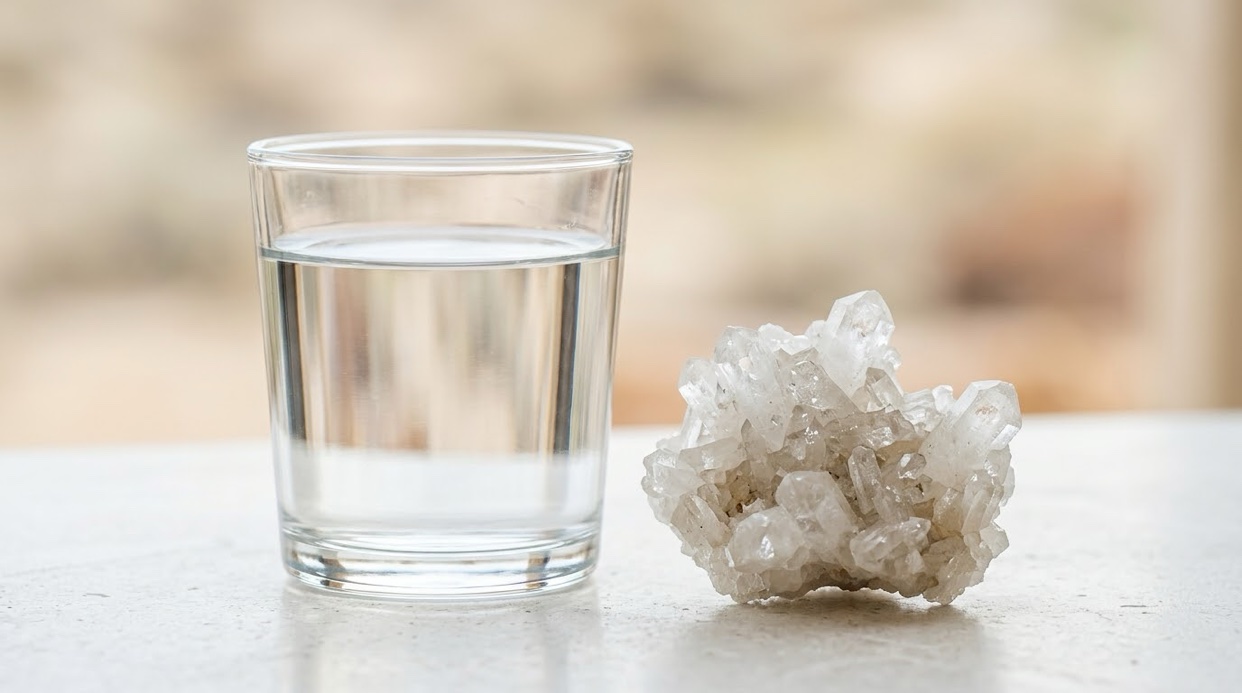
When most people think of boron, they picture the green-labeled box of Borax sitting in the laundry room, or maybe a bar of heavy-duty hand soap. If you remember your high school science class, you might recall it as a metalloid—an element that shares properties of both metals and non-metals—sitting at element number 5 on the periodic table.
While boron plays a crucial role in modern manufacturing, agriculture, and household cleaning, it is also a naturally occurring element that regularly turns up in groundwater. As a water treatment professional, I get questions all the time from homeowners who notice boron on a lab report and want to know what it means for their family.
Here is a straightforward, honest breakdown of what boron is, how it behaves in water, and how to address it in your home without the hype or scare tactics.
1. What Boron Is and Where It Comes From
Boron is a naturally occurring metalloid found throughout the Earth’s crust, in soil, in rock formations, and in significant concentrations in seawater. Because it binds readily with oxygen, it is almost never found as a pure element in nature; instead, it exists as borate minerals and salts.
Beyond its natural geological presence, boron is heavily used in industrial and consumer products. You will find it in:
- Household Cleaners & Detergents: Sodium tetraborate (Borax) is a staple booster in laundry and cleaning products.
- Glass and Ceramics: Borosilicate glass (like heat-resistant cookware and lab equipment) uses boron to resist thermal shock.
- Fertilizers & Agriculture: Boron is an essential micronutrient for plant growth and is widely added to commercial crop fertilizers.
- Industrial Manufacturing: It is utilized in flame retardants, fiberglass, and semiconductor production.
2. How It Gets Into Drinking Water
Boron typically enters drinking water supplies through two primary routes:
- Natural Weathering and Erosion: As groundwater flows over and through subterranean rock formations, borate minerals gradually dissolve and leach into aquifers and private wells. Coastal groundwater can also see elevated boron levels due to natural seawater intrusion.
- Human Activity and Runoff: Agricultural runoff containing boron-rich fertilizers, industrial wastewater discharge, and municipal sewage (carrying dissolved household laundry detergents) can seep into surface rivers and shallow groundwater basins.
3. What It Can Do to a Person’s Health
Boron is actually an essential trace element for plants, and humans naturally consume small amounts of it every day through food like fruits, nuts, and vegetables.
However, consuming high levels of boron in drinking water over extended periods can cause health issues. Long-term exposure to elevated concentrations can lead to gastrointestinal irritation (such as nausea, vomiting, and diarrhea) and may cause potential adverse effects on the male reproductive system and fetal development during pregnancy.
For gardens, excess boron in irrigation water can also stunt or damage sensitive plants like citrus trees and ornamental flora.
4. The Federal Picture: Regulations vs. Advisories
When evaluating boron in tap water, homeowners often expect to see an enforced federal standard. However, boron currently has NO EPA Maximum Contaminant Level (MCL).
Because the EPA has not set a legally enforceable federal standard, public water utilities are not required to remove boron under federal law. Instead, authorities rely on non-enforceable guidance:
- World Health Organization (WHO): The WHO sets a recommended guideline value of 2.4 milligrams per liter (mg/L) for drinking water.
- U.S. EPA Health Advisories: Rather than an enforceable standard, the EPA has issued Health Advisories for boron. EPA’s Lifetime Health Advisory is 5 mg/L for adults. For children, EPA’s 1-day and 10-day advisories are both 3.0 mg/L, and its longer-term advisory is 2.0 mg/L for children and 5.0 mg/L for adults.
What This Means for a Homeowner
Because there is no federal MCL, municipal water suppliers are not legally required to test for or treat boron unless mandated by specific state-level rules. If you rely on a private well, testing and managing boron falls entirely on your shoulders. The WHO and EPA advisory numbers serve as valuable benchmarks to compare against your water test results to determine if action is needed.
5. How a Homeowner Can Test Their Water
You cannot see, taste, or smell boron in typical drinking water concentrations. The only reliable way to know if boron is in your tap water—and at what level—is through a certified laboratory test.
- Avoid Over-the-Counter Test Strips: DIY color strips sold in home improvement stores are fine for basic hardness or chlorine checks, but they cannot accurately measure trace elements like boron.
- Order a Certified Metals Panel: Use a state-certified drinking water laboratory. Laboratories typically test for boron using advanced instrumentation such as ICP-OES (EPA Method 200.7) or ICP-MS (EPA Method 200.8).
- Container Tip: Certified labs usually provide specialized plastic sampling bottles. Avoid taking water samples in standard glass jars, as borosilicate glass can leach tiny traces of boron into the sample and skew your results.
6. How to Remove Boron (And What Actually Works)
Removing boron from drinking water requires honest expectations: boron is one of the more challenging elements to remove using standard residential filtration.
Why Reverse Osmosis (RO) Struggles with Boron
Standard home Reverse Osmosis systems rely on semi-permeable membranes that excel at blocking charged ions (like sodium, calcium, or lead). However, at a neutral drinking water pH (around 6.5 to 7.5), boron exists in water predominantly as boric acid (H_3BO_3)—a very small, uncharged molecule.
Because it lacks an electrical charge and has a small molecular size, boric acid easily slips right through standard residential RO membranes. While standard point-of-use RO systems typically reject 95% to 99% of common salts, a single-pass residential RO unit operating at neutral pH will often only reject 40% to 70% of the boron present.
What Actually Works for Boron Removal
- Specialized Boron-Selective Ion Exchange Resins: For significant whole-house or municipal boron removal, specialized ion-exchange media containing specific functional groups (like N-methylglucamine) are used. These resins chemically bind boric acid, capturing it regardless of pH. Standard water softeners will not remove boron.
- Multi-Pass / High-pH Reverse Osmosis Systems: Above boric acid’s pKa (about 9.2), boron increasingly converts into the negatively charged borate ion, B(OH)₄⁻, which RO membranes reject far better. In commercial and desalination settings, a second RO pass at pH around 10 to 10.5 typically achieves boron rejection above 95%. While complex for a typical home kitchen, some advanced residential drinking units combine specialty high-rejection membranes with fine-tuned flow rates to improve removal.
The Role of Physical Sediment Filters & Micron Ratings
Physical sediment filters alone—including carbon blocks—do not remove dissolved boron. However, they play a vital pre-filtration role in protecting sensitive treatment equipment from clogging.
When choosing pre-filters for a treatment system, understanding micron ratings is essential:
- Micron Rating: A micron (micrometer) measures pore size. A 5-micron or 1-micron pre-filter is typically installed ahead of an RO system to trap fine rust, sand, and sediment particles.
- Nominal Rating vs. Absolute Rating:
- Nominal Rating: Means the filter can trap approximately 60% to 85% of particles at that rated micron size. Some larger particles can still pass through.
- Absolute Rating: Means the filter traps 99.9% or more of particles at that micron size under strict lab testing conditions.
Using an absolute-rated pre-filter ensures consistent protection for downstream membranes and specialty resins.
The Bottom Line
Boron is a naturally occurring element that is rarely cause for immediate alarm, but elevated levels warrant a practical treatment strategy. Because there is no federal EPA limit, compare your lab test results against the WHO guideline of 2.4 mg/L or the EPA lifetime health advisory of 5 mg/L.
If your water test shows high boron levels, keep in mind that standard off-the-shelf pitch filters and basic water softeners won’t do the job. Work with a qualified professional to look at specialty boron-selective resins or tested high-rejection reverse osmosis systems that are verified for your specific water chemistry.
Leave a Reply