
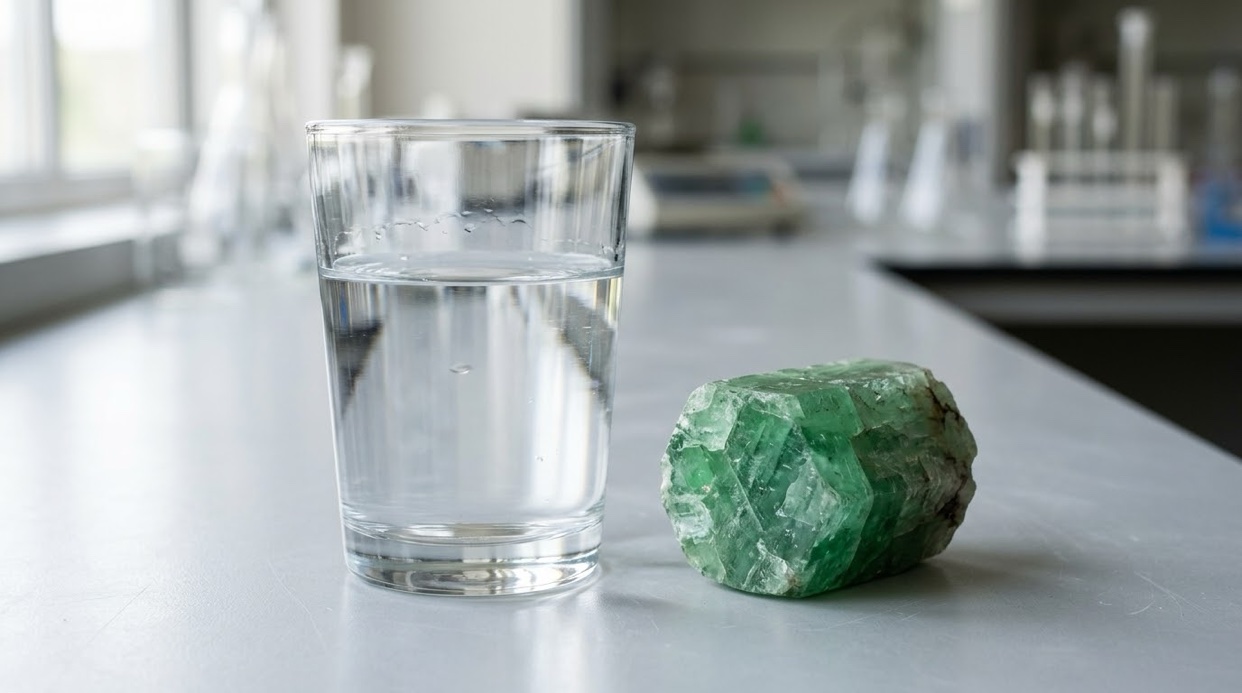
If you look at a periodic table, you will spot beryllium sitting right near the top left—element number 4. It is a light, strong metal that occurs naturally in rocks, soil, and coal, and it has found its way into high-tech manufacturing, aerospace, and electronics.
Because it is relatively rare compared to heavy hitters like iron or calcium, most people rarely think about it. However, as someone who spends every day helping homeowners understand what is coming out of their taps, I know that even the lesser-known elements on the periodic table deserve a closer look. Here is a clear, honest breakdown of what beryllium is, how it behaves in water, and what you can do about it if it shows up in your home.
1. What Beryllium Is and Where It Comes From
Beryllium is a naturally occurring element found in mineral deposits throughout the Earth’s crust. Because of its light weight and high tolerance for heat, it is widely used in specialized industrial applications—everything from defense hardware and telecommunications to electrical equipment, glass manufacturing, and alloy production.
In nature, beryllium is locked inside rock formations. When rocks gradually break down over centuries, small amounts of beryllium are released into the surrounding environment. However, human activity—specifically industrial waste discharge, metal processing, and coal combustion—can significantly increase the concentration of beryllium in localized areas.
2. How Beryllium Gets Into Drinking Water
Beryllium typically makes its way into drinking water supplies through two primary pathways:
- Natural Erosion: As groundwater flows through subterranean rock and soil deposits containing beryllium, the mineral slowly leaches into aquifers and wells.
- Industrial Runoff and Discharge: Wastewater from manufacturing plants, metal refineries, or runoff near coal-burning power plants can carry beryllium into surface waters (like rivers and lakes) or filter down into nearby groundwater tables.
For homes relying on deep private wells in areas with specific rock formations or near industrial sites, naturally occurring or leached beryllium can become a factor. Public municipal supplies treat surface and groundwater, but levels can vary depending on local geology and nearby land use.
3. What It Can Do to a Person’s Health
When inhaled as airborne dust in occupational settings, beryllium poses serious respiratory risks. In drinking water, however, the primary concern is long-term ingestion through daily drinking and cooking.
Consuming water with elevated levels of beryllium over extended periods—typically many years or decades—can lead to potential health complications. Chronic exposure to levels above federal safety standards has been linked to intestinal lesions, inflammation, and damage to internal tissues. Long-term studies also suggest potential risks to the bones and kidneys, as the body struggles to process heavy mineral loads over time.
It is important to keep perspective: brief, low-level exposure is unlikely to cause acute illness. The goal of monitoring and treating beryllium is to protect your health over a lifetime of daily water consumption.
4. The Federal Standard: The EPA Limit
To safeguard public health, the U.S. Environmental Protection Agency (EPA) regulates beryllium in public water systems under the Safe Drinking Water Act.
The standard: The Maximum Contaminant Level (MCL) for beryllium is 4 parts per billion (0.004 mg/L).
To put that in perspective, 4 parts per billion is equivalent to four drop-sized drops of water in an Olympic-sized swimming pool. Because the federal limit is set at such a tiny threshold, standard water testing methods must be precise to detect it.
5. How a Homeowner Can Test Their Water
You cannot see, smell, or taste beryllium in water. The only way to know if it is present—and at what concentration—is through lab analysis.
If you want to test your water for beryllium:
- Skip the DIY Test Strips: Over-the-counter strip tests sold at hardware stores are great for basic pH or hardness checkups, but they cannot measure trace heavy metals down to parts-per-billion levels.
- Use a Certified Laboratory: Order a certified drinking water test kit or hire a state-certified drinking water laboratory. They will send you a specialized bottle to sample your water at the tap and mail back.
- Review the Metals Panel: Beryllium is typically tested as part of a broader “heavy metals” or “inorganic chemicals” panel, which often includes lead, arsenic, cadmium, and copper.
6. How to Remove Beryllium from Drinking Water
If a certified test reveals beryllium levels near or above 4 parts per billion, standard point-of-use or point-of-entry treatment technologies can effectively reduce or eliminate it.
Effective Filtration Technologies
- Reverse Osmosis (RO): A point-of-use RO system installed under the kitchen sink is generally the most reliable residential method for removing dissolved beryllium. RO works by forcing water under pressure through a semi-permeable membrane. The membrane pores are tight enough to block charged beryllium ions while letting pure water molecules pass through.
- Cation Exchange (Water Softeners): In aqueous environments, beryllium typically exists as a positively charged ion (Be^{2+}). Standard ion exchange resins—similar to those used in water softeners to trade calcium for sodium—can exchange beryllium ions out of solution. However, this depends heavily on your water’s overall chemistry and pH.
- Activated Alumina: Media filters using activated alumina can selectively adsorb dissolved metals like beryllium under proper operating conditions and controlled flow rates.
The Role of Physical Sediment Filters & Micron Ratings
Physical sediment filtration plays an important supporting role in water treatment, but it is critical to understand its limitations regarding dissolved metals like beryllium.
If beryllium is present in water as dissolved ions, a physical filter—no matter how fine—will not catch it. Dissolved minerals pass right through filter pores. However, if beryllium is bound to suspended soil, silt, or particulate rust (insoluble form), physical sediment filters can trap those particles before they reach your main treatment equipment.
When evaluating physical sediment pre-filters, you will encounter two key terms:
- Micron Rating: A micron (micrometer) is one-thousandth of a millimeter. The lower the rating, the smaller the particles the filter can capture. For pre-filtering fine particulate matter before an RO system, a 5-micron or 1-micron sediment filter is standard industry practice.
- Nominal vs. Absolute Rating:
- Nominal Rating: Indicates a filter can capture approximately a percentage (often 60% to 85%) of particles at that micron size. It allows some particles of that size or slightly larger to slip through.
- Absolute Rating: Indicates the filter will trap 99.9% or more of particles at the specified micron size under strict lab testing conditions.
For heavy metal particle protection, an absolute-rated pre-filter offers much tighter consistency than a nominal filter.
The Bottom Line
Beryllium in drinking water is uncommon, but when it occurs—usually due to local rock erosion or nearby industrial activity—it should be addressed promptly. It isn’t something to panic over, but it is something to handle methodically.
If you rely on a private well or live near industrial operations, get your water tested by a certified lab. If tests show beryllium approaching the 4 parts per billion limit, a well-maintained home Reverse Osmosis system is typically your cleanest, most dependable solution for pure drinking water.
Leave a Reply