
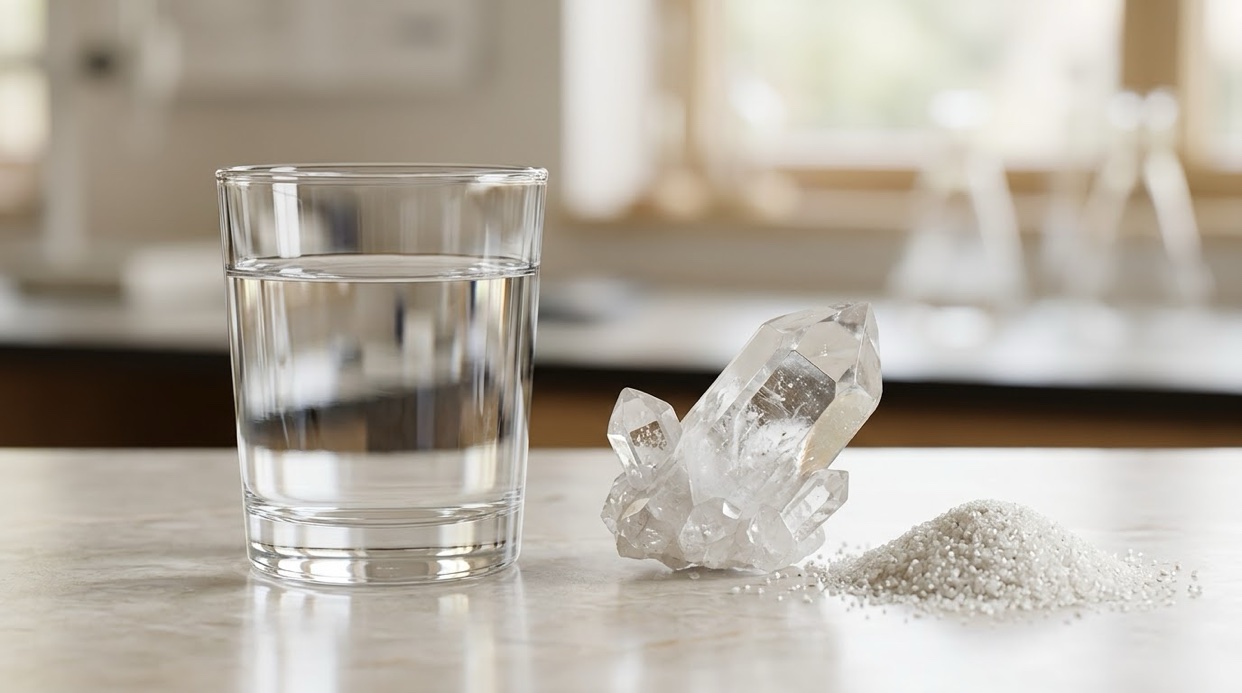
If you take a look at the periodic table, you will spot silicon sitting right at element number 14. It sits directly beneath carbon, sharing a spot in the chemical family that makes up the bedrock of our physical world.
Silicon is the second most abundant element in the Earth’s crust, trailing only oxygen. It is the fundamental building block of sand, quartz, granite, and glass, and it forms the physical foundation of modern microchips and computer electronics.
When homeowners see “silicon” or “silica” turn up on a water test, they often wonder what it means for their family’s health and their home’s plumbing. As someone who spends every day helping people navigate what comes out of their taps, I can tell you that silicon in drinking water is almost entirely a nuisance and plumbing story, not a health story.
Here is a clear, honest breakdown of what silicon is, how it behaves in water, why it is so stubborn to deal with, and how to manage it in your home without any sales pitch or scare tactics.
1. The Honest Naming Point: Silicon vs. Silica
Before diving into how it gets into your water, it is worth clarifying a common point of confusion around the terminology:
In water chemistry, nobody is dealing with pure elemental silicon metal. Instead, it shows up dissolved as silica (silicon dioxide, SiO_2).
When silicon interacts with oxygen and water underground, it forms silica and silicic acid compounds. Because of this, water testing laboratories and water treatment professionals almost always measure and list it on lab reports as Silica (SiO_2) rather than plain silicon. Whenever you see “silica” on a water quality panel, that is the dissolved silicon in your water.
2. How It Gets Into Drinking Water
Silica makes its way into drinking water supplies through natural geological weathering:
- Natural Erosion of Rock and Sand: As rainwater and subterranean groundwater flow through soil, sand, granite, and quartz rock formations, small amounts of silica slowly dissolve into solution.
- Volcanic and Mineral-Rich Geology: Certain geographic regions—especially areas with volcanic geology, basalt formations, or thermal mineral springs—have groundwater with naturally high silica concentrations. Deep private wells drawing from bedrock in these regions frequently show elevated silica levels.
3. What It Does: A Nuisance Story, Not a Health Hazard
When evaluating silica in drinking water, it helps to separate health effects from home maintenance impacts.
No Known Health Hazards
To put it plainly: there are no known health hazards associated with drinking water containing typical levels of dissolved silica. In fact, some dietary studies suggest trace silica may even support bone and connective tissue health. You can drink water containing silica without worrying about toxic health effects.
The Maintenance Nuisance
Where silica causes real trouble is inside your home’s pipes, appliances, and fixtures:
- Hard, Glassy Scale: Unlike soft calcium scale that can often be dissolved with household vinegar, silica forms a rock-hard, glass-like scale (magnesium silicate or complex silica deposits) on heating elements, glass shower doors, and chrome fixtures. Once silica scale bakes onto a surface, it is notoriously difficult to scrub or etch off.
- Etched Glassware and Spotting: High-silica water leaves persistent white spots and haze on glassware and dishes coming out of the dishwasher.
- Membrane Fouling: For homeowners using water treatment equipment, high silica concentrations can coat and foul the semi-permeable membranes used in Reverse Osmosis systems, drastically shortening their lifespan if not managed properly.
4. The Federal Picture: Unregulated by the EPA
When reviewing a home water test, homeowners often look for a federal safety benchmark.
Silica has NO EPA Maximum Contaminant Level (MCL) and NO Secondary Maximum Contaminant Level (SMCL).
It is completely unregulated at the federal level by the U.S. Environmental Protection Agency. Because dissolved silica poses no health hazard to humans and varies widely across regional geology, the EPA has not established primary health limits or aesthetic secondary guidelines for public water supplies.
5. How a Homeowner Can Test Their Water
You cannot smell or taste silica in drinking water, though extremely high levels can occasionally give water a slightly slick feel.
- Ask the Lab Specifically for Silica (SiO_2): Silica is not included on standard basic home drinking water test panels. When ordering a water test from a state-certified drinking water laboratory, explicitly request that Silica or Reactive Silica be added to your testing panel.
- Skip DIY Home Test Strips: Over-the-counter dip strips sold at hardware stores are designed for basic pH, total hardness, or free chlorine. They cannot measure dissolved silica concentrations accurately.
6. How to Remove Silica (And What Actually Works)
Removing silica from water requires honest expectations: silica is one of the more difficult dissolved components to remove from residential water.
What Works (With Caveats)
- Reverse Osmosis (RO): An under-sink point-of-use Reverse Osmosis system is the most practical residential option for drinking water. RO membranes reject dissolved (reactive) silica very effectively — typically 95–99% for modern thin-film composite membranes, with commercial FilmTec elements listing 99.7–99.8% silica rejection in standard solute tests. Silica fouling is not triggered by 20–30 mg/L in the feed water by itself; it becomes a risk when recovery concentrates silica in the reject stream above its solubility — about 120–150 mg/L as SiO₂ at 25 °C and near-neutral pH, and higher with a suitable antiscalant — so high-silica water needs lower recovery, pretreatment, or antiscalant, not just a feed-water warning.
- Specialized Anion Exchange: At commercial or industrial scales, strongly basic anion exchange resins in hydroxide form can remove reactive silica. However, this process requires complex chemical regeneration that is rarely practical for a standard residential whole-house setup.
What Does NOT Work
- Standard Water Softeners: Conventional cation exchange water softeners trade calcium and magnesium for sodium. They do not remove dissolved silica (SiO_2).
- Standard Carbon Filters: Activated carbon filters excel at removing chlorine and organic tastes, but they have zero effect on dissolved silica.
Pre-Filtration and Micron Ratings
If silica exists in your water as fine, colloidal (suspended particle) silica rather than fully dissolved silica, physical sediment pre-filters can help protect downstream equipment.
When evaluating pre-filters, pay attention to micron ratings:
- Micron Rating: A micron measures pore size. A 5-micron or 1-micron sediment pre-filter is standard ahead of an under-sink RO system to catch fine particles.
- Nominal vs. Absolute Rating:
- Nominal Rating: Indicates the filter will trap approximately 60% to 85% of particles at that micron size under standard flow.
- Absolute Rating: Traps 99.9% or more of particles at the specified micron size under strict lab testing conditions.
Using an absolute-rated pre-filter ensures your treatment equipment gets consistent physical protection against fine particulate buildup.
The Bottom Line
Silicon in drinking water—measured on lab reports as dissolved silica (SiO_2)—is entirely a nuisance story, not a health concern. It forms hard, glassy scale on fixtures and dishwashers, but it won’t hurt you to drink it.
Because there is no federal EPA limit, you only need to manage silica if it is causing scaling or spotting in your home. If you want pure drinking water free of silica at the kitchen sink, an under-sink Reverse Osmosis system is your most effective option.
Leave a Reply