
If you take a look at the periodic table, you will spot hydrogen sitting right at the top left corner—element number 1. It is the lightest, simplest, and most abundant element in the entire universe.
When homeowners ask me about hydrogen in drinking water, I always smile, because hydrogen comes with a fundamental, honest truth: hydrogen is literally half of what water is. Every single drop of pure water (H_2O) consists of two hydrogen atoms chemically bonded to one oxygen atom. You couldn’t take hydrogen out of water if you tried—without it, you wouldn’t have water at all!
Because hydrogen is part of the water molecule itself, no certified lab report will ever list “hydrogen” as a pollutant or contaminant, and you can’t filter it out. Instead, hydrogen’s real role in water quality comes down to a single, critical concept that every homeowner should understand: pH.
As someone who spends every day helping people make sense of their tap water, here is a clear, plain-English breakdown of what hydrogen actually does in your water, why pH matters so much, and how it impacts your home.
1. The Real Role of Hydrogen: Understanding pH
When water treatment professionals talk about hydrogen in drinking water, we are really talking about hydrogen ions (H^+).
In any body of water, a tiny fraction of H_2O molecules naturally split apart into positively charged hydrogen ions (H^+) and negatively charged hydroxyl ions (OH^-). The balance between these two ions determines your water’s pH—which literally stands for the “potential of hydrogen.”
Put simply:
- High concentration of hydrogen ions (H^+): Your water is acidic.
- Low concentration of hydrogen ions (H^+): Your water is alkaline (or basic).
pH isn’t just an abstract scientific term; it is a measure of how active hydrogen ions are in your water, and it dictates how your water interacts with everything it touches—from your copper pipes to your laundry detergent.
2. Walking the pH Scale
The pH scale runs from 0 to 14, with 7 representing neutral:
- Below 7.0 (Acidic): The water has an excess of active hydrogen ions. Acidic water is aggressive and reactive.
- 7.0 (Neutral): Hydrogen ions (H^+) and hydroxyl ions (OH^-) are in perfect balance. Pure, distilled water at room temperature sits right around 7.0.
- Above 7.0 (Alkaline): The water has fewer hydrogen ions and an excess of hydroxyl ions (OH^-). Alkaline water is rich in dissolved mineral bases like calcium and magnesium.
The Federal Picture: Secondary Guidelines
When reviewing your municipal water report, you won’t find a health-based limit for pH.
The U.S. Environmental Protection Agency (EPA) lists pH under its Secondary Maximum Contaminant Level (SMCL) guidelines, recommending a target range of 6.5 to 8.5.
It is important to understand what a Secondary guideline means: 6.5 to 8.5 is a non-enforceable aesthetic guideline, NOT a mandatory health standard. Public utilities aim for this range to prevent pipe corrosion and aesthetic issues, but it is not enforced as a primary health limit.
3. Why pH Matters More Than Almost Anything Else in Your Home
While hydrogen ions themselves don’t pose a direct health hazard when you drink them, the pH of your water can cause major headaches throughout your home. In fact, low or high pH damages your plumbing first—and damaged plumbing is often where real drinking water contaminants actually originate.
Acidic Water (pH Below 6.5)
When water has an abundance of active hydrogen ions, it becomes aggressive and hungry to react with metals:
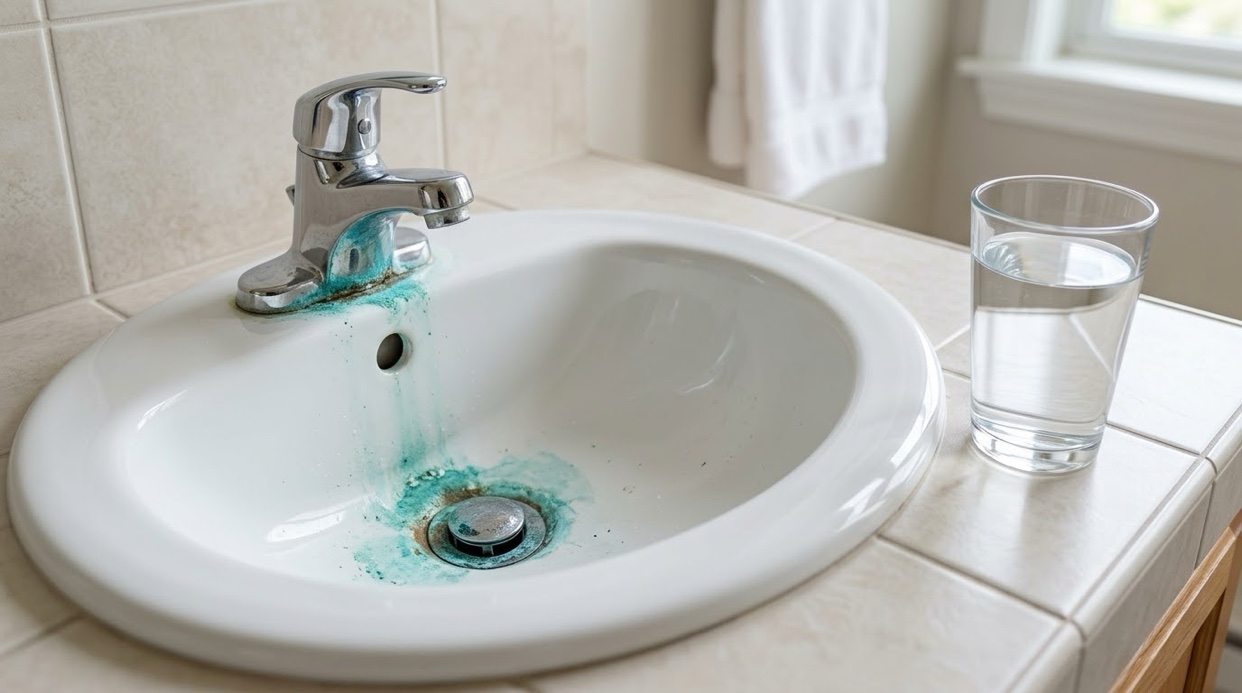
- Pipe Corrosion: Acidic water dissolves copper, brass, and lead out of your home’s plumbing, hot water heater, and fixtures.
- Blue-Green Staining: If you see bluish-green stains on your porcelain sinks, tubs, or toilets, acidic water is actively dissolving your home’s copper pipes.
- Pinhole Leaks: Over time, low-pH water eats thin spots right through copper lines, leading to hidden pinhole leaks behind drywall and under floors.
- Secondary Contaminants: As acidic water corrodes your plumbing, it carries dissolved lead and copper directly into your kitchen tap.
High-pH / Alkaline Water (pH Above 8.5)
When water has a low concentration of hydrogen ions and a high concentration of mineral bases:
- Scale Buildup: High-pH water readily drops calcium and magnesium out of solution, coating heating elements, showerheads, and dishwasher interiors in crusty white scale.
- Bitter Taste: Water with a very high pH can taste slippery, soda-like, or unpleasantly bitter.
- Reduced Soap Efficiency: High-pH water interferes with soaps and detergents, leaving clothes looking dingy and dishes covered in a film.
4. Testing Your Water’s pH
Unlike trace heavy metals or synthetic chemicals that require expensive lab equipment, testing your water’s pH (hydrogen ion activity) is simple, fast, and inexpensive:
- At-Home Dip Strips: Basic pH test strips give a quick, color-coded estimate of where your water sits on the 0 to 14 scale.
- Digital pH Meters: Handheld digital pH meters provide precise, electronic readings down to a fraction of a decimal point for homeowners who want exact numbers.
- Certified Lab Testing: If you are testing private well water for a broader panel, certified laboratories always measure pH alongside hardness and heavy metals to check for corrosive conditions.
5. How to Balance pH in Your Home
Because you cannot “filter out” hydrogen, managing hydrogen activity comes down to neutralizing acidic water or adjusting high-pH water.
Treating Acidic Water (Low pH)
If your water tests below 6.5, the solution is neutralization—adding natural minerals back into the water to bind with the excess hydrogen ions:
- Calcite Neutralizing Tanks: Whole-house neutralizing tanks filled with crushed calcium carbonate (calcite) dissolve tiny amounts of natural calcium into acidic water as it passes through, safely raising the pH to a neutral, non-corrosive level (around 7.0 to 7.2).
- Magnesium Oxide Blends: For extremely low pH (below 6.0), a blend of calcite and magnesium oxide (Corosex) is used to bring the pH back into a safe, non-corrosive range.
Managing High-pH Water
High pH is usually managed by addressing the underlying mineral hardness (using standard water softeners) or by installing Reverse Osmosis systems at the kitchen tap, which naturally lowers finished drinking water pH slightly by removing alkaline minerals.
A note on ‘hydrogen water’ and molecular-hydrogen gadgets: these products are marketed with health claims that are not established by evidence, and no homeowner needs them — ordinary water already is hydrogen, in the only form that matters.
The Bottom Line
Hydrogen isn’t a contaminant—it is the literal foundation of water itself (H_2O), and its ion activity determines your water’s pH.
You don’t need to fear hydrogen or try to filter it out. Instead, test your water’s pH to make sure it falls within the EPA’s secondary recommended range of 6.5 to 8.5. If your water is acidic (below 6.5), installing an acid neutralizer will protect your plumbing, prevent blue-green stains, and keep dissolved metals out of your family’s drinking glass.
Leave a Reply