
Hi, I’m Steve. I’ve been in the water treatment business since 1994. Bromodichloromethane is a mouthful, so let’s break it down: it’s one of the chemicals your water picks up because it was disinfected. It isn’t leaked by a factory and it doesn’t wash off a field. It’s made inside the treatment process, in the same family as chloroform. Here’s what it is, what the numbers mean, and what actually removes it.
What It Is, and How It Forms
Bromodichloromethane is one of the four trihalomethanes — the group your water report calls Total Trihalomethanes (TTHMs). The four are chloroform, bromodichloromethane, dibromochloromethane, and bromoform.
The recipe is simple. Source water from a river or reservoir carries natural organic matter — decaying leaves and plant material — plus trace amounts of natural bromide. The plant adds chlorine or chloramine to kill bacteria and viruses. As the disinfectant travels through the system, it reacts with that organic matter and bromide, and trihalomethanes form as a side effect.
Two things push levels up:
- Warm weather. Summer water carries more organic material, and warm water makes chlorine react faster. THM levels are usually highest in the warm months.
- Water age. The reaction doesn’t stop at the plant. It continues while the water sits in mains and storage tanks, so homes at the far end of a distribution system often see higher THM levels than homes near the plant.
Private wells: untreated well water doesn’t get continuously chlorinated, so the reaction doesn’t happen. The rare exception is a well that was shock-chlorinated and used before it was thoroughly flushed.
What the Science Says About Health
Bromodichloromethane is not an acute poison. At the levels found in city water, it won’t make you sick tonight. The concern is long-term exposure over decades.
In rodent studies, high lifetime doses produced tumors of the kidney, liver, and large intestine. Based on that evidence, the EPA classifies bromodichloromethane as a probable human carcinogen, and the IARC lists it in Group 2B. Some studies have also looked at high trihalomethane exposure during pregnancy and possible effects like low birth weight; the findings there are suggestive, not settled, and I’ll tell you plainly that the science isn’t finished.
What makes this one different from most contaminants is that drinking is only one of three doors in:
- Drinking — the water itself, ice, and drinks made with it.
- Breathing — it’s volatile, meaning it escapes from hot water into the air. A hot shower fills a small bathroom with THM vapor.
- Skin — some absorbs through skin in a hot bath or shower.
Studies have found that a hot shower can put as much trihalomethane into the body as drinking the water does — sometimes more. That’s not a reason to fear your shower. It’s a reason to know the whole picture, and it’s why the fix list below includes your bathroom, not just your kitchen.
The Numbers
Read these carefully, because this is where most websites muddy the water:
- Individual legal limit: none. The EPA does not set a limit for bromodichloromethane by itself.
- The legal limit that applies (TTHM MCL): 80 ppb (0.080 mg/L) — the enforceable ceiling for all four trihalomethanes added together, measured as an annual average. Your utility must stay under it.
- EPA health goal for bromodichloromethane (MCLG): zero. For a probable carcinogen, the goal is set at zero — the level at which there’d be no expected risk at all. The goal is not a law; it’s the target the law is built around. A goal of zero does not mean water is unsafe at the legal limit; it means the EPA couldn’t name a threshold where the theoretical cancer risk is provably zero.
- WHO guideline: 60 ppb (0.06 mg/L) for bromodichloromethane individually.
- EWG health guideline: 0.06 ppb — a one-in-a-million lifetime cancer-risk target, far stricter than any law.
Those numbers explain a pattern you’ll see on water reports: my own utility reports bromodichloromethane at 6.13 ppb, inside a TTHM total of 31.7 ppb — comfortably under the 80 ppb legal limit, and over a thousand times higher than EWG’s 0.06 ppb guideline. Both statements are true at once. The legal limit, the health goal, and the advocacy guideline are three different yardsticks; an honest reading names which one it’s using.
How It’s Reduced
Good news: trihalomethanes are among the more cooperative contaminants to remove at home, because they’re organic chemicals — and carbon eats organic chemicals.
Activated carbon works. Bromodichloromethane sticks to carbon’s enormous internal surface by adsorption. Granular activated carbon and solid carbon block both do this well, provided the water gets enough contact time — a quality filter run at its rated flow. A worn-out cartridge that’s long past its change date won’t.
Reverse osmosis works too — mostly because a good RO system is a chain: carbon prefilters strip the THMs before the membrane, and the membrane (pores around 0.0001 micron) and post-filter finish the job. RO units typically reduce trihalomethanes by 95% or more as a system.
Aeration helps because THMs are volatile — left open to air, they leave the water. It’s real but slow and impractical as a whole-house strategy; carbon and RO are the reliable tools.
The bathroom half of the problem: a kitchen filter can’t help your shower. What honestly helps there:
- Ventilation — run the exhaust fan during and after hot showers. This is the biggest, cheapest lever, because the exposure is mostly vapor.
- Temperature — warm instead of steaming-hot showers vaporize far less.
- Shower filters — a carbon shower filter can reduce chlorine at the showerhead, but be skeptical of any shower filter claiming big THM reductions; the water moves too fast for much adsorption. Ventilation does more than the cartridge does.
Certification is how you tell the real from the marketing. NSF/ANSI Standard 53 is the health-effects standard — a filter certified under Standard 53 for VOC or trihalomethane reduction has been independently lab-tested for it. Standard 42 is only about taste and odor. Read the performance data sheet and look for trihalomethanes or bromodichloromethane by name. “Tested to” a standard is not the same as certified to it.
How to Find Your Level
Hardware-store strips can’t measure trihalomethanes at parts-per-billion. You have two honest routes:
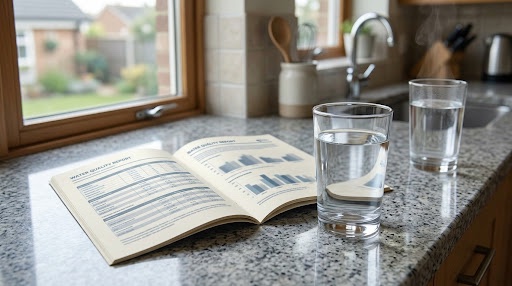
Your Consumer Confidence Report. Every community water system publishes one by July 1, free. Find the “Total Trihalomethanes (TTHM)” row under disinfection byproducts: the highest level and range tell you where your system stands against the 80 ppb limit. The report won’t break out bromodichloromethane alone — utilities report the group, not the members.
A certified lab. If you want your own tap’s individual number, a state-certified lab can run it — ask for a volatile organics test (EPA Method 524.2 is the standard one). They’ll give you special vials with no air space, because a volatile chemical escapes a half-full bottle before it ever reaches the lab.
The Bottom Line
- Bromodichloromethane forms wherever chlorine meets natural organic matter and bromide — which is most chlorinated city water. It’s a managed trade-off of disinfection, not a scandal.
- The law limits the group at 80 ppb; the health goal for this one member is zero; know which yardstick a claim is using before you react to it.
- Check your water report’s TTHM line first — it’s free.
- For drinking and cooking water, a carbon block or RO system certified under NSF/ANSI 53 or 58 handles trihalomethanes at the tap for pennies a gallon.
- For the shower, ventilate and ease the temperature. That’s the honest fix.
Chlorination is one of public health’s greatest wins — it ended the era of cholera and typhoid from the tap. The byproducts are real, they’re manageable, and now you know how to read them. Facts first, then filter. — Steve
Leave a Reply